
Are Bail Bonds Public Record? What Families Can See
In most cases, yes. The bail amount, the charges and the booking details of an arrest are generally public information, and court filings are open unless a judge or a statute seals them. What changes from place to place is where you look, how much detail you get and which documents stay private. If someone you love was just arrested in Southern California, you do not have to sort this out alone: our bilingual agents are available 24/7 and can help you find the booking and bail details you need to act.
TL;DR
- Arrest and booking details, including the bail amount, are generally open to the public. California law spells this out for law-enforcement agencies.
- Court records are public too, except sealed files, juvenile cases and some restricted documents such as federal bail reports.
- Rules differ by state, county and even by department. A record that is public in one database can be restricted in another.
- Some places keep the contents of certain bond paperwork confidential, so seeing who posted bail is not guaranteed.
- Families who need someone out can skip most of the searching: a licensed agent can pull the booking details together with you and start the process.
Table of Contents
- What “public record” means in a bail case
- What California law says about bail information
- It is not the same everywhere
- What is not public
- Can you see who posted bail?
- How to look up bail information step by step
- Why public records are only half the job
- Where we fit in
- Our perspective
- FAQ
- Sources
What “public record” means in a bail case
A public record is a document or data set that a government body must let ordinary people inspect. Bail touches several of these at once, and they are held by different offices:
- The arresting agency or jail (police department or county sheriff) keeps the booking record: who was arrested, when, on what charges and what bail was set.
- The court clerk keeps the case file and docket: the charges filed, hearing dates, orders and outcomes.
- The bail bond company holds your signed agreement and payment paperwork. That is a private contract between you and the company, not a government record.
When people ask whether “bail bonds” are public record, they usually mean the first two: can I see what bail was set, and can I see whether it was paid? Both answers depend on which office holds the record.
What California law says about bail information
Most of our clients are in California, so start there. California Government Code section 7923.610, operative since January 1, 2023, requires state and local law-enforcement agencies to disclose several items about an arrested person. These include:
- the person’s identity and the details of the arrest and booking,
- the amount of bail set,
- the time and manner of release, or the place where the person is currently held,
- the charges.
The same section carves out an exception: an agency can hold back information when releasing it would put someone’s safety at risk or interfere with an investigation. That exception is narrow, and in an ordinary arrest the bail amount and custody status are available.
In practice, this is why county sheriffs run online inmate locators and booking desks that answer calls from the public. If you are not sure how to use them, our guide for families on finding an inmate with official .gov tools walks through it step by step.
It is not the same everywhere
Bail information is public across the country in broad terms, but the details are set by each state and sometimes each agency. A few examples from official and legal-aid sources show the range.
| Place | What the public can generally get | Source |
|---|---|---|
| Chicago, IL | Name, charges, arrest date and time, release date and time, bond type, amount and date, for adults arrested by the Chicago Police Department on or after January 1, 2014 | CPD arrest search |
| Santa Clara County, CA | For people in custody: bail, charges, warrants, holds, initial court date and projected release date, through the sheriff’s booking unit | Sheriff’s Office |
| New Jersey | Defendant’s name and background, charges, circumstances of arrest, and whether bail was posted and in what amount | Government Records Council |
| Minnesota | Arrest histories are often available from local police or sheriffs, but access varies by department; the state’s own arrest-history database is nonpublic | Minnesota legal-aid fact sheet, 2025 |
Two lessons follow. First, the bail amount is among the items most consistently treated as public. Second, a state-level database and a local sheriff’s records can follow different rules, so a search that comes up empty in one place does not mean the information is secret. It may only mean you are asking the wrong office.
Illinois shows how detailed these laws can get. Under Public Act 102-1104, arrest information for a person in custody includes pretrial-release conditions and the times the person was received, discharged or transferred. Specific items can still be withheld if disclosure would interfere with proceedings, endanger someone or compromise jail security.
New Jersey changed its rules recently. The state’s records council says its open-records reform law, P.L. 2024, c.16, took effect September 3, 2024 and changed exemptions, request processes and response requirements. If you are dealing with a records request outside California, check the current rules of that state’s agency.
What is not public
Open does not mean unlimited. These are the usual limits:
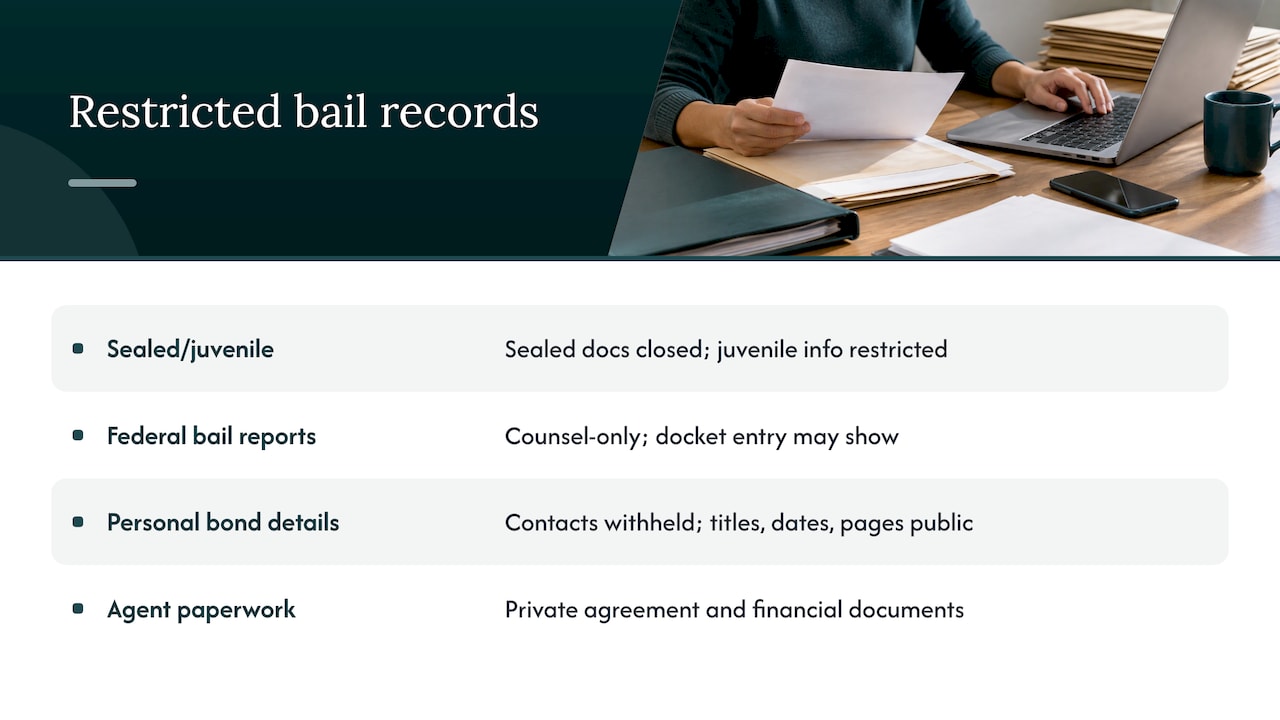
Sealed and juvenile cases. Documents sealed by law are not publicly accessible, and the Minnesota fact sheet notes that this can include some financial or private-health documents. Juvenile cases get extra protection. For example, the Winnebago County, Illinois circuit clerk limits juvenile-case information to attorneys of record and listed parties.
Federal bail reports. Federal courts post most unsealed criminal case materials through PACER, the federal courts’ online records system, and at courthouse terminals. But the District of South Dakota’s CM/ECF manual says juvenile criminal cases are sealed and bail reports are restricted to the defendant’s counsel and government counsel. A docket entry can be visible while the report behind it is not.
Personal contact details. In a 2026 decision, the Fifth Circuit described a Harris County, Texas order that made the contents of certain misdemeanor bonds confidential while leaving their titles, filing dates and page counts public. The court also held that the public’s right to inspect judicial records did not reach defendants’ personal contact information withheld under that order.
Your own paperwork with a bail agent. What you sign with a bail company is a private agreement. The financial documents a company may ask you to provide, such as pay stubs or bank statements, are part of that private file. Our guide on what to gather before you call lists what is typically useful.
Can you see who posted bail?
This is one of the most common follow-up questions, and the honest answer is that it depends. The research above shows three possibilities:
- Some jurisdictions publish bond type, amount and date, as Chicago’s arrest search does, without naming the payer.
- Some courts treat bond paperwork as part of the case file, which is open unless sealed.
- Some places, such as Harris County for certain misdemeanor bonds, keep the contents of bond documents confidential.
So you cannot assume that a family’s name will or will not appear. If you are posting bail for a relative, you can ask the court clerk or the jail how that county handles it. If you work with us, your agent can tell you what to expect for the county where your loved one is held.
How to look up bail information step by step
Here is the routine a family can follow in the first hour.
- Get the basics. You need the person’s full legal name and, if possible, date of birth. A booking number makes everything faster.
- Identify the right county. Bail is handled where the arrest happened and where the person is held, which may not be where they live. Our California counties page shows the areas we serve.
- Check the jail’s inmate locator. Most county sheriffs publish one. It usually shows the booking number, charges, bail amount and custody status. Not every record appears immediately after an arrest, so new bookings can take a few hours to show up.
- Call the booking desk if the locator shows nothing. Santa Clara County’s sheriff, for example, directs the public to its Administrative Booking Unit for bail, charges, holds and the projected release date.
- Check for holds. A person with several charges or a warrant elsewhere may not be released even after bail is posted on one charge. Our article on checking jail holds before posting bail explains how to spot them.
- Use the court if the case has been filed. Court clerks can give you the docket. In the federal system, remote access runs through PACER, and, as the District of Arizona’s e-filing manual says, the public can also view electronic dockets and documents at the clerk’s office.
- Understand the number you find. In California, bail varies widely by charge. Our guide on misdemeanor and felony bail amounts in California helps you see what the figure you found means in practice.
Buffalo, New York offers a good illustration of how many roads lead to the same answer: Legal Aid there says you can ask the relevant court, call the sheriff’s automated inmate system, or contact the defendant’s attorney to learn the bail amount.
Why public records are only half the job
Finding the bail number is the easy part. The harder part comes next: bail is often thousands of dollars, the jail is open at night, and the family may be short on both time and cash. A record tells you what is owed. It does not post the bond, explain the paperwork or help with payment.
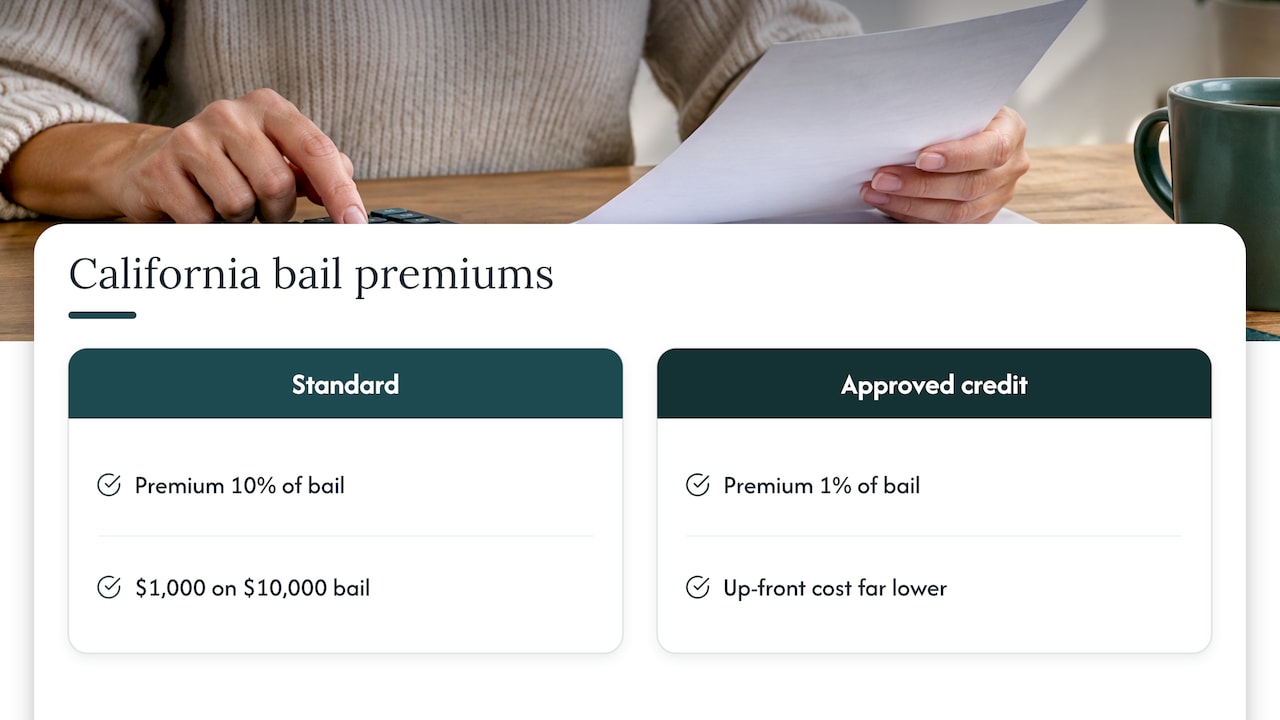
That is where a bail agent comes in. A bail bond is a contract in which a licensed company guarantees to the court that the defendant will appear, in exchange for a fee. In California, the standard premium is 10% of the bail amount. On a $10,000 bail, that is a $1,000 premium. We also offer 1% bail bonds in California with approved credit, which can bring the up-front cost far below that.
Because our agents are bilingual and on call around the clock, a family that finds a bail amount at 2 a.m. can talk to a person in English or Spanish instead of waiting for a morning office to open.
Where we fit in
If you have found the bail amount and need your relative home, we can take it from there. The Bail Network connects you to local licensed bail agents near the jail, with bilingual support and 24/7 availability. Our payment options are designed to make bail affordable, including plans as low as 1% with approved credit, and the standard 10% premium is also available. You can start at our main bail bonds page or, if cost is the main worry, look at our no money down bail bonds.
If you cannot get to an office, our guide on posting bail remotely explains what can be done from afar, and our online bail bonds page covers the online option in California and Texas.
Our perspective
Families usually come to us after typing a name into a search box and finding a number they did not expect. Public records are a gift in that moment, because they remove the guessing. But they also make the next step feel urgent, and that is where people make costly mistakes.
Our view is simple. Use the public information to get the facts: the bail amount, the charges, whether there is a hold. Then talk to someone who can explain what those facts mean for your family’s budget and your loved one’s timeline. That is why we built our service around bilingual agents who answer at any hour, payment plans with approved credit, and educational guides that explain each part of the bail process in plain language.
Nobody should have to decode a booking record and a bond contract alone while worrying about a relative in custody. You can read the record yourself, and when you are ready for the next step, we are ready to pick up the phone.
Jake
FAQ
Is a bail bond itself a public record?
The bail amount and the fact that a bond was posted are generally part of public jail or court records, depending on the county. The contract you sign with a bail company is a private agreement. Some jurisdictions also keep the contents of certain bond documents confidential.
Can anyone look up someone’s bail amount?
In most places, yes. California law requires law-enforcement agencies to disclose the amount of bail set, subject to narrow safety and investigation exceptions. You can usually check the county sheriff’s inmate locator or call the booking desk.
Can I see who posted bail for someone?
It depends on the county and the court. Some systems show only the bond type, amount and date, and some restrict bond paperwork. Ask the clerk or jail in the county where the case is, or ask your bail agent what to expect.
Are juvenile or sealed cases public?
No. Juvenile cases and documents sealed by law are restricted, and federal bail reports are limited to the defendant’s counsel and the government. Only the parties and their attorneys can generally get that information.
Does a public arrest record mean the person is guilty?
No. An arrest record shows that a person was booked on certain charges, not that a court found them guilty. Court outcomes appear separately in the case file.
Sources
- California Government Code section 7923.610
- Chicago Police Department arrest search
- Santa Clara County Sheriff’s Office, Administrative Booking
- New Jersey Government Records Council, OPRA law enforcement presentation
- New Jersey Government Records Council, OPRA Custodian’s Handbook, January 2025
- Illinois Public Act 102-1104
- Minnesota legal-aid fact sheet on public and private criminal records, 2025
- Winnebago County Circuit Clerk FAQ
- U.S. District Court, District of South Dakota, CM/ECF User Manual
- U.S. District Court for Arizona, electronic case filing manual, September 2025
- U.S. Court of Appeals for the Fifth Circuit, 2026 opinion
- Legal Aid Society of Buffalo, finding out how much bail to post