
Families: Assault Bail Costs, 10–15% Bond Fees and First Steps
Bail for assault ranges widely, with simple misdemeanor assault often requiring bail below a few thousand dollars, and aggravated assault with a weapon or serious injury potentially requiring much higher amounts. If the amount feels impossible right now, payment plans and bail bond agents exist specifically for this situation.
TL;DR:
- Bail amounts for assault vary widely, with simple misdemeanors often requiring less than $5,000, while serious felonies can exceed $100,000.
- Judges may adjust preset bond figures based on injury severity, criminal history, flight risk, and whether the victim is a protected person.
- Using a bail bond typically costs 10% to 15% of the bail amount as a nonrefundable fee, making it a more feasible option for high bail totals.
- Immediate steps after arrest include consulting a lawyer and bail bond agent, gathering documents, and exploring alternative releases like recognizance bonds.
- Bond schedules are guides, not fixed amounts, and actual bail can increase if aggravating factors are present or if there are prior offenses.
Table of Contents
- How Much Is Assault Bail? Typical Ranges by Charge
- How Do Judges Decide the Bail Amount?
- Cash Bail vs. a Bail Bond: What You Actually Pay
- What to Do First When You Can’t Afford Bail
- Can You Get Bail Reduced or Get Released on Recognizance?
- After Bail Is Posted: Timeline and What Happens Next
- What Families Get Wrong About Assault Bail
- Get Immediate Help Posting Bail Right Now
- Where These Bail Figures Come From
- Sources
- FAQ
How Much Is Assault Bail? Typical Ranges by Charge
The gap between the lowest and highest assault bail amounts is enormous, and it comes down almost entirely to how the charge is classified. A shove in a bar fight and an assault with a deadly weapon are both “assault,” but they live in completely different bail brackets.
Florida’s statewide bond schedule spells this out in dollar terms. Under the AOSC24-126 bond schedule, a third-degree felony involving force carries a preset bond around $5,000, while various misdemeanors fall between $150 and $1,000. That’s the floor for most simple assault cases nationally, though your county’s number may differ.
Texas and New York show how much the top end can vary. In Harris County, Texas, a Class C assault might get you released on a $500 bond or even a personal bond with no cash required, but aggravated assault in Texas commonly runs $20,000 to $100,000 or more. New York draws similar lines by degree: third-degree assault bail often lands near $20,000, while first-degree assault with serious injury can reach six figures depending on the victim’s condition and the defendant’s ties to the state.
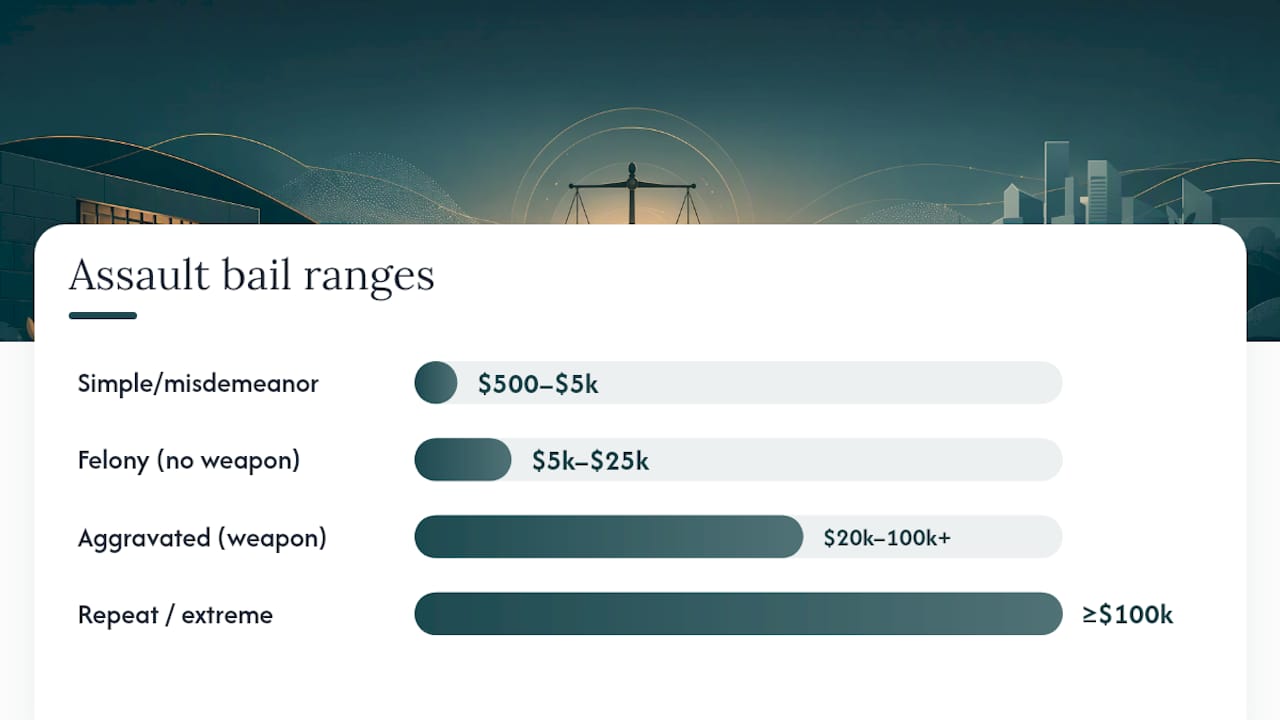
A rough national snapshot looks like this:
- Simple/misdemeanor assault: $500 to $5,000 in most counties
- Felony assault (no weapon, moderate injury): $5,000 to $25,000
- Aggravated assault (weapon, serious injury, or protected victim): $20,000 to $100,000+
- Repeat offenders or extreme circumstances: six figures is not unusual
According to a national overview from LegalClarity, assault bail nationally spans from a few hundred dollars for minor misdemeanors to over $100,000 for the most serious felonies. Many counties post these figures on preset bond schedules, but a judge can always deviate upward if the facts of the case call for it.
How Do Judges Decide the Bail Amount?
Preset bond schedules give judges a starting point, not a final answer. At arraignment, the judge looks at the case in front of them and decides whether the scheduled amount fits or needs adjusting.
The factors that move the number most are:
- Charge degree and injury severity. A broken bone or hospitalization pushes bail well above a schedule’s baseline.
- Prior criminal history or open bench warrants. Someone with a clean record almost always gets a lower number than a repeat offender.
- Flight risk and community ties. Steady employment, a lease, and family in the area work in the defendant’s favor.
- Victim status and aggravating factors. Assaults on police officers, minors, or intimate partners often trigger automatic increases. Oklahoma’s Signature Bail notes that protected-victim cases can multiply a preset misdemeanor bond several times over.
- Whether the schedule applies at all. Judges retain discretion to raise or lower bail beyond the preset figure when circumstances warrant it.
Pro Tip: If the defendant voluntarily surrendered to police rather than being arrested after a chase or standoff, mention this to counsel before arraignment. Judges often weigh voluntary surrender as evidence of low flight risk, and it can shave real money off the bail figure.
Cash Bail vs. a Bail Bond: What You Actually Pay
Cash bail means paying the full amount to the court directly, and you get it back (minus court fees) once the case resolves, assuming every court date is met. A bail bond works differently: a licensed agent posts the full bail on the defendant’s behalf, and you pay the agent a nonrefundable premium, typically 10% to 15% of the total.
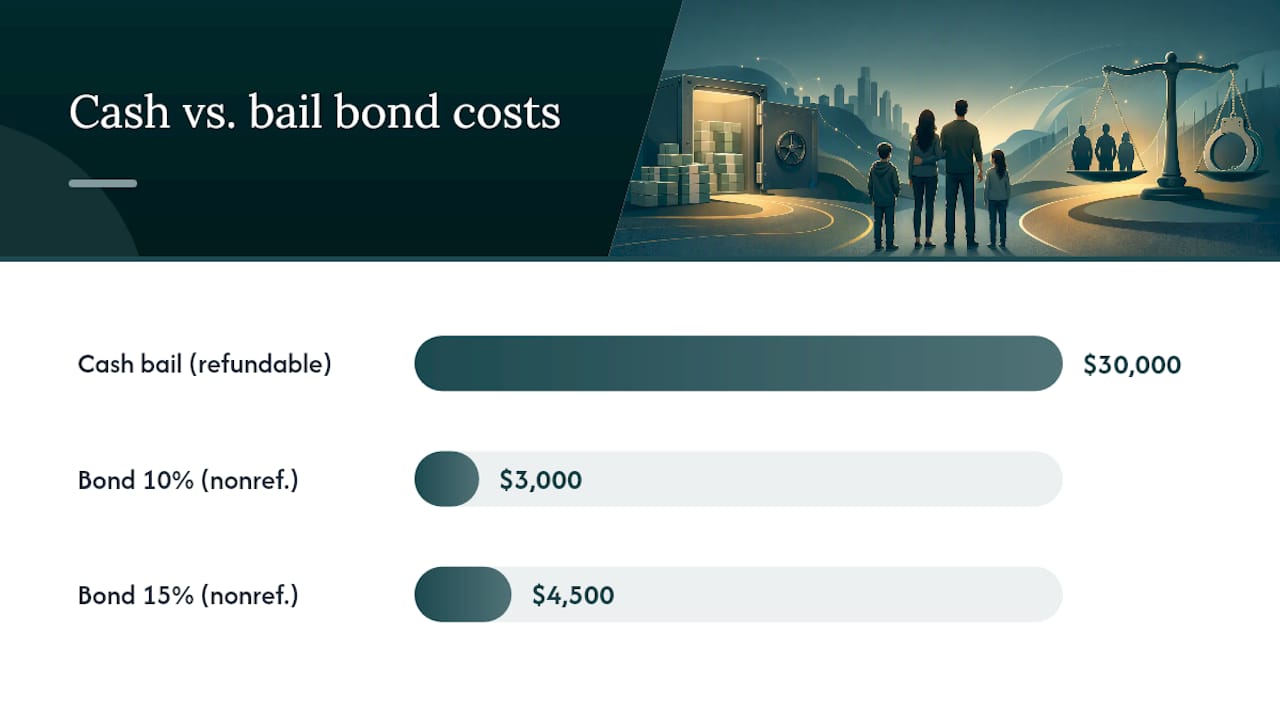
Here’s how that math plays out on a felony assault case:
- Bail is set at $30,000.
- A bondsman charges a 10% premium: you pay $3,000 upfront, and that money is gone regardless of the case outcome.
- At a 15% premium, the same $30,000 bail costs $4,500 out of pocket.
Some states cap what agents can charge, and fees vary by company and by collateral offered. Xavier Law Firm walks through this exact $30,000 example for Texas defendants, and it illustrates why families often ask about financing before committing to either route. A bail bond agent can also structure that premium into a payment plan rather than demanding it all at once.
What to Do First When You Can’t Afford Bail
The first few hours after an arrest matter. Here’s the order that tends to work best:
- Call a criminal defense attorney immediately. Counsel can argue for a lower bail or release on recognizance right at arraignment, before you spend a dollar on bond.
- Contact a bail bond agent and ask about payment plans, bilingual agents, and what collateral they’ll accept. Have the defendant’s full name, date of birth, booking facility, and charges ready.
- Gather documentation proving employment, a lease or mortgage, and family ties in the area. These strengthen both a bail-reduction motion and a bondsman’s approval process.
- Check for alternative release options at the jail, such as a citation release or a personal recognizance bond, which some counties offer for lower-level charges without any bail at all.
Pro Tip: Before you sign anything with a bondsman, ask directly whether the fee is refundable under any circumstance and whether a cosigner is required. Reputable agents answer this without hesitation.
Can You Get Bail Reduced or Get Released on Recognizance?
A bail-reduction motion or an ROR (release on recognizance) request works best when it’s backed by paper, not just a verbal promise to show up. Judges respond to verifiable ties: something they can check, not something they have to take on faith.
Bring or ask your attorney to gather:
- Recent pay stubs or an employer letter confirming steady work
- A lease or mortgage statement showing local residence
- School enrollment records for the defendant or their children
- Character references from employers, clergy, or community members
Arguments that consistently move the needle include voluntary surrender, no open bench warrants, and stable local employment. If the arraignment judge won’t budge, counsel can file a separate bail-reduction motion later, sometimes pairing it with a pretrial-services report if one is available.
After Bail Is Posted: Timeline and What Happens Next
Once bail is paid, either in cash or through a bond, release usually happens within a few hours, though larger jails can take longer depending on staffing and how backed up processing is that day.
- The jail verifies the bond or cash payment and processes release paperwork.
- The defendant must appear at every scheduled court date. Missing one triggers a bench warrant and forfeits the bail entirely.
- If cash bail was posted, the court refunds it (minus administrative fees) after the case concludes, whether that ends in dismissal, plea, or trial.
- Bond premiums paid to an agent are never refunded, regardless of how the case turns out.
For California cases specifically, Liberty Bell Law outlines how the reduction and refund process works at the county level, since procedures shift depending on where the case is filed.
What Families Get Wrong About Assault Bail
Most people assume the number posted on a bond schedule is the final word. It isn’t. That number is a starting point a judge can raise the moment aggravating facts show up, like a domestic relationship between the parties or an injury that required hospitalization. Families who walk into arraignment expecting the schedule amount and get blindsided by a $20,000 increase almost always missed a factor like prior domestic violence dynamics that courts treat as an automatic aggravator.
The other misconception is thinking a bail bond is somehow the “expensive” option compared to cash. For most families, it’s the only realistic option, since coming up with $20,000 to $100,000 in cash on short notice simply isn’t possible.
— Jake
Get Immediate Help Posting Bail Right Now
Bail bond services help people get out of custody faster than most families can arrange cash on their own, because a bond agent only requires a fraction of the total bail upfront instead of the full amount in hand.
Before you call, have the defendant’s full name, date of birth, the facility where they’re held, and the bail amount if it’s already been set. If you don’t know the bail amount yet, agents can help you locate an inmate and pull that information directly. Payment options, including how financing works, are explained in detail on The Bail Network’s payment page, and if you’re wondering how other families afford to pay bond on short notice, that page breaks down the real options. Start there, or call directly to get an agent working on release within minutes.
Where These Bail Figures Come From
Exact bail amounts come from local court orders and bond schedules, including Florida’s AOSC24-126 and county-level guides for Texas and New York cited above. Always confirm the current figure with your local court, since schedules update annually.
This article is general information, not a substitute for advice from a qualified lawyer. Consult a qualified legal professional about your own circumstances before acting on anything here.
Sources
- AOSC24-126 (Florida bond schedule)
- How much is bail for assault in Texas? | Xavier Law Firm
- How Much is Bail for 1st, 2nd, 3rd Degree Assault Charges in NY | Jason Goldman Law
- How Much Is It to Bail Someone Out of Jail for Assault? | LegalClarity
FAQ
How Much Is Bail for Assault in the United States?
Bail for assault typically ranges from a few hundred dollars for minor misdemeanors to over $100,000 for aggravated felonies involving weapons or serious injury, according to LegalClarity. The exact figure depends on the charge degree, the jurisdiction, and the defendant’s criminal history.
What Is the Lowest Charge for Assault?
Simple assault, sometimes called misdemeanor assault, is the lowest charge in most states and usually involves no weapon and minor or no injury. It carries the lowest bail amounts, often between $500 and $5,000 depending on the jurisdiction.
How Much Does It Cost to Bail Someone Out for Assault?
If you pay cash bail directly, you pay the full amount and get it back later minus fees. If you use a bail bond agent instead, you typically pay a nonrefundable premium of 10% to 15% of the total bail, so a $30,000 bail could cost $3,000 to $4,500 out of pocket.
How Much Is Bail for Assault in Texas?
In Texas, Class C assault can result in bail as low as $500 or a personal bond with no cash required, while aggravated assault commonly ranges from $20,000 to $100,000 or more depending on the weapon involved and injury severity.