
Don't Wait: How Families Can Seek Bail After Sentencing Within Days
Sometimes, but rarely. Courts can grant an appeal bond or stay of sentence that lets a convicted person stay free while an appeal moves forward, but this is not a right. Federal law starts from a presumption against release, and states set their own narrow rules on top of that. If you’re in this position, the clock is already running. Call an attorney today, because the filing deadlines that determine whether bail after sentencing is even possible often close within days.
TL;DR:
- Successfully obtaining bail after sentencing requires a strong legal issue with reversal potential, a short sentence, and solid community ties documented in the motion.
- State rules on post-sentencing bail are highly variable, with some jurisdictions allowing it under specific conditions and others explicitly restricting or banning it for serious offenses.
- The decision process focuses on the crime’s seriousness, flight risk, public safety, and the merit of the appeal, emphasizing the importance of specific evidence and documentation.
- Filing deadlines are strict and often close within days after sentencing, making prompt action and well-prepared motions essential for a chance at release.
- Moving quickly to arrange financing and collateral after bail is granted is critical, as delays or violations of release conditions can severely impact the chances of ongoing appeal success.
Table of Contents
- How the Law Treats Bail After Sentencing
- State Rules Vary More Than Most People Expect
- What Judges Actually Weigh When Deciding
- Filing for Bail After Sentencing: The Steps and the Clock
- Conditions of Release and What Happens If You Slip Up
- What to Do Right Now, in Order
- Why Bail After Sentencing Isn’t the Same Thing as Pretrial Bail
- The Misconceptions That Trip People Up
- What’s at Stake If You Push for Bail After Sentencing
- Two Scenarios That Show How Different the Outcomes Can Be
- Publisher Perspective: What We See in Practice
- If a Judge Grants Bail, Move Fast on the Logistics
- Sources
- FAQ
How the Law Treats Bail After Sentencing
Once a judge hands down a sentence, the legal ground shifts entirely. The presumption of innocence that shaped your pretrial bail is gone, replaced by a presumption that you belong in custody. 18 U.S.C. § 3143 sets the federal baseline: a convicted defendant seeking release pending appeal must show, by clear and convincing evidence, that they are not a flight risk or danger to the community, and that the appeal raises a substantial question likely to produce reversal or a new trial.
That’s a high bar. It’s not enough to argue the sentence feels unfair or that you have a good lawyer. You need a specific, non-frivolous legal issue with real odds of changing the outcome. Congressional commentary on the statute confirms courts apply this standard narrowly, reserving release for cases with genuine legal merit.
Your old pretrial bond doesn’t carry over, either. Sentencing typically discharges it, and the bond company’s obligation ends unless the court sets an entirely new post-sentence bond.
State Rules Vary More Than Most People Expect
Federal law is only the starting point. States handle post-sentencing bail in wildly different ways. Where your case sits determines what’s even possible.
Some states build in explicit permission. Pennsylvania’s Rule 521 allows bail after a finding of guilt for sentences under a set length, but it comes with conditions: the judge must impose release terms, and you must move quickly to perfect your appeal or lose eligibility. Other states, including Maine, flatly bar bail for certain violent or serious offenses and require judges to put their reasons for any denial on the record.
This means two people with similar convictions in different states can face completely different outcomes. Don’t assume what you read about one state’s rule applies to yours. Check your jurisdiction’s specific statute or, better, have counsel check it for you.
What Judges Actually Weigh When Deciding
Judges don’t flip a coin on post-sentencing bail. They work through a fairly consistent set of factors, and understanding them tells you exactly what evidence to bring to the hearing.
- Seriousness of the crime and sentence length. A short sentence for a nonviolent offense reads very differently than a decade for a violent one.
- Flight risk. Ties to community, a valid passport, family nearby, and steady employment all cut in your favor.
- Danger to the public. Judges want assurance that releasing you doesn’t put anyone at risk.
- Risk of tampering. Any hint you’d contact witnesses or interfere with evidence kills your chances fast.
- Merit of the appeal. This is often the deciding factor. A substantial legal question with real reversal potential matters more than character letters.
- Criminal history and prior court compliance. A clean record and no history of missed court dates strengthen your case considerably.
Bring documentation for each point. Vague reassurances don’t move judges; specifics do.
Filing for Bail After Sentencing: The Steps and the Clock
Speed decides more of these cases than legal argument does. Here’s the practical sequence.
- File your notice of appeal or post-sentence motion immediately. Filing windows vary by court, but many state courts expect prompt action shortly after sentencing, and federal timelines have their own strict clocks. Missing the window can end your chance before a judge even considers bail.
- Move for a stay of sentence or an appeal bond. This motion needs to spell out the specific appellate issue, not a general complaint about fairness, along with proposed release conditions the judge can act on.
- Request a hearing and show up prepared. Bring proof of employment, letters from family, a stable address, and anything documenting your ties to the community. If the judge denies release, ask about your options for appellate review of that denial.
Pro Tip: A short, sharply focused motion that names the exact legal issue and proposes strict conditions, like electronic monitoring or surrendering your passport, tends to land better than a thick folder of general character letters. Judges respond to clarity and speed, not volume.
Conditions of Release and What Happens If You Slip Up
Assume any bail after sentencing comes with tighter strings than your original pretrial release. Judges know the calculus has changed. Common conditions include electronic monitoring, restricted travel, regular check-ins, and strict no-contact orders around witnesses or victims.
The money side gets heavier too. Post-sentencing bonds often run higher than pretrial amounts, and sureties may require additional collateral given the increased risk profile. Premiums paid to a bail bond company are generally not refundable, while collateral posted against the bond typically returns once the case resolves and conditions are met, a distinction worth clarifying with whoever sets up your bond.
Violating any condition is worse than it sounds. Beyond immediate revocation and forfeiture of the bond, a violation can undercut your appeal itself and follow you into how courts treat you going forward.
What to Do Right Now, in Order
If someone in your family was just sentenced and you’re wondering whether release pending appeal is realistic, this is the order that matters most.
- Call defense counsel today, and ask specifically about appellate counsel if your trial lawyer doesn’t handle appeals.
- Start gathering employment verification, a signed lease, letters from family and employers, and any treatment or supervision plan you could propose to the court.
- Confirm with counsel what your jurisdiction’s filing deadline actually is. Processing timelines differ enough by state and county that guessing wrong costs you the window entirely.
- If a judge does set a post-sentence bond, arranging financing and collateral promptly helps avoid delays in release.
Pro Tip: Walk into the hearing with a concrete supervision plan already written out, not a promise to “figure it out.” Judges are far more willing to release someone who hands them a specific plan for monitoring, housing, and employment than someone who simply asks for a chance.
Why Bail After Sentencing Isn’t the Same Thing as Pretrial Bail
Pretrial bail exists to answer one question: will this person show up for trial? The person hasn’t been convicted of anything yet, the presumption of innocence is fully intact, and the bond’s entire job is to guarantee court appearances while the case plays out. That’s why pretrial bonds are relatively routine and, for many offenses, calculated off a standard bail schedule.
Bail after sentencing answers a completely different question: should this convicted person avoid serving their sentence right now, while an appeal is pending? The presumption of innocence is gone. The person has already been found guilty and sentenced, and the legal system’s default position flips to detention. Release at this stage isn’t about appearance risk anymore. It’s about whether the appeal itself has real legal merit and whether releasing the person poses an acceptable risk to public safety.
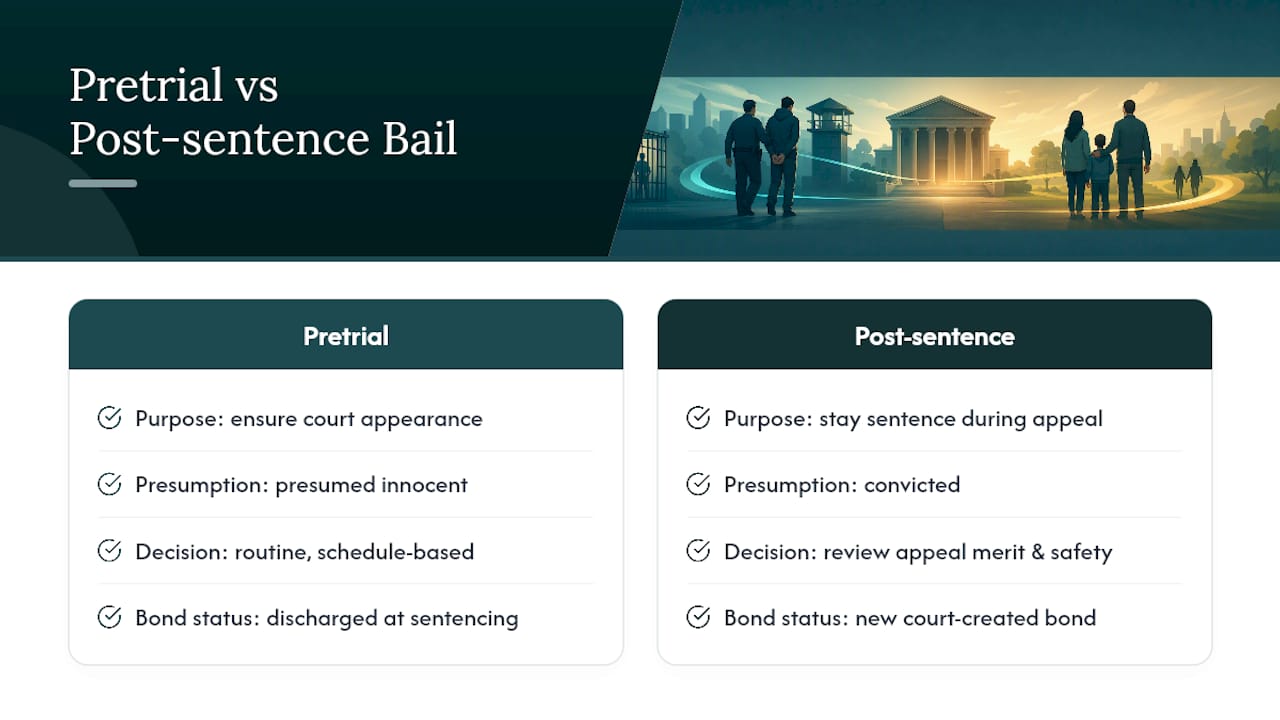
That distinction shows up in the paperwork, too. A pretrial bond gets discharged at sentencing, full stop. A post-sentencing appeal bond is a brand new instrument the court has to affirmatively decide to create, and it typically carries stricter conditions and higher amounts than what came before. Some states allow this second bond specifically when the sentence is shorter than the expected appellate timeline, recognizing that making someone serve an entire sentence before a court even rules on their appeal could itself be a serious injustice if the conviction gets reversed later.
The Misconceptions That Trip People Up
The biggest misconception is that filing an appeal automatically pauses the sentence. It doesn’t. An appeal and a stay of sentence are two separate legal actions, and you need to request the stay or appeal bond specifically. Plenty of people file a notice of appeal, assume they’re covered, and end up in custody anyway because nobody asked the court for release.
A second misconception: that a good lawyer or a sympathetic story is enough. Judges are bound by statutory standards like the clear-and-convincing-evidence test in federal cases. Sympathy doesn’t satisfy that standard. A specific, documented legal issue does.
Third, people often assume bail after sentencing works the same everywhere. It doesn’t. What Pennsylvania allows under Rule 521 and what Maine restricts for serious offenses are genuinely different frameworks, not just different numbers plugged into the same formula.
Finally, some assume that if bail is denied once, that’s the end of the road. In many jurisdictions you can seek review of that denial at a higher court, though the timeline for doing so is often just as tight as the original filing window. Denial at the trial court level isn’t necessarily the final word, but treating it as automatic finality means missing a real opportunity.
What’s at Stake If You Push for Bail After Sentencing
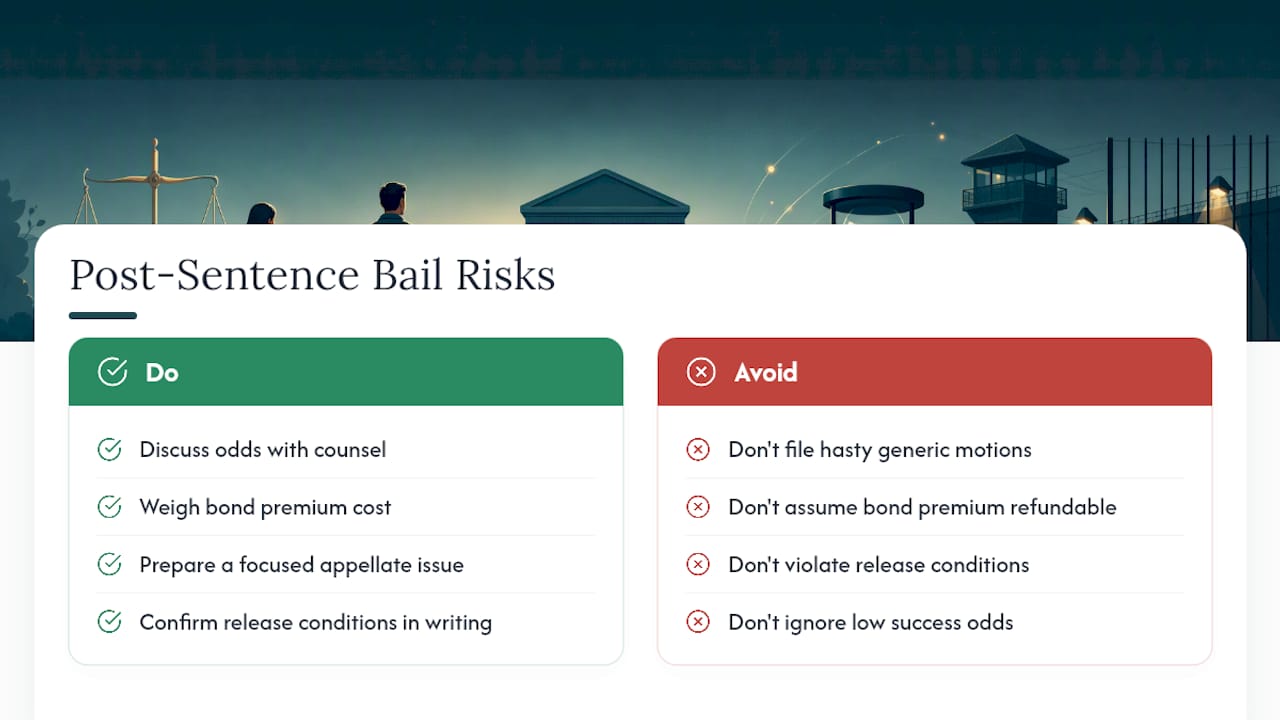
Pursuing post-sentencing release carries real financial and legal exposure, and it’s worth going in with eyes open. If a bond is granted, the premium paid to secure it is typically non-refundable regardless of how the appeal turns out. That’s the cost of the opportunity, not a deposit against winning.
There’s also the risk of a weak or rushed motion. Filing a hasty, generic request without a solid appellate issue can waste the narrow window you had, and some courts view repeated frivolous motions unfavorably when considering later requests in the same case. A denied motion isn’t just a setback; in some jurisdictions it can shape how the court views subsequent filings.
If release is granted and conditions are violated, even a minor one like a missed check-in, the consequences compound. Revocation typically means immediate return to custody, forfeiture of posted collateral, and a court record that now shows a failure to comply, which can undercut credibility on appeal itself. Courts that were on the fence about your appeal’s merits may reasonably factor in that you couldn’t hold up your end of a release agreement.
There’s also a quieter risk: the emotional toll of pursuing a low-odds outcome. Because federal and most state standards start from a presumption against release, many post-sentencing bail requests are denied. Families sometimes spend money on motions or bond premiums for a request that never had a realistic chance given the offense and sentence length, which is exactly why an honest conversation with counsel about the odds, before filing, matters more than optimism.
Two Scenarios That Show How Different the Outcomes Can Be
Picture two defendants sentenced on the same day in different cases. The first received a short sentence for a nonviolent, first-time offense, and their appellate lawyer identified a specific, documented error in how evidence was admitted at trial. They had a stable job, a lease in their name, and no history of missed court dates. Their motion for an appeal bond named the evidentiary issue directly, proposed electronic monitoring, and came with employer letters confirming their job was waiting. The judge granted a bond with strict conditions, because the sentence was short enough that serving it before the appeal resolved risked real unfairness if the conviction was reversed.
The second defendant received a long sentence for a violent offense and filed a notice of appeal built around a general claim that the trial “wasn’t fair.” No specific legal error, no proposed conditions, no documentation of community ties. The motion was denied quickly, and under Maine’s statutory framework, the judge was required to state on the record why release wasn’t appropriate given the offense.
The difference between these outcomes wasn’t luck. It was sentence length, the strength of a documented appellate issue, and whether the motion gave the judge something concrete to act on.
Publisher Perspective: What We See in Practice
Successful post-sentencing bail is genuinely rare, and it clusters around a specific profile: short sentences, a documented appellate issue, and strong community ties. When a judge does allow release, families still need to move fast on the financial side. That’s where 24/7 bilingual agents, immediate inmate-locating help, and flexible payment plans make a real difference during an already stressful window.
— Jake
If a Judge Grants Bail, Move Fast on the Logistics
Getting a judge to grant an appeal bond is the hard part. Once that happens, the financial side needs to move just as quickly, and that’s where Thebailnetwork’s role starts.

Some bail bond companies run 24/7 bilingual bail agents, which matters when a judge sets a post-sentencing bond outside normal business hours and your family has one shot to act before conditions change. If you’re still working through your case, understanding how bail amounts get calculated helps you walk into that hearing prepared, and knowing how payment options work means you’re not scrambling for financing after the judge already ruled.
Talk to your attorney first about whether an appeal bond is realistic in your case. If the court sets one, reach out to Thebailnetwork right away so posting the bond and arranging any collateral doesn’t become the reason release gets delayed.
This article is general information, not a substitute for advice from a qualified lawyer. Consult a qualified legal professional about your own circumstances before acting on anything here.
Sources
- 18 U.S.C. § 3143 — Release or detention of a defendant pending sentence or appeal
- §3143. Release or detention of a defendant pending sentence or appeal (USC commentary)
- 234 Pa. Code Rule 521. Bail After Finding of Guilt
- Getting Bail During the Appeal Process — Justia
FAQ
Can You Get Bail After Being Sentenced?
Sometimes, through an appeal bond or stay of sentence, but it requires a judge to find the appeal raises a substantial legal question and that you’re not a flight risk or danger, per federal standards.
Do You Go to Jail Right Away After Sentencing?
In most cases, yes, unless a judge has already granted a stay of sentence or appeal bond before you’re taken into custody, which requires a specific motion filed promptly after sentencing.
Can Bail Be Granted After Sentencing in Every State?
No. Rules vary widely: some states like Pennsylvania set explicit conditions for post-sentence bail, while others restrict or bar it entirely for serious or violent offenses, as Maine’s statutes demonstrate.
How Long Does It Take to Get Bail Money Back After Sentencing?
Collateral posted against a bond typically returns once the case concludes and all release conditions are satisfied, while premiums paid to a bail bond company are generally non-refundable; ask Thebailnetwork about specific timelines if a post-sentencing bond is set in your case.