
Bail Bond Myths: 9 Things Families Get Wrong
Most bail bond myths come down to three misunderstandings: who sets bail, what a bond actually costs, and how fast release can happen. You usually do not need the full bail amount in cash, a bail agent does not set the amount, and paying bail says nothing about guilt. If someone you love was just arrested in Southern California, our bilingual agents at The Bail Network are available 24/7 and can walk you through the real process, starting with the standard 10% premium and our approved-credit options.
TL;DR
- A court or magistrate sets bail, not the bail agent, and the amount does not signal guilt or innocence.
- You do not have to pay the full bail in cash. A bail bond lets a licensed agent post it for you in exchange for a fee.
- In California, the bond fee is most commonly 10% of the bond. It is a fee for the service, so it is not returned if charges are dropped.
- Release can start as soon as the person is booked. You do not have to wait 24 hours to begin.
- Payment plans exist, and we offer plans as low as 1% with approved credit.
Table of Contents
- Why bail myths spread so fast
- Myth 1: “You have to pay the full bail amount in cash”
- Myth 2: “A high bail means the person is guilty”
- Myth 3: “The bail agent decides how much bail is”
- Myth 4: “Bail bonds are only for people who can’t get out another way”
- Myth 5: “You get the fee back if the case is dismissed”
- Myth 6: “Bail is too expensive for most families”
- Myth 7: “You always have to put up your house or car”
- Myth 8: “You have to wait 24 hours before anyone can post bail”
- Myth 9: “Missing court is no big deal once you’re out”
- Is this bail agent real? A quick way to check
- Rules differ by state
- Putting it together: what to do in the first hour
- Our view: the myth behind all the other myths
- Get help posting bail now
- FAQ
- Sources
Why bail myths spread so fast
An arrest usually happens without warning. Families end up on the phone at 2 a.m. trying to understand a system with its own vocabulary: booking, arraignment, surety, exoneration. Rumors, movie scenes and half-remembered advice fill the gap.
The cost of believing a myth is real. Some families wait a day because they think nothing can happen yet. Others give up because they think they need thousands in cash. Others sign a contract without knowing what it says. Each myth below comes with the fact, the source, and what it means for your next call.
A quick definition first. Bail is money or a guarantee a court sets so a defendant can wait for trial at home and still come back to court. According to the New York Department of Financial Services, bail is typically returned at the end of the case if the defendant follows court orders. A bail bond is a contract with a licensed agent who pays that amount for the defendant when the family cannot.
Myth 1: “You have to pay the full bail amount in cash”
The fact: No. If a defendant or their family cannot afford the full amount, they can sign a bail bond contract with a licensed agent who posts it for them, as the New York Department of Financial Services explains. Once the paperwork is finalized, the bond goes to the court for approval and the defendant is released.
Behind that simple description is a real commitment from the agent. The Washington State courts’ glossary of bail terms describes the arrangement: the bail bond company signs a promissory note to the court for the full bail amount, charges a fee usually around 10% or more, and is liable for the full amount if the defendant fails to appear.
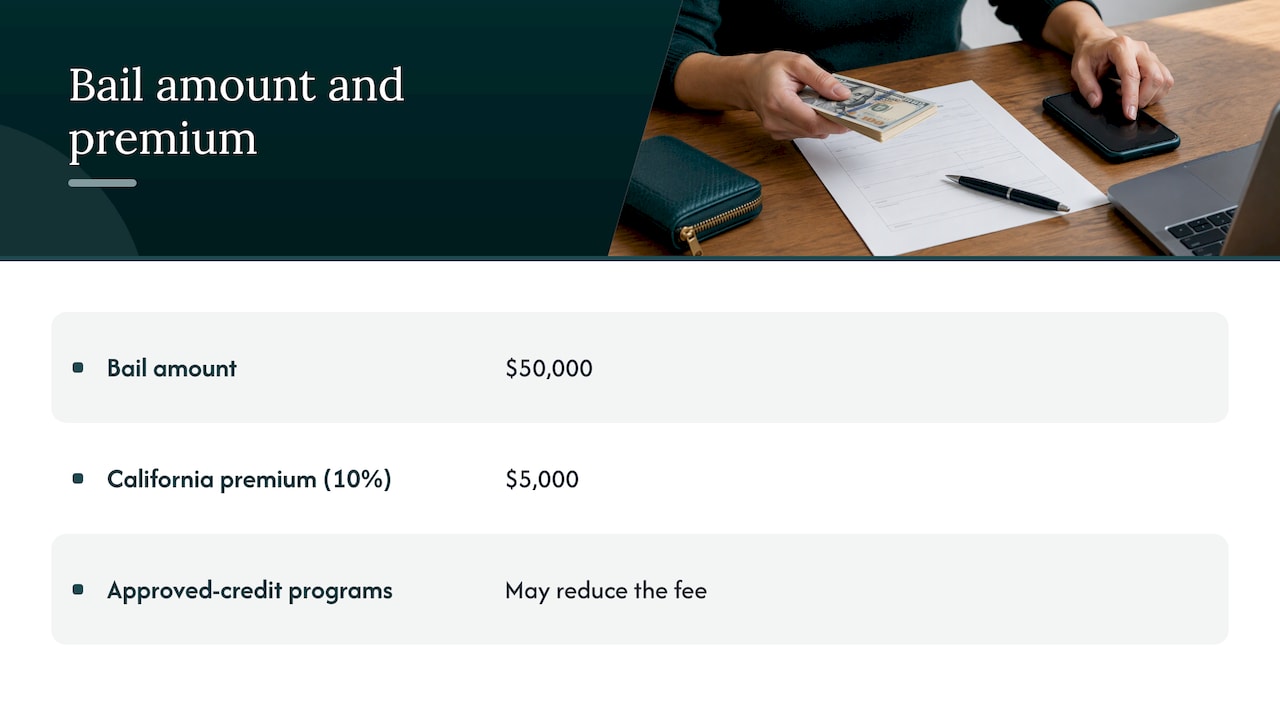
So a $50,000 bail does not require $50,000 from you. In California, with a 10% premium, the fee is $5,000. With our approved-credit programs, it can be less. We explain those further down.
If you want to compare the ways to pay, our guide Bondsman vs. Jail Cashier walks through each route and what it asks of your family.
Myth 2: “A high bail means the person is guilty”
The fact: Bail is not a verdict. The American Bar Association states that bail is not a fine and not punishment. Its purpose is to make sure the defendant appears for hearings and trial. Mass.gov says the same: the amount does not indicate guilt or innocence, and deciding guilt is for a judge or jury.
This matters emotionally. Families often feel shame when they call a bail agent, as if hiring one means admitting something. It does not. Using a bond is a way to keep a person at home, working and preparing a defense while a case moves forward.
Myth 3: “The bail agent decides how much bail is”
The fact: Courts set bail, and the agent works within that number. The ABA explains that the judge or magistrate sets the amount by weighing factors such as flight risk, the type of crime, dangerousness and community safety. A judge may also release a defendant on their own recognizance, meaning on a promise to return, with no payment at all.
In San Francisco, the city treasurer’s office notes that before the first court appearance, bail is set from a fixed fee schedule based on the severity of the charge. At arraignment, the first court hearing, a judge may raise or lower it. Los Angeles, Orange and San Diego counties publish their own schedules, so the number depends on the charge and the county, not on who you call.
The agent’s job starts after the number exists. And bail agents do not work for the court either. The New York DFS is explicit that agents are not court employees, which is why you should read your own agreement carefully. Our article on what you sign and what it means covers each part of a typical agreement.
Myth 4: “Bail bonds are only for people who can’t get out another way”
The fact: Bonds are used by all kinds of families, and sometimes bail is not even needed. The ABA notes that judges can release defendants on their own recognizance. For some first-time cases, that is a real possibility, and a fast phone call can clarify what applies. Our page on bail for first-time offenders explains how OR release and cash bail differ.
When bail is set and the amount is out of reach, the bond is the practical tool. The ABA also notes that in many jurisdictions defendants can be released after paying 10% of the bail directly to the court, and that in most states those who cannot afford bail can arrange release through a bondsperson who guarantees the rest. Rules differ by state, so ask what applies in the county where your family member is held.
Myth 5: “You get the fee back if the case is dismissed”
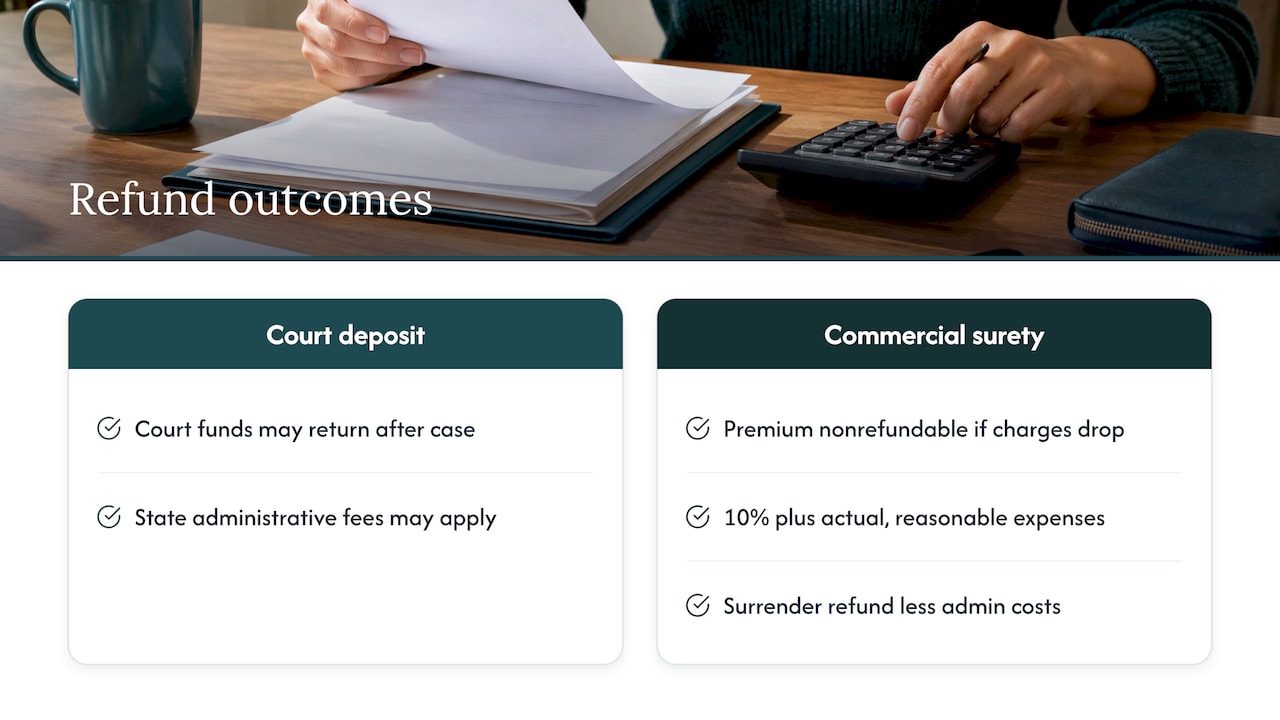
The fact: The bond fee, called the premium, pays for the service of posting the bond and carrying the risk, so it is not refunded when charges are dropped. The California Department of Insurance says the cost is most commonly 10% of the bond plus actual, necessary and reasonable expenses, and that the premium is nonrefundable even if charges are dropped. If the person is surrendered, the fee can be refundable minus administrative costs.
Think of it like the premium on any insurance policy: you pay it for coverage during the period you need it. A person’s final case outcome does not change what the agent put on the line the day of release.
The National Conference of State Legislatures draws the contrast for reference: money posted directly with the court may come back at the end of the case, though many states authorize administrative fees, while money paid to a commercial surety is not returned. That is the tradeoff of a bond. You pay a fraction up front so the family keeps its savings available for rent, food and a defense attorney.
Myth 6: “Bail is too expensive for most families”
The fact: The standard California premium is 10% of the bond, and many families do not have that sum sitting ready either. This is where payment flexibility matters.
At The Bail Network, the standard bail premium is 10%. We also offer payment plans as low as 1% with approved credit. We have a page for 1% bail bonds in California and another for 2% bail bonds with approved credit. Approval depends on credit, so the agent will confirm which option fits your situation.
Here is what that looks like on a $50,000 bond, using the percentages only as arithmetic:
| Premium rate | Fee on a $50,000 bond |
|---|---|
| Standard 10% | $5,000 |
| 2% with approved credit | $1,000 |
| 1% with approved credit | $500 |
We also have pages describing no money down bail bonds and no-collateral bail bonds for families whose first question is how to start without cash on hand or property to pledge.
Myth 7: “You always have to put up your house or car”
The fact: Collateral is something an agent may ask for to secure the bond, such as cash, a car title or property, and it is not always part of the deal. The California Department of Insurance states that collateral or liens are released after bail is paid and the case is settled, with the bond exonerated. Exonerated means the court has formally ended the bond obligation, usually when the case concludes and the defendant has attended every date.
The New York DFS adds that collateral should be reasonable, such as around 10% of the bond value, and that an agent may keep it only if the defendant fails to return to court or follow orders and the bond is forfeited. The legal details differ from state to state, but the principle is the same: collateral is security, not a fee.
If you do pledge something, ask for a written receipt and a written explanation of when it will be returned.
Myth 8: “You have to wait 24 hours before anyone can post bail”
The fact: Release can begin as soon as the person has been booked and bail has been set. The San Francisco Treasurer’s bail report notes that bail can be posted at any time after booking or after the first arraignment. Before arraignment, the amount comes from the fixed schedule mentioned above.
In California, the Law Revision Commission says the first court appearance must occur within 48 hours of arrest, excluding Sundays and holidays. At that hearing a judge can raise or lower the amount. So you do not need to wait for court to act, but you should know the amount can change at arraignment.
Actual release time depends on how busy the jail is and how fast paperwork clears. That is why we run around the clock, and why the earlier you call, the better. Our 24-hour bail bonds page explains how to reach us, and our online bail bonds page shows how to start the paperwork remotely.
What to have ready when you call
The fastest calls are the ones where you can give the agent a few facts:
- The full name and date of birth of the person arrested.
- The jail or station where they are held, and the booking number if you have it.
- The charges, if you know them, and the bail amount.
- Your own ID, employment details and a phone number that will be answered.
Our checklist, information needed for bail, goes through each item. If English is not the first language in your home, our agents are bilingual, so you can handle the call in the language you are most comfortable with.
Myth 9: “Missing court is no big deal once you’re out”
The fact: This is the myth with the highest cost. The NCSL says that failing to appear while on pretrial release can lead to revocation or modification of bond, a warrant, arrest, detention, forfeiture of money bail, suspension of driving privileges, or new criminal charges.
For a family, the practical lesson is simple. The person released must attend every date, and the co-signer shares responsibility for that. Write the dates on a calendar, set phone reminders, and arrange rides in advance. If a date becomes impossible to keep, tell the bail agent and the defendant’s attorney before it passes.
Is this bail agent real? A quick way to check
People search “is the bail bond company real” and “why is a bondsman calling me” for good reasons. After an arrest, a family member’s name and number can end up on public lists, and unwanted calls can follow. Calls are also sometimes scams that ask for payment by gift card or an app.
A few habits keep you safe:
- Ask for the agent’s full name and California bail agent license number, and confirm it with the state’s Department of Insurance, the regulator for bail agents in California.
- Never pay by gift card, and never pay anyone who will not give you a written agreement and receipt.
- Read every page before signing. Our guide to questions to ask a bail agent puts cost and release time first, which are the two things families need to know right away.
Remember also that the premium, collateral and charges must match what you were told. The California Department of Insurance publishes consumer information on bail bonds and is the right place to take a complaint about a licensed agent.
Rules differ by state
Everything above applies to California, where we work. Other states differ. Illinois, for example, ended the requirement of posting monetary bail on January 1, 2023, under its Pretrial Fairness Act. Delaware describes four bail types: own-recognizance, unsecured, secured and cash-only. If a loved one was arrested outside California, check the court rules where they are held.
Putting it together: what to do in the first hour
- Find where the person is held and confirm the bail amount.
- Gather the details listed above.
- Call a licensed agent, ask about the premium, payment plan and any collateral, and get everything in writing.
- Complete the paperwork. The bond goes to the court for approval, and then release follows.
- Write down every court date and share it with everyone involved.
Our longer guide, how bail bonds work in California, covers each step in more depth.
Our view: the myth behind all the other myths
The biggest myth we hear is that nothing can be done tonight. Families call us exhausted and scared, sure that they need money they do not have, or that the process has to wait until morning.
It does not. Bail is a court’s tool to make sure someone returns. A bond is a way to meet that requirement without emptying your savings. When we explain the fee, the payment plan options and the paperwork up front, the fear usually shrinks.
That is why our agents are bilingual and available 24/7, and why we publish guides on every step. A family that understands the agreement makes better decisions, and a person who is home is able to work, care for family and prepare for court. Our payment plans as low as 1% with approved credit exist for exactly that reason.
Jake
Get help posting bail now
If you need to act today, The Bail Network serves families across Southern California with bilingual agents, 24/7 availability and inmate locator support. The standard premium is 10%, and approved-credit plans can lower what you pay up front. Start on our bail bonds page or call and tell us where your loved one is held.
If the amount is your main worry, our affordable bail bonds page explains the options. We also serve specific counties, including San Diego and Orange County, where you can search for an inmate for free.
FAQ
Does using a bail bond mean my family member is guilty?
No. Bail is not a punishment, and its amount does not indicate guilt or innocence. A judge or jury decides guilt later. A bond simply lets the person wait for court at home.
How much does a bail bond cost in California?
The cost is most commonly 10% of the bond, plus reasonable expenses, according to the California Department of Insurance. At The Bail Network, the standard premium is 10%, and we offer payment plans as low as 1% with approved credit. A $50,000 bond at 10% is a $5,000 fee.
Do I get my money back if the charges are dropped?
The premium is the fee for posting the bond, and in California it is not refunded when charges are dropped. Collateral is different: it is released after the case is settled and the bond is exonerated. Ask your agent to put the return terms for any collateral in writing.
How fast can someone be released?
Bail can be posted any time after booking, and you do not need to wait 24 hours to start. How quickly the person walks out depends on the jail’s processing and how soon the paperwork is complete. Calling early and having the person’s details ready helps.
Can I use a bail bond if I do not speak English well?
Yes. Our agents are bilingual and available around the clock, so you can discuss the cost, the agreement and the court dates in the language you are most comfortable with.
Sources
- New York State Department of Financial Services: Bail Information for Consumers
- California Department of Insurance: Bail Bonds
- Washington State Courts: Glossary of Terms and Phrases Relating to Bail
- Mass.gov: Learn how bail is set
- American Bar Association: How Courts Work, Bail
- NCSL: FAQs on Pretrial Policy
- California Law Revision Commission: Staff Memorandum 2022-10
- Illinois Courts: Pretrial Fairness Act flowchart
- Delaware Courts: Bail and Bail Bonds