
Bail Check-Ins: Who Sets Them, How They Work, and What Happens If You Miss One

A bail check-in is a required report to a court program or pretrial officer while a criminal case is still open. A judge orders it as a condition of release, so the schedule, the place and the method depend on the court order, not on the bail bond. If someone you love has just been arrested, the safest approach is to get them out and then read the release paperwork line by line, because every check-in rule you need is in it. Our agents can post the bond around the clock, in English or Spanish, so the person is home and able to start meeting those conditions from day one.
TL;DR
- A check-in is a court-ordered condition of release. It is separate from court dates and from any contact a bail agent asks for.
- Frequency is set by the judge and can be daily, weekly or monthly. The first report is often in person, usually within a day or so of release.
- Check-ins can be by phone, in person, or through a monitoring app, depending on the county and the risk level of the case.
- If you miss one, call the pretrial officer as soon as possible. Missed check-ins are reported to the court and can lead to a warrant or loss of release.
- Only the judge can change the conditions. Ask the attorney, not a friend or a website, before assuming anything has changed.
Table of Contents
- What a bail check-in actually is
- Who can require check-ins
- What check-ins look like in practice
- Language help and getting the details right
- If you cannot make a check-in, or already missed one
- Why rules differ, and how they change
- Check-ins and the cost of getting out
- How we help families get started
- Our perspective
- FAQ
- Sources
What a bail check-in actually is
When someone is released while their case is pending, a judge can attach conditions to that release. One of the most common is regular reporting to a pretrial services office. In Linn County, Oregon, for example, the court may require a person to attend hearings and check in with Pretrial Services daily, weekly or monthly. That supervision applies while the case is open, which is different from probation after a sentence or parole after prison.
Three things get mixed up all the time:
- Court dates. These are hearings where the defendant must appear before the judge. Missing one is a failure to appear. Our guide on what happens if you miss a court date after posting bail in California covers that separately.
- Pretrial check-ins. These are the routine reports to a pretrial officer or caseworker between court dates.
- Contact with the bail agent. This is a matter of the bond agreement and keeping the agent informed about where the defendant is and when the next hearing is.
All three matter, and each has its own consequence if it is ignored.
Who can require check-ins
Only a judge or other judicial officer orders them. Under federal law, if release on a promise to appear or an unsecured bond is not enough, the judicial officer must choose the least restrictive conditions that still assure the person’s appearance and community safety. Those can include regular reporting, curfew, travel limits, no-contact orders, drug and alcohol restrictions, and treatment. The order has to state the conditions clearly and warn of the consequences, including an immediate warrant.
States write their own versions. Virginia’s code, for instance, lets any judicial officer set conditions such as custody with a pretrial services agency, curfew, testing and GPS monitoring. The point for a family is that no program has one fixed schedule. Illinois’ statewide pretrial office says supervision varies by case and that a judge can change the requirements at any time, and it tells people to rely on their court records, their attorney and their assigned officer.
What check-ins look like in practice
The examples below come from different places. They show the range, not a rule for your county.
| Place | Who you report to | Typical pattern |
|---|---|---|
| Linn County, Oregon | Pretrial Services | Daily, weekly or monthly; first check-in in person, then reminders by text |
| Douglas County, Colorado | Pretrial Release Supervision | In-person intake within 24 hours of release on weekdays, a one-time $40 fee |
| Larimer County, Colorado | Pretrial Services | Report within 24 hours of posting bond, then a weekly check-in call |
| Michigan’s 3rd Circuit Court | Pretrial Services | Weekly contact unless the judge orders otherwise |
| Eastern District of Missouri (federal) | Assigned pretrial officer | Set schedule of phone and/or personal contact, plus home visits |
Notice the first-contact rule. In several places the very first report must happen within a day or so of release and in person. If the person is released late in the evening or on a weekend, that clock still matters, so ask the jail or the court exactly when and where the first report is due. Our weekend bail process checklist walks through how to avoid losing time when release happens outside business hours.
Phone, in-person and app check-ins
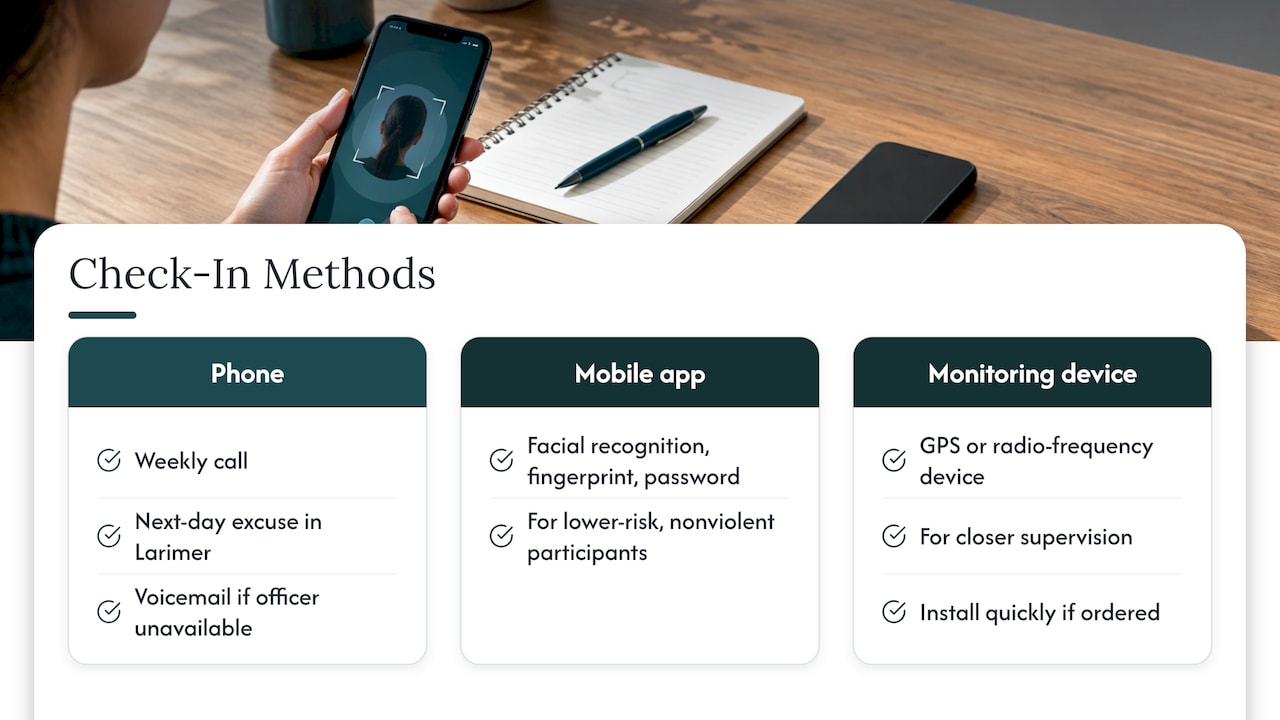
Some courts take a weekly call. Larimer County asks callers for their full name, date of birth and next court date, and it lets someone who forgot call the next day to excuse the missed call. The Missouri federal court says that if the officer is not available on call-in day, a voicemail with a callback number and a statement that there are no problems is accepted. Those are local practices, so confirm yours.
Higher-supervision cases can involve technology. The federal judiciary describes a mobile-app version in which the participant completes a check-in using facial recognition, a fingerprint or a password, and says apps suit lower-risk, nonviolent participants while GPS or radio-frequency devices are used for people who need closer supervision. If the court orders a device, it generally has to be installed quickly, so ask the attorney or the pretrial office what is expected on release day. For a closer look at how monitoring compares with a bond, see our guide on electronic monitoring versus bail.
Language help and getting the details right
Check-in rules are easy to misunderstand when they are explained fast, at a jail window, in a second language. A few habits protect the defendant:
- Get the release order in writing and read it with the family, not just the defendant.
- Write down the name of the officer or program, a phone number, the day, the time and the method.
- Ask for language help. Some offices list Spanish-speaking case managers; Larimer County’s pretrial page, for example, names Spanish-speaking staff. Where it is not offered, the defense attorney can help sort out what the order says.
- Put reminders in a phone and share them with a family member who can nudge the defendant.
- Keep proof. Note the date and time of every call, visit or message.
Our agents are bilingual and available 24/7, so a family can talk through the process in the language they are most comfortable with at the moment it matters. Our guide on the information needed for bail lists what to have ready before you call, and a short list of questions to ask a bail agent about cost and release time helps you make that call count.
If you cannot make a check-in, or already missed one
Act the same day. Contact the pretrial officer first, then the attorney.
In Linn County, Oregon, someone who misses a check-in should call their Release Assistance Officer as soon as possible. Non-compliance is reported to the court, the District Attorney and the defense attorney, and it can lead to stricter conditions, revocation of release or a return to custody. Illinois’ pretrial office says failure to comply can bring court-imposed sanctions including pretrial detention, and that someone who misses a court date should contact their attorney and pretrial officer immediately because a warrant may be issued. Michigan’s court notes that a violation can result in bond revocation and a warrant, and that only the judge can change bond conditions.
A practical sequence:
- Call the pretrial office or officer named in the order. Say who you are, your case number and why you missed or will miss the check-in.
- Call the defense attorney, who can ask the judge for a change if the schedule conflicts with work, medical care or transportation.
- Let the bail agent know. If a hearing is involved, a warrant can affect the bond.
- Keep records of every call and message.
- Do not stop reporting because a call went unanswered. Reach out again and document it.
It is also worth knowing that some courts forgive a missed contact when it is explained promptly. Do not count on that: the officer and the judge decide.
Why rules differ, and how they change
Because conditions are set by judges and local programs, they shift by county and sometimes by case. New Jersey is a useful example of how the rules themselves evolve. A Supreme Court amendment to Rule 3:26-2, effective November 1, 2024, gives eligible defendants who stayed compliant for six months a review for possible reduction of monitoring, and sets a timeline for considering violations of monitoring. That is New Jersey law and does not apply in California or elsewhere, but it shows why a family should ask the attorney about the current rules in the county where the case sits, not rely on what a relative went through years ago.
Check-ins and the cost of getting out
Check-ins are a feature of pretrial release in general, whether a person is released on their own promise, with a cash deposit or through a bail bond. Getting out sooner means the defendant can work, care for family and prepare for court while meeting these conditions. If you are weighing options, our article on bail for first-time offenders explains release on a person’s own recognizance versus cash bail, and the one on cite and release versus bail covers how some people avoid booking altogether. If a bail hearing is coming, use our bail hearing preparation checklist.
How we help families get started
We post bail bonds across Southern California, and our agents are bilingual and available around the clock. The standard bail premium is 10%, and with approved credit we offer flexible payment plans as low as 1%, so cost does not have to be the reason a family waits. You can look at our 1% bail bonds and no money down bail bonds pages, or reach an agent any time through our 24-hour bail bonds page.

We also offer an inmate locator support and educational guides on the bail process, so families know what comes next after release, including the check-in questions above.
Our perspective
The families we hear from are rarely worried about the bond itself by the time the person is out. They are worried about doing everything right afterward. Check-ins are where that worry lives, because the rules sit in a court order that few people have ever read.
Our view is simple. Get your loved one home quickly, then treat the release paperwork as the playbook. Put the reporting schedule on a calendar, share it with a family member, and keep every confirmation. Our bilingual agents are available 24/7 so you can ask questions in the language you are most comfortable with, and our payment plans, as low as 1% with approved credit, are designed so that cost does not delay a release.
Staying informed is what protects a defendant. That is why we publish guides on every step of the process, not only the bond.
Jake
FAQ
How often do I have to check in on bail?
It depends on the judge’s order. Courts use daily, weekly or monthly schedules, and some begin with an in-person visit. Michigan’s 3rd Circuit, for example, expects weekly contact unless the judge orders otherwise. Read the release order or ask the pretrial office for your exact schedule.
Is a bail check-in the same as a court date?
No. A court date is a hearing before the judge, while a check-in is a report to a pretrial officer between hearings. Both are required if the judge ordered them, and missing either one can trigger consequences, including a warrant.
Can I check in by phone?
Often, yes, but it varies. Some programs take weekly calls, some require in-person visits at first, and some use an app. Larimer County, Colorado, for instance, uses weekly check-in calls after an initial report within 24 hours. Confirm the method in your order.
What should I do if I missed a check-in?
Call the pretrial officer right away, then your attorney. Linn County, Oregon, tells people to call their Release Assistance Officer as soon as possible, since missed check-ins are reported to the court. Quick contact and a clear explanation give the judge a better picture than silence.
Can the check-in rules be changed?
Only by the judge. Ask the defense attorney to request a change if the schedule causes a real problem, such as a work conflict. Some places review eligible people for reduced monitoring after steady compliance, as New Jersey’s 2024 rule does, but that depends on local law.
Sources
- Oregon Judicial Department, Linn County Pretrial Release Program
- 18 U.S.C. § 3142, Release or detention of a defendant pending trial
- Code of Virginia, Article 1. Bail
- Illinois Office of Statewide Pretrial Services, Pretrial Supervision
- Douglas County, Colorado, Pretrial Release Supervision
- Larimer County, Colorado, Pretrial Services
- Michigan 3rd Circuit Court, Pretrial Services
- US District Court, Eastern District of Missouri, Pretrial Services
- US Courts, Use of Location Monitoring in the Field
- New Jersey Courts, Pretrial Release notice on Rule 3:26-2