
Cosigner vs. Collateral on a Bail Bond: What Each Means
A cosigner is a person who signs the bail bond agreement and promises to answer for the defendant. Collateral is something of value, such as cash, a vehicle or a home deed, that is pledged as security for the bond. They are different things, and one bond can involve both, either, or neither. Which one you need depends on the bail amount, the person’s circumstances and the bail agent’s approval. At The Bail Network, our licensed bilingual agents are available 24/7 across Southern California to walk you through it, and our cosigner bail bonds page explains how the signing works.
TL;DR
- Cosigner (indemnitor): a person, usually a relative or friend, who signs the agreement and takes on responsibility if the defendant does not meet the bond’s terms.
- Collateral: property or funds pledged to the bail agent as security. It is a separate item from the premium, the fee for the bond.
- Premium: the standard bail premium is 10% of the bail amount. We also offer payment plans as low as 1% with approved credit.
- Getting collateral back: it is generally returned after the case ends and the defendant has attended every court date, but the rules differ by state, so read your agreement before you sign.
Table of Contents
- What a cosigner actually is
- What collateral is
- Cosigner vs. collateral side by side
- What each one can cost you
- How the rules differ by state
- Do you need both?
- Paying less up front
- If you cannot provide a cosigner or collateral
- Our perspective
- Talk to an agent now
- FAQ
- Sources
What a cosigner actually is
In bail paperwork, a cosigner often goes by a more formal name: the indemnitor. The New York Department of Financial Services describes the indemnitor, sometimes called the co-signer, as the person who pays the bail agent or pledges collateral, usually a friend or family member who signs the indemnity agreement. “Indemnify” simply means to cover someone else’s loss. Here, the loss is the bail amount the bond company owes the court if the defendant does not show up.
The defendant is the person in custody. The cosigner is the person outside who vouches for them. A bail agent wants to know the defendant will return to court, and often the best evidence of that is a stable adult who knows the defendant, has a job and a home, and will keep in touch.
A federal National Institute of Justice study of the industry found that bondsmen tend to prefer cosigners who are employed, own property and know the defendant well. The study dates from 1986, but the logic is the same today: the cosigner is the person the agent can reach.
What the cosigner agrees to do
Signing is not a formality. Courts in other countries describe the same role in similar terms. Legal Aid Ontario explains that the person promises an amount of money if the accused misses court or breaks conditions, and has a duty to call the police if conditions are broken. The U.S. version is a contract with the bail agent rather than a promise to the court, but the practical duties look alike:
- Make sure the defendant knows every court date and gets there.
- Stay in contact with the agent and report changes of address or phone.
- Be responsible for the full bond amount if the defendant fails to appear and the forfeiture is not resolved.
- Pay any premium balance if you are on a payment plan.
We cover the details in our guide to what you are actually agreeing to as a bail bond cosigner, and our piece on indemnitor responsibilities explains why the 10% premium is not the whole picture of what you sign.
What collateral is
Collateral is security. It gives the bail agent something to hold against the risk that the defendant will not return. The same New York page says collateral is something of value, such as cash, property or a home deed, that the indemnitor or defendant pledges while the defendant is out on bail. It also makes a point many families miss: the premium fee is separate from both the cosigner and the collateral.
Common forms include:
- Cash or a bank account
- A vehicle title
- Real estate, through a deed of trust or mortgage
- Jewelry, equipment or other valuables
Our guide to six asset types and how families pledge less goes through each one. If you are in California, what collateral is and when you get it back covers the local picture.
Why agents ask for it
The NIJ study mentioned above noted that bondsmen value collateral partly for its psychological effect: defendants whose parents pledged homes or valuables are less likely to flee. It is not only about recovering money. It also raises the stakes for everyone to make sure the defendant appears.
Cosigner vs. collateral side by side
| Cosigner (indemnitor) | Collateral | |
|---|---|---|
| What it is | A person who signs the agreement | An asset pledged as security |
| What you give | Your signature and your responsibility | Cash, a title, a deed or valuables |
| Who provides it | Usually family or a friend | The cosigner or the defendant |
| Is it the fee? | No | No. The premium is separate |
| What happens at the end | Your obligation ends once the bond is exonerated and any balance is paid | The asset is returned, subject to state rules and your agreement |
| Main risk | Responsibility for the bond amount if the defendant does not appear | The agent may keep or sell the asset after a forfeiture |
The two often go together. A cosigner can pledge collateral, and a defendant can pledge collateral that a cosigner then vouches for. But they are not the same obligation, and you can sign one without the other.
What each one can cost you
Missing court is the real risk
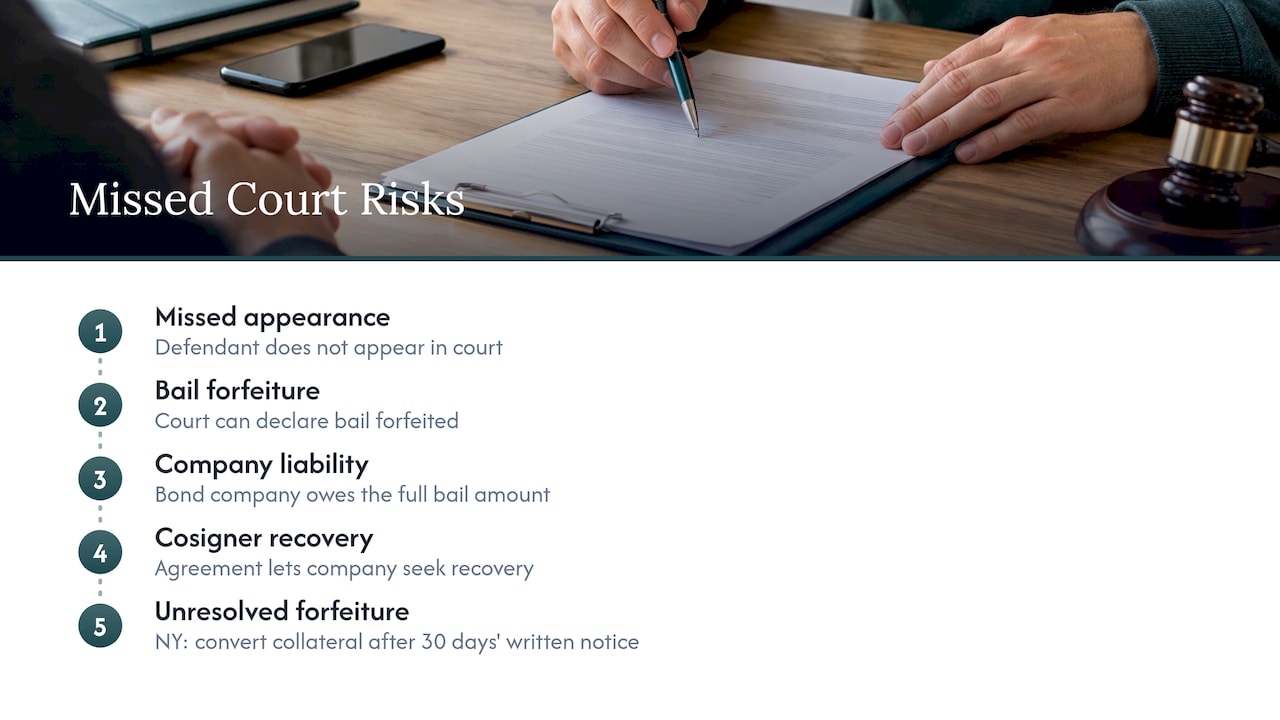
If the defendant does not appear, the court can declare the bail forfeited. That means the bond company becomes liable for the full bail amount, and the cosigner’s agreement is how the company looks to recover it. In New York, for example, regulation 11 NYCRR 28.11 allows the agent to convert non-cash collateral to cash if a forfeiture is not discharged, but only after giving the indemnitor and the defendant at least 30 days’ written notice.
Forfeiture does not always end in a loss. Courts often give a window to bring the defendant back. We explain how that works in what happens when a bail bond is forfeited in California. The fastest way to protect yourself is to contact the agent the moment you learn a court date was missed.
Collateral is refundable, with conditions
The good news is that collateral is a security deposit, not a payment. New York City’s Bail Bond Consumer Bill of Rights states that collateral is refundable and must be returned when the case is over if the defendant followed court orders, whether the outcome was a conviction or an acquittal. The agent may keep it if the defendant violates court orders such as missing a scheduled appearance.
The premium is a different story. It is the fee for the bond service, and it is not what comes back at the end. If charges are dropped, our guide on five steps to get your bail money back shows what to ask for and when.
How the rules differ by state
Bail is regulated state by state, and the details of collateral change with the state. Here are examples from official sources, so you can see what to look for in your own agreement:
| State | What the official source says |
|---|---|
| New York | Collateral of up to 10% of the bail amount is presumed reasonable, and the agent must return it within 45 days of exoneration |
| Florida | Collateral must be reasonable and held separately from the agent’s own funds, and the agent must give 10 days’ written notice before converting it to cash after a forfeiture |
| Nevada | Collateral must be specifically identified in the agreement with a detailed written receipt, and the agent holds it for you rather than owning it |
| Virginia | The bondsman must give a written receipt describing the collateral and the terms of redemption or forfeiture, and return it within 15 days of a request once all fees are paid |
The pattern is the same everywhere: a written receipt, a reasonable amount, separate handling and a return after the bond ends. The deadlines and amounts are what differ. We serve Southern California, and the same habits protect you there: get the receipt, know exactly what you pledged, and keep copies.
What to check before you sign
- What exactly is pledged. The agreement should name each item, not a vague “assets.”
- A written receipt. Ask for one that describes the collateral in detail.
- When it is returned. Look for the trigger, usually exoneration of the bond, and how many days the agent has after that.
- What happens after a forfeiture. Find the notice period before collateral can be sold.
- How you can end your role. Ask what the process is if you need to be removed as cosigner. Our 48 to 72 hour playbook for cosigners walks through it.
Do you need both?
Not always. What the agent asks for depends on the bail amount, the defendant’s ties to the community and the cosigner’s credit and income. A smaller bond with a steady, employed cosigner may need no collateral at all. A larger bond may need both a cosigner and an asset pledge.
We offer options for families who do not want to put up property. Our no-collateral bail bonds page explains how that works, and no money down bail bonds covers the other side of the cost.
A worked example
Say bail is set at $20,000. At the standard 10% premium, the fee is $2,000. That is what you pay for the bond, and it is not returned. Now suppose the agent also asks for collateral and your family pledges a vehicle title. The title is not a payment. It is held as security, and it should come back when the case ends and the defendant has made every court date. Your sister signs as the cosigner. She is responsible for the defendant’s appearance and for the agreement’s terms, but she has not paid anything beyond the premium unless the agreement says so.
Three separate items: the fee, the pledge and the signature. Knowing which is which is most of the battle.
Paying less up front
The premium is the part most families feel first. We offer payment plans as low as 1% with approved credit, so the amount due at the start is smaller. See 1% bail bonds in California and 2% bail bonds with approved credit for how each works. Approval depends on credit, which is why a cosigner with steady income helps.
If you cannot provide a cosigner or collateral
Legal Aid Ontario notes that without money or social support to find a surety, a person is more likely to stay in jail until trial. That is the stake. Even if you do not own property, a cosigner with a steady job can be enough, and our team can talk through what would work for your situation. A defendant’s attorney can also ask the court about bail conditions, which is a step for the court and the defense lawyer, not the bond agent.
Our perspective
Families call us at the worst hour, often with one question: “Do I have to put up my house?” Usually the answer is more flexible than they fear, but only when they understand the difference between signing and pledging.
A cosigner is a promise from a person. Collateral is security from an asset. We would rather you walk in knowing which one you are giving, and what it takes to get it back, than discover it after a missed court date.
That is why we publish plain guides on every step, and why our agents are bilingual and available around the clock. Whether the conversation happens in English or Spanish, you should be able to read the agreement, ask every question and sign only what you understand.
If the premium is the obstacle, tell us. Payment plans as low as 1% with approved credit exist for exactly that reason.
Jake
Talk to an agent now
If someone you love is in custody in Southern California, our agents can explain the cosigner role, the collateral question and the cost on one call, in English or Spanish, at any hour. Start with the Bail Network’s bail bond service, or choose 24-hour bail bonds if it cannot wait.
Have the defendant’s full name, the jail where they are held and the bail amount ready, if you have them. Our inmate locator support can help with the rest.
FAQ
Is a cosigner the same as an indemnitor?
Yes, in bail the two terms usually mean the same person. The indemnitor is the one who signs the indemnity agreement and takes responsibility for the bond, and many people simply call that person the cosigner. Both are different from the defendant.
Can I be a cosigner without putting up collateral?
Often yes. Whether collateral is needed depends on the bail amount and the agent’s assessment of the defendant and the cosigner. Options such as no-collateral bail bonds exist for families who prefer not to pledge property.
Do I get my collateral back?
Generally, yes, once the bond ends and the defendant has met every court obligation. Official sources, such as the NYC Bail Bond Consumer Bill of Rights, say it is refundable if court orders were followed. The timing depends on your state and your agreement, so ask for the return terms in writing.
Is the 10% premium the same as collateral?
No. The premium is the fee for the bond. Collateral is security that is held and then returned. The New York DFS treats them as separate items, and so should your agreement.
Sources
- Bail Information for Consumers, New York DFS
- NYSDFS Regulations, Final Adoption of 11 NYCRR 28 (2023)
- Bail Bond Consumer Bill of Rights, NYC
- Florida Statutes 648.442 (2024)
- Nevada Division of Insurance Bulletin 18-002
- Code of Virginia, Article 11. Bail Bondsmen
- Commercial Bail Bonding: How It Works, National Institute of Justice
- What is a surety?, Legal Aid Ontario