
Families: 3–10% Credit Card Fees vs 10% Bondsman Premium to Post Bail
Yes, in many jurisdictions you can use a credit card for bail, either by paying the court or jail directly (when the facility allows it) or by paying a bail bondsman’s premium. The route you take changes the cost significantly. Direct card payments often carry a processing fee, while bondsman premiums are typically nonrefundable but can total less than paying full bail plus fees. Call the jail or court first to confirm what they accept.
TL;DR:
- Paying bail with a credit card may involve a processing fee of 3% to 10%, adding hundreds of dollars to the total cost, depending on the bail amount.
- Only certain jurisdictions accept credit card payments directly to courts or jails, often requiring prior approval from a judge or confirmation via official payment pages.
- Using a bail bondsman typically costs around 10% of the bail as a nonrefundable premium, which might be cheaper overall than paying full bail plus processing fees.
- A credit card charge for bail can negatively impact credit scores if utilization spikes above 30%, and cash advances from cards accrue interest immediately without a grace period.
- When payment methods fail, options include bonds with collateral, release on own recognizance, or payment plans offered by some bondsmen, with refunds taking weeks once cases conclude.
Table of Contents
- How Paying Bail With a Credit Card Actually Works
- How Do You Actually Pay Bail With a Credit Card?
- What Does It Cost to Pay Bail With a Credit Card?
- Does Every County Accept Credit Cards for Bail?
- What If a Credit Card Isn’t an Option?
- What Happens to the Money: Refunds and Timelines
- The Real Risk: Debt and Your Credit Score
- What the Law Says About Credit Card Bail by Jurisdiction
- How to Choose a Bail Bondsman Who Takes Credit Cards
- What Bail Agents Wish Families Knew Before Paying
- How The Bail Network Can Help Right Now
- Where to Verify Local Bail Payment Rules
- Sources
- FAQ
How Paying Bail With a Credit Card Actually Works
There are two distinct paths, and confusing them is the most common mistake families make under pressure.
The first is a direct payment to the court or jail. Some facilities run kiosks, online portals, or phone lines that accept cards for the full bail amount, but only when local policy and, in some cases, a judge’s order permit it. Legal Aid NYC notes that credit card bail is often accepted at courthouse kiosks or through online systems specifically when a judge has authorized that payment method.
The second path is paying a licensed bail bondsman. Instead of covering the entire bail, you pay the bondsman a premium (a percentage of the total bail) and the bondsman posts a surety bond for the rest. This premium is nonrefundable, but it means you’re not charging the full bail amount to a single card.
A wrinkle in both paths: third-party processors. Counties frequently contract with payment vendors like AllPaid, which Harris County’s sheriff’s office uses for card transactions. These processors add their own convenience fees on top of whatever the court or jail charges, so “credit card bail” rarely means paying the sticker amount.
- Direct court/jail payment: full bail charged, subject to acceptance and processor fees
- Bondsman payment: nonrefundable premium charged, bond covers the rest
- Processor fees apply in both cases when a third-party vendor handles the transaction
How Do You Actually Pay Bail With a Credit Card?
Once you know your loved one has been booked, speed matters, but so does getting the details right the first time.
- Call the jail or check its payments page. Have the inmate’s full legal name and booking number ready. Most facilities won’t discuss payment options without both.
- Confirm the accepted channels. Ask specifically whether they take cards at an in-person kiosk, through an online portal, over the phone with a bondsman, or only through a processor. Policies vary even between facilities in the same county.
- Gather cardholder information. If you’re paying on someone else’s behalf, know whether the cardholder needs to be physically present, provide a photo ID, or complete an e-signature authorization form.
- Have a backup plan. If your credit limit falls short, ask about splitting the charge across two cards, requesting a temporary limit increase from your card issuer, or, as a last resort, a cash advance.
Pro Tip: Call your card issuer before you go to the jail or bondsman’s office. A large, unusual charge can trigger a fraud hold and freeze the transaction at the worst possible moment.
What Does It Cost to Pay Bail With a Credit Card?
The sticker price on bail is never the real price once cards enter the picture, and the gap between options can run into hundreds of dollars.
Processing fees on direct card payments to a court or jail commonly run 3% to 10% of the transaction, depending on the processor. On a $2,000 bail, that’s an extra $60 to $200. On $10,000 bail, a 10,000forward fee range translates to $300 to $1,000 tacked onto the total.
- $2,000 bail with a 5% processing fee: $2,100 total
- $10,000 bail with a 7% processing fee: $10,700 total
- $10,000 bail paid through a bondsman at a 10% premium: $1,000 (nonrefundable, bond covers the rest)
Cash advances make things worse. Most card issuers charge a separate cash advance fee, and interest starts accruing immediately with no grace period, unlike a standard purchase.
A bail bondsman’s premium is regulated in many states at around 10% of the total bail, and while that fee is nonrefundable, it’s often the cheaper path overall since you’re financing a fraction of the bail instead of the whole amount plus processing charges.
Does Every County Accept Credit Cards for Bail?
No, and this is where families get tripped up. Acceptance is set at the county or facility level, not nationally, so what worked for a friend in another state may not apply where you are.
Some sheriff’s offices publish clear payment pages. Milwaukee County, for example, lists accepted payment methods directly on its site. Others rely entirely on third-party processors like AllPaid or GovPayNet, and their fee schedules live in the processor’s fine print, not the county’s page.
- Check the sheriff’s or court’s official “pay bail” page first
- Look for a bail schedule PDF, which many courts publish showing standard amounts by offense
- If a third-party processor is named, read its fee disclosure before authorizing anything
Government (.gov) pages are the most reliable source. Private bail-advice sites can be outdated, but a county’s own payment page reflects current policy.
What If a Credit Card Isn’t an Option?
Card declined, limit too low, or the facility simply doesn’t accept plastic. None of those situations mean you’re out of options.
- Surety bond through a bail bondsman: you pay the premium (cash, card, or sometimes financing) and the bondsman posts the full bond. This is usually the fastest fallback when a card can’t cover the full bail.
- Property bond: collateral like real estate secures the bail instead of cash, though this process typically takes longer and isn’t available everywhere.
- Release on own recognizance (ROR): a judge releases the defendant without payment, based on flight risk and offense severity. Availability varies by court and case.
- Ask about payment plans or split payments. Many bondsman offices, including The Bail Network, let clients divide costs across multiple cards or arrange financing instead of one lump charge.
What Happens to the Money: Refunds and Timelines
This is where the two payment paths diverge sharply, and it’s the part people misunderstand until they’re staring at a bank statement weeks later.
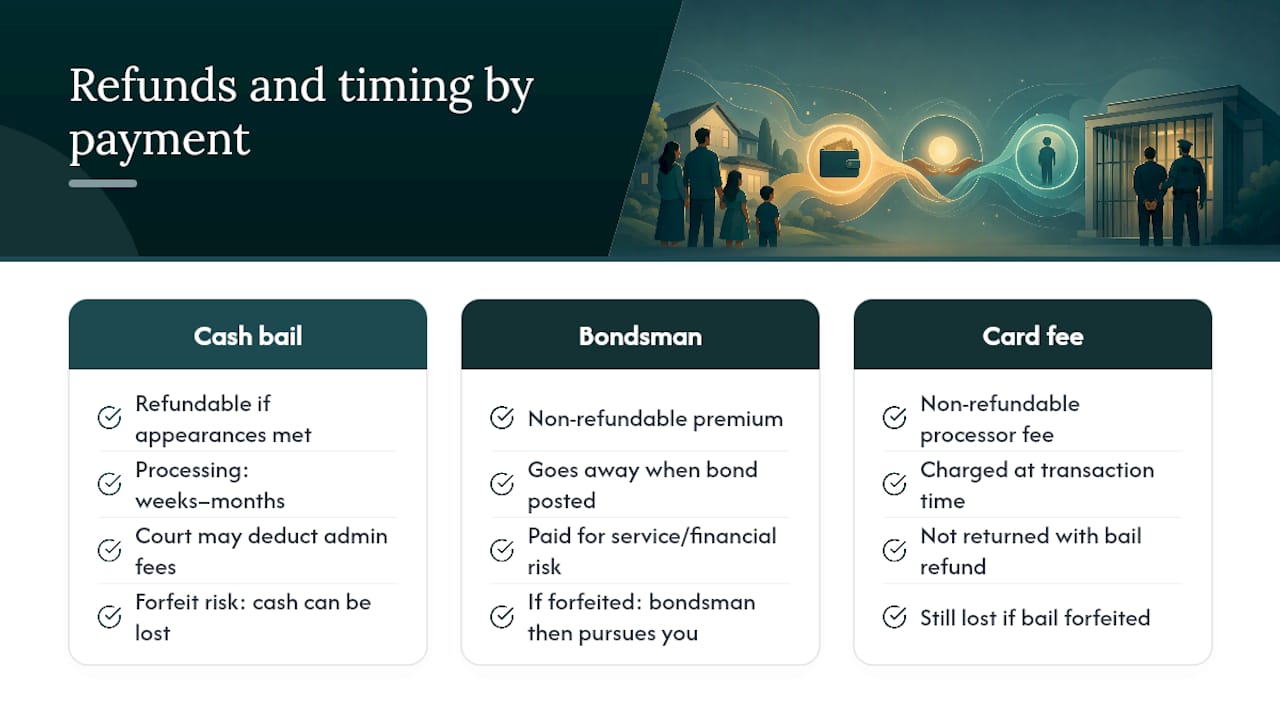
If you post cash bail directly with the court and the defendant makes every required court appearance, that money is refundable once the case concludes, though courts often deduct administrative fees first. Processing that refund isn’t instant. It can take anywhere from a few weeks to a few months after the case closes, depending on the court’s backlog and whether the funds were paid by card, check, or cash.
A bondsman’s premium works differently, and this is the detail that surprises first-time bail payers most. That percentage you paid the bondsman, commonly around 10% of the total bail, is gone the moment the bond is posted. It doesn’t come back even if the defendant shows up to every hearing and the case is dismissed. You’re paying for a service (the bondsman assuming financial risk on the full bail amount), not making a deposit.
Card processing fees follow the same rule. Whatever a third-party processor charged to run your transaction is a service fee, not part of the bail itself, so it’s never refunded even if the underlying bail amount eventually comes back to you.
Timing matters for another reason: if the defendant misses a court date, the entire bail (cash bond) or the full bond amount (surety) can be forfeited. With a surety bond, that liability initially falls on the bondsman, who will then pursue anyone who signed as a co-signer or indemnitor for that amount. Understanding a co-signer’s role before signing anything protects you from an unpleasant surprise later.
The Real Risk: Debt and Your Credit Score
Charging bail to a credit card solves an immediate crisis, but it can create a slower one if you’re not careful about the math.
A $10,000 charge on a card with a $12,000 limit pushes your credit utilization to roughly 83%. Utilization above 30% is generally considered a red flag by credit scoring models, and a spike that large can knock points off your score within a billing cycle, even if you’ve never missed a payment. If you use a cash advance instead of a standard purchase, interest starts compounding immediately, since cash advances typically carry no grace period and a higher annual percentage rate than purchases.
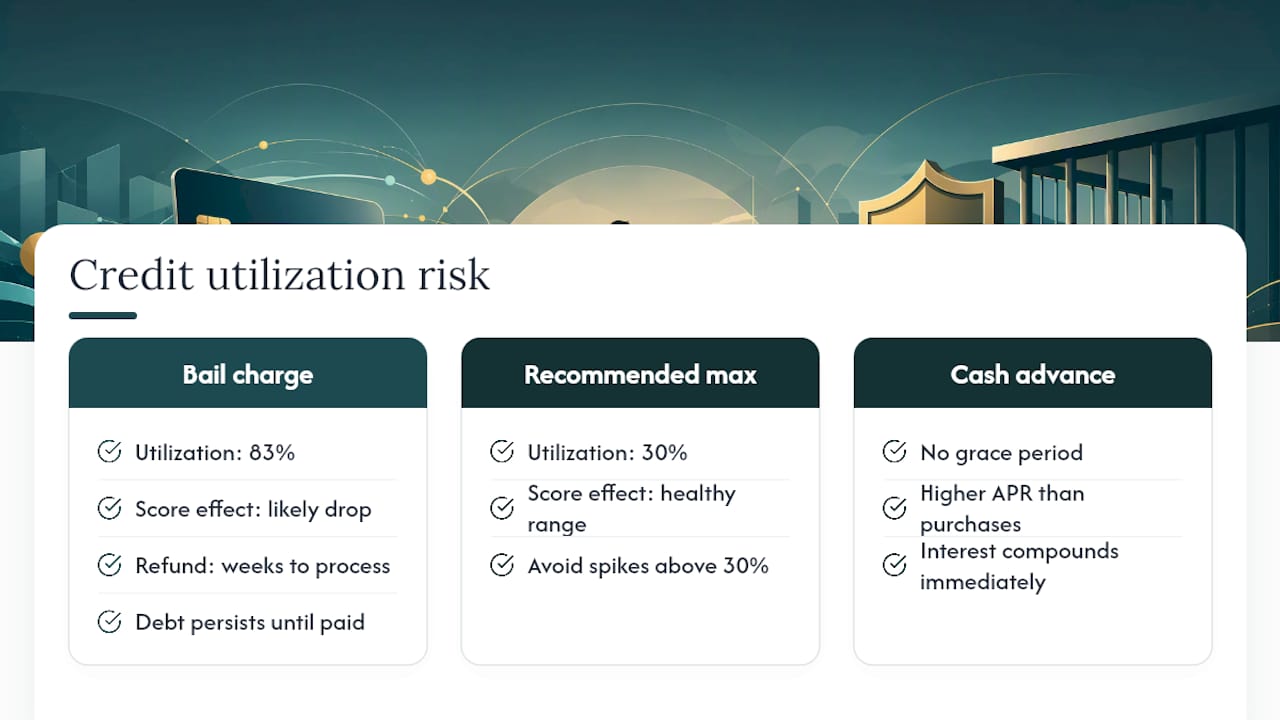
There’s also the practical debt question. A large bail charge doesn’t disappear when the case resolves. If you paid the court directly and eventually get a refund, that money can pay down the card, but only after the court processes it, which can take weeks. In the meantime, minimum payments and accruing interest are your responsibility regardless of the case outcome. If you paid a bondsman’s premium, there’s no refund coming at all, so that portion of the debt is permanent from day one.
None of this means a credit card is the wrong choice. For many families it’s the fastest way to secure someone’s release when a loved one is sitting in a cell. It does mean treating the decision like the financial commitment it is: know the fee, know the interest terms, and have a repayment plan before you authorize the charge, not after.
What the Law Says About Credit Card Bail by Jurisdiction
Whether a facility can accept your card at all comes down to local and sometimes judge-specific rules, not a nationwide standard.
Some jurisdictions permit credit card payments for bail only when a judge has explicitly authorized that method for a given case, a distinction Legal Aid NYC points out in its explanation of bail procedures. Other counties leave the decision entirely to the sheriff’s department, which sets its own accepted payment channels independent of any specific judge’s order.
Bail bondsman premiums are a different regulatory animal. In many states, the premium rate a bondsman can legally charge is set or capped by state insurance regulators, commonly landing around 10% of the total bail. That means a bondsman advertising a dramatically lower rate, without approved credit or another qualifying condition, may be operating outside standard practice for that state, and it’s worth asking directly how the rate is structured.
Card network rules add another layer. Visa, Mastercard, and other networks have historically scrutinized bail-related transactions because of chargeback risk, and some processors classify bail payments under specific merchant category codes that can affect which cards are accepted or whether rewards points apply.
Because these rules shift by state, county, and sometimes by individual court, there’s no universal answer to “can I use my credit card here.” The only reliable move is checking the specific jail or court’s own payment page, or asking a licensed local bondsman directly, before assuming your card will work the way it did somewhere else.
How to Choose a Bail Bondsman Who Takes Credit Cards
Not every bondsman who accepts cards operates the same way, and the differences matter more once real money is on the line.
Start with licensing. A legitimate bondsman is licensed in the state where they’re posting bond, and that license should be verifiable through the state’s department of insurance or equivalent regulator. Ask directly, and be wary of anyone reluctant to confirm it.
Get the fee breakdown in writing before you authorize any card charge. A trustworthy agent will tell you the exact premium percentage, whether there’s an additional card processing surcharge, and whether collateral is required, before you hand over card details, not after. If a bondsman quotes a premium well below the typical 10% many states use as a benchmark with no explanation, treat that as a reason to ask more questions, not a reason to celebrate.
Red flags include pressure to pay immediately without explaining terms, refusal to provide a written agreement, requests for payment through unusual channels like gift cards or wire transfers, and vague answers about collateral requirements. A bondsman offering flexible plans, such as 1% or 2% options with approved credit, should be able to explain exactly what “approved credit” means and what happens if a payment is missed.
Availability counts too. Arrests don’t happen on a schedule, so a bondsman offering 24/7 bilingual support removes one more obstacle when you’re already dealing with enough stress.
What Bail Agents Wish Families Knew Before Paying
The most common mistake isn’t a bad decision, it’s a rushed one. Families often skip calling the jail’s payments line first, then discover mid-transaction that the facility doesn’t take cards at all, forcing a scramble for cash under time pressure. A close second: reaching for a cash advance out of panic when a standard card purchase would have worked fine and cost far less in interest.
Ask any experienced agent for a written fee breakdown before you authorize a charge. Ask whether splitting payment across two cards is possible. Ask how long processing actually takes, since “immediate release” claims vary more than families expect once paperwork and facility backlogs enter the picture.
— Jake
How The Bail Network Can Help Right Now
If a credit card at the jail didn’t pan out or the fees didn’t make sense, Thebailnetwork is a direct next step: a licensed bail agent network built specifically around flexible payment, not a one-size-fits-all card charge. Thebailnetwork offers 1% bail bonds and 2% bail bonds with approved credit, backed by bilingual agents available 24/7 across Southern California, so you’re not stuck waiting on hold during the worst hours of the night.
Before you call, have three things ready: the inmate’s full name, the booking number, and the bail amount from the jail’s records. Thebailnetwork’s agents will walk you through your payment options, including how bail bond payments work and what a full fee breakdown looks like before you authorize anything. Every premium is nonrefundable by law, and a straightforward agent will say so upfront rather than burying it in paperwork. Reach out through Thebailnetwork’s site to get a clear quote and start the release process today.
Where to Verify Local Bail Payment Rules
Local rules override anything a general guide can tell you, so confirm with the source that governs your case.
- Your county sheriff’s or court’s official “pay bail” page (search “[county name] sheriff pay bail”)
- The local court’s published bail schedule, often posted as a PDF like San Diego’s bail schedule
- Any third-party processor named on the facility’s page, checked for its own fee disclosure
This article is general information, not a substitute for advice from a qualified lawyer. Consult a qualified legal professional about your own circumstances before acting on anything here.
Sources
- County of Milwaukee | Pay Bail
- What You Need to Know About Bail — Legal Aid NYC
- Can You Pay Bail By Credit Card? — Schwartz Cohen
- Four types of bail: Cash, surety, ROR & property — LegalClarity
- San Diego County bail schedule (example)
FAQ
Can a Credit Card Be Used for Bail?
Yes, in many places, either by paying the court or jail directly when the facility allows it, or by paying a bail bondsman’s premium with a card. Acceptance and fees vary by county, so checking the specific jail’s payment page is the only way to know for certain.
How Much Is a $1,000 Bail Bond?
If you pay a bondsman rather than the full cash bail, the nonrefundable premium is commonly around 10% of the bail in many states. Rates can vary by state regulation and by whether a program like Thebailnetwork’s 1% or 2% approved credit options applies.
What Happens if I Cannot Afford Bail?
Options include a surety bond through a licensed bondsman (paying only a percentage as premium), a property bond using real estate as collateral, or release on own recognizance if a judge approves it. Many bondsmen, including Thebailnetwork, also offer payment plans and split-payment arrangements for families who can’t cover a lump sum.
Is $10,000 a Lot for Bail?
It’s a mid-to-high range amount that reflects the severity of the charge, and paying it directly with a card could add 3% to 10% in processing fees, or $300 to $1,000 on top of the bail. Going through a bondsman instead typically means paying a nonrefundable premium of around 10%, or roughly $1,000, without financing the full amount yourself.