
48 Hour Holds: Comply With and Modify Domestic Violence Bail Conditions
If you’re facing a domestic violence charge, expect bail conditions that go far beyond a simple check-in requirement: no-contact orders, a stay-away radius from your home or workplace, firearm surrender, and sometimes electronic monitoring. Judges set these based on documented risk to the alleged victim, not just the charge itself. Your most urgent move is twofold: hire counsel immediately and arrange bond fast, because a single violation, even an accidental one, can mean re-arrest before your case ever gets a hearing.
TL;DR:
- Bail conditions often include multiple restrictions such as no-contact orders, exclusion zones, firearm surrender, and electronic monitoring, each with compliance risks.
- Judges base bail decisions on documented risk factors like prior history, severity of allegations, and evidence of threats, often within a 48-hour window before finalizing conditions.
- Violating bail conditions usually results in immediate arrest and potential forfeiture of posted bond or monitoring fees, emphasizing strict adherence and prompt legal action.
- Challenging or modifying bail terms requires filing specific motions, providing evidence of stability, and proposing alternatives that prioritize safety and compliance.
- Federal and state laws enforce these conditions over civil protective orders if conflicts arise, and proper legal guidance is essential to navigate enforcement and modifications.
Table of Contents
- Common Domestic Violence Bail Conditions Explained
- How Judges Decide Bail in Domestic Violence Cases
- The Bail Hearing Timeline: Holds, Review, and What Happens First
- Bail Conditions vs. Protective Orders: Which One Controls?
- How to Challenge or Modify Bail Conditions: A Step-by-Step Roadmap
- Consequences of Breaching Bail Conditions
- Staying Compliant: A Practical Checklist
- What Years in the Bail Business Teach You About These Cases
- Fast, Flexible Bail Support When You Need It Most
- Where to Verify These Bail Rules
- Sources
Common Domestic Violence Bail Conditions Explained
Domestic violence bail conditions almost never come as a single restriction. Courts typically stack several at once, and each carries its own compliance risk.
- No-contact orders: These block direct and indirect contact, including calls, texts, social media messages, and even relaying messages through mutual friends or family.
- Exclusion zones: A judge can bar you from your own home, workplace, or your children’s school, sometimes with a specific radius measured in feet or blocks.
- Firearm surrender: Federal and state law generally require defendants to surrender weapons to police or a licensed dealer, with a receipt filed as proof of compliance.
- Electronic monitoring: GPS ankle monitors track location in real time, and defendants typically pay the daily monitoring fee themselves, sometimes for months.
- Substance testing: Random alcohol or drug screening, and occasionally mandatory enrollment in a treatment or batterer intervention program.
- Reporting and curfews: Regular check-ins with a pretrial officer, home detention windows, or a strict curfew tied to the exclusion order.
Financial bail, whether cash or a surety bond, runs parallel to these conditions. Posting bond gets you out of custody. It does not erase a single one of the safety conditions attached to your release.
How Judges Decide Bail in Domestic Violence Cases
Judges lean heavily on documented risk indicators rather than gut instinct. Police reports, medical records from the alleged incident, and any prior protective orders all factor into the decision, along with your criminal history and record of appearing for past court dates.
Severity matters enormously. Allegations involving a weapon, strangulation, or visible injury push judges toward stricter conditions or even bail denial. Some jurisdictions build this weighting directly into statute.
North Carolina’s domestic violence bail statute, § 15A-534.1, requires judges to weigh criminal history and victim safety before setting release terms, and allows courts to hold a defendant for up to 48 hours while sorting out appropriate conditions like stay-away orders or alcohol monitoring. That 48-hour window is not arbitrary. It gives the court time to gather safety information before finalizing terms.
Similar statutory frameworks exist elsewhere. A CNMI statute lists factors like the nature of the offense, weight of the evidence, and family ties, and mandates that courts issue written conditions and notify both law enforcement and the victim. The specific statute varies by state or country, but the underlying logic rarely does: worse alleged conduct plus higher escalation risk equals tighter conditions. For a deeper look at how these factors translate into dollar amounts, see how judges decide bail amounts.
The Bail Hearing Timeline: Holds, Review, and What Happens First
Many jurisdictions impose a mandatory holding period, often in the range of 12 to 48 hours, before a defendant sees a judge in a domestic violence case. This delay exists specifically to let officers and prosecutors gather safety information rather than rushing a release that could put the alleged victim at risk.
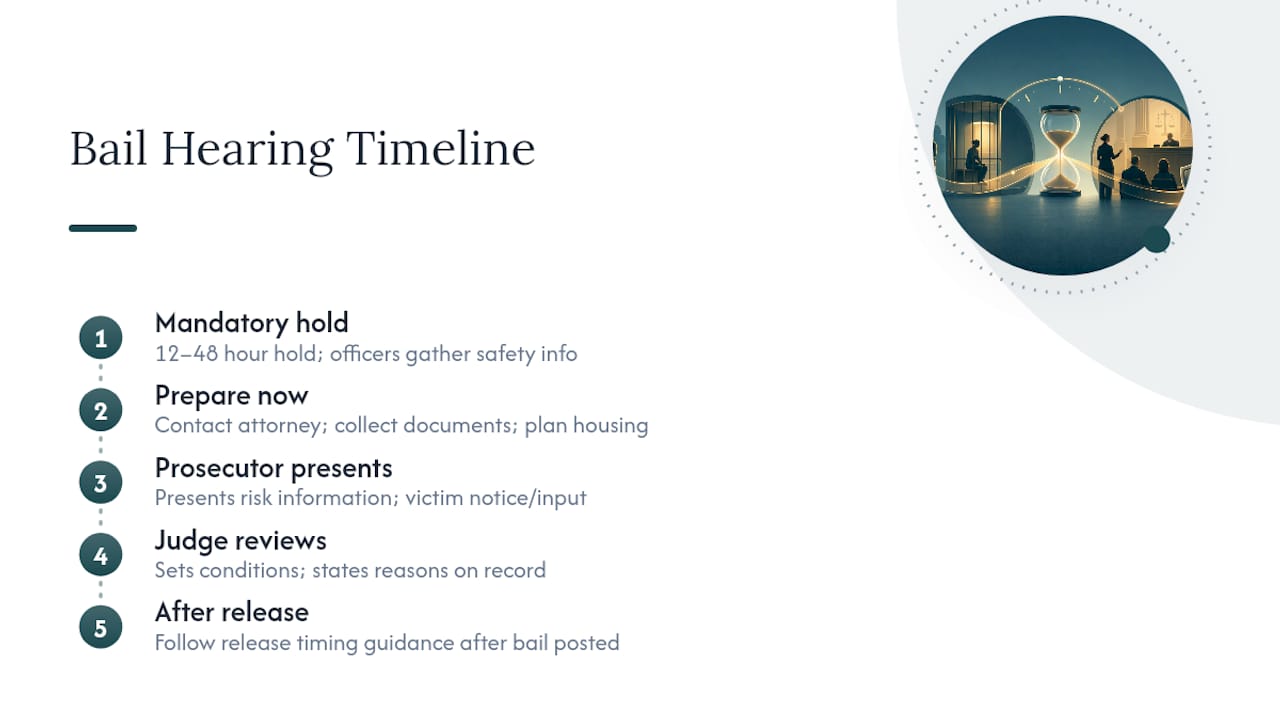
At the hearing itself, the prosecutor typically presents risk information, and in many jurisdictions the victim has a right to notice and input on proposed conditions. The judge then sets conditions and, under frameworks like Michigan’s benchbook guidance, must state the reasoning behind any custodial decision on the record.
Before that hearing, three things matter most: contact a defense attorney immediately, gather documents that support stability (proof of address, employment records, treatment enrollment if relevant), and start planning for alternate housing now if exclusion from your home looks likely. Waiting until after the hearing to figure out logistics wastes time you don’t have. Learn more about what happens once release is granted in this guide to release timing after bail is posted.
Bail Conditions vs. Protective Orders: Which One Controls?
Criminal bail conditions and civil protective orders can overlap, and when they conflict, courts generally enforce whichever term is most restrictive. If your bail order allows supervised contact for a custody exchange but a protective order bars all contact, the protective order wins.
Courts are required to put these conditions in writing and distribute them to law enforcement, the prosecutor, and the victim, which is why written bail orders and victim notification show up consistently across state statutes. If you’re unsure which order governs a specific situation, especially around children, don’t guess. Ask your attorney to seek clarification from the court immediately, and document every attempt you make to arrange safe, lawful contact through proper channels rather than improvising.
How to Challenge or Modify Bail Conditions: A Step-by-Step Roadmap
Bail conditions aren’t set in stone. Courts modify them regularly when a defendant presents the right evidence in the right format.
- File the correct motion. An emergency motion applies when conditions create an urgent hardship (no housing, lost job access). A standard motion to modify works for less time-sensitive requests, like loosening an overly broad no-contact clause.
- Build your evidence file. Proof of stable housing, current employment, clean drug or alcohol tests, and enrollment in a treatment program all carry weight. A clean record of compliance since release strengthens the request further.
- Propose a workable alternative, not just a removal. Judges respond better to solutions that preserve safety, like supervised contact for custody exchanges, a third-party intermediary for communication, or GPS monitoring in place of a full exclusion zone.
- Let counsel argue the specifics. Prosecutors often push back with updated risk assessments, and a defense attorney who frames the request around verifiable stability tends to fare better than one who simply asks for less restriction.
Courts weigh escalation history, including prior protective orders or injuries, more heavily in domestic violence cases than in other criminal matters. Verifiable stability evidence, not just a promise to behave, is what actually moves a judge.
Consequences of Breaching Bail Conditions
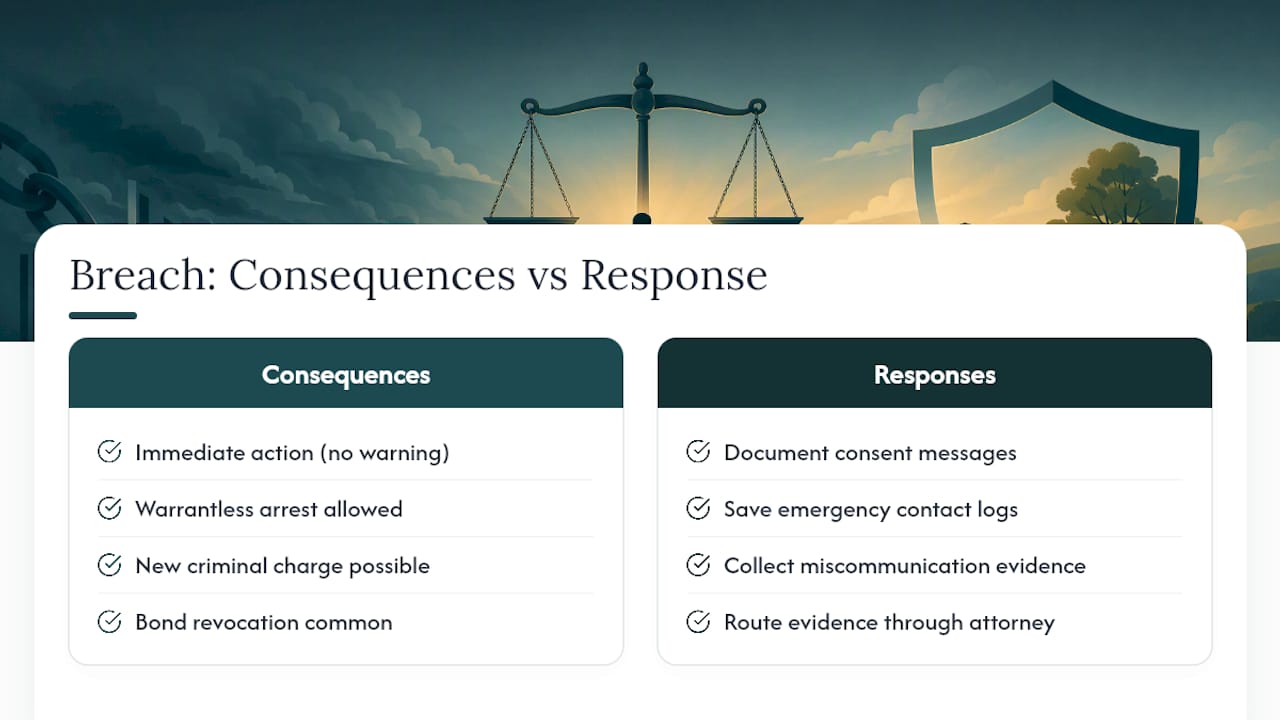
Violating a no-contact order or exclusion zone in a domestic violence case usually triggers immediate consequences, not a warning. Many jurisdictions permit warrantless arrest the moment officers have reasonable suspicion of a violation of pretrial release conditions, and that arrest can come with an entirely new charge on top of the original one.
Bond revocation is common, and any money posted can be forfeited depending on the circumstances. Monitoring fees don’t stop just because you’re back in custody, either.
If you’re accused of a breach you didn’t intend, document everything: consent messages, emergency contact logs, or evidence of miscommunication. Route this through your attorney rather than contacting the alleged victim directly to “clear things up.” Request an emergency hearing as soon as possible. Judges respond to concrete evidence far faster than explanations offered after the fact.
Staying Compliant: A Practical Checklist
Small habits prevent big problems. Keep a dated log of where you go and who you’re in contact with, especially anyone connected to the case. Save every receipt tied to monitoring fees or treatment attendance since courts often ask for proof of ongoing compliance during a review hearing.
If children are involved, route all communication through counsel or a court-approved intermediary rather than direct contact. Excluded from your home? Document your alternate housing arrangement and any temporary custody plan in writing, dated as you go.
Pro Tip: When negotiating conditions with the court, push for narrow, specific language, an exact address and time window, rather than an open-ended prohibition. Vague terms create more disputes over alleged violations than tight, specific ones ever do.
What Years in the Bail Business Teach You About These Cases
Posting a bond gets someone out of custody fast. It does not touch a single condition a judge has already ordered for the alleged victim’s safety, and clients sometimes conflate the two, expecting a bond agent to negotiate a no-contact order down. That’s not how it works.
The most common confusion involves monitoring costs. Families are often surprised the daily GPS fee falls on the defendant, not the court, and that it continues regardless of case outcome until a judge says otherwise. Coordinating a fast bond with equally fast legal counsel is what actually reduces the odds of an accidental violation in that first shaky week.
— Jake
Fast, Flexible Bail Support When You Need It Most
Thebailnetwork gets you out of custody quickly so you can focus on the legal fight that actually changes your conditions. Our bilingual agents work 24/7 across Southern California, and our flexible payment plans start at 1% down with approved credit, which matters when you’re already facing monitoring fees and legal costs on top of bond.
One thing worth saying plainly: Thebailnetwork posts the bond, but we cannot remove or change a judge’s conditions. That part is entirely up to your attorney and the court. What we can do is get your family member home fast, use our inmate locator to find them if you’re not sure where they’re being held, and walk you through the bond process so you’re not guessing at the worst moment. If you need help posting bond right now, start with Thebailnetwork and let us handle the logistics while you focus on lining up counsel.
Where to Verify These Bail Rules
For the exact statutory language behind these conditions, review North Carolina’s § 15A-534.1, Michigan’s pretrial release benchbook, and England and Wales bail guidance. Rules vary by jurisdiction, so confirm local court rules before filing a motion, and consult an attorney for case-specific guidance.
This article is general information, not a substitute for advice from a qualified lawyer. Consult a qualified legal professional about your own circumstances before acting on anything here.
Sources
- What are the rules for bail for domestic abuse cases? (UKLegalGuides)
- § 15A-534.1. Crimes of domestic violence; bail and pretrial release. (UNC SOG excerpt)
- Pretrial release and conditions (Michigan benchbook)
- Can you bond out on a domestic violence charge? (LegalClarity)