
Get Someone Out Fast: 4 Domestic Violence Bail Options by State

Yes, most people arrested for domestic violence can seek bail, but expect delays a typical arrest doesn’t carry. Misdemeanor bail often runs in the low thousands; felony bail commonly starts higher and climbs from there depending on injuries, weapons, and prior history. Many states also impose mandatory holds or require a judge, not a clerk, to set the amount, which slows everything down.
TL;DR:
- Bail in domestic violence cases is typically decided by a judge and considers factors like injury severity, weapon involvement, prior history, and community ties.
- Mandatory holds and judge review periods, often lasting several hours, are the main delays in posting bail rather than the bail amount itself.
- Court conditions usually include no-contact orders and monitored visits, with fees for monitoring often paid by the defendant, not the court.
- The most effective strategy is to gather booking details, confirm bail status, and contact a bondsman promptly, focusing on hold periods over the bail sum.
- State laws vary, with some requiring victim notification and extended review times, making legal advice and timely action crucial.
Table of Contents
- What Are Your Domestic Violence Bail Options?
- Who Decides Domestic Violence Bail Amounts?
- How Long Before You Can Post Bail?
- What Conditions Come With Release?
- How Do You Post Bail Quickly?
- What If Bail Is Denied or Too High?
- How Does Domestic Violence Bail Vary by State?
- How Thebailnetwork Helps Families Move Fast
- What Nobody Tells You About Domestic Violence Bail
- Get Help Posting Bail Right Now
- Where to Verify These Rules
- Sources
What Are Your Domestic Violence Bail Options?
Once a judge sets an amount, families generally choose between four paths, each with different speed and cost trade-offs.
- Cash bail: Pay the full amount directly to the court. You get it back (minus fees) when the case resolves, but few families have $25,000 sitting in a bank account on a Tuesday night.
- Surety bond: A bail bondsman posts the full amount for a nonrefundable premium, typically a percentage of the total, sometimes backed by collateral. This is the route most families actually use because it doesn’t require the full sum upfront.
- Property bond: You pledge real estate equity instead of cash. Courts need to verify that equity, sometimes with an appraisal, so this option almost always takes longer than cash or surety.
- Own-recognizance (OR) release: No money changes hands. Judges reserve this for low-risk defendants, and it’s uncommon in domestic violence cases specifically because of the safety concerns involved.
Whichever route you pick, budget for recurring costs too. Electronic monitoring and program fees usually land on the defendant, not the court, and they don’t stop once you’re out.
Who Decides Domestic Violence Bail Amounts?
A judge sets bail in nearly every domestic violence case, not a bail schedule or a booking officer. That distinction matters because judges weigh factors a standard bail chart never captures: the nature of the offense, whether there were injuries or a weapon, the defendant’s criminal history, flight risk, ties to the community, and specifically any prior domestic violence incidents involving the same victim.
- Severity of alleged injuries and whether a weapon was involved
- Criminal history, especially prior domestic violence charges or restraining order violations
- Flight risk and community ties (job, family, housing stability)
- Victim statements and prosecutor recommendations at the hearing
Ohio Revised Code §2919.251 requires judicial review in domestic violence cases and specifically lists factors like history of domestic violence and mental health that the court must weigh. North Carolina’s §15A-534.1 similarly directs a judge, not a magistrate or clerk, to set conditions in many domestic violence cases. If you want a deeper breakdown of how judges weigh these variables, how a judge decides bail amounts walks through the reasoning in more detail.
How Long Before You Can Post Bail?
Booking doesn’t mean bail is available immediately. Many states build in a mandatory cooling-off period before anyone, including a bondsman, can act.
- Massachusetts generally bars bail admission sooner than six hours after arrest for certain domestic-violence-related offenses, unless a judge authorizes earlier release in open court, according to Section 42A.
- California commonly applies a similar hold window under its penal code provisions covering domestic-violence-related offenses, though exact hours vary by county.
- Arraignment typically happens within 24 to 48 hours of arrest, excluding weekends and holidays, which can stretch a Friday night arrest into a Monday morning hearing.
The clock starts at booking, not the moment of arrest, so a late-night arrest with a delayed booking process can push your hold window further than you’d expect.
What Conditions Come With Release?
Getting out on bail rarely means walking away clean. Courts attach conditions specifically designed around victim safety, and violating any of them can send you straight back to custody.
- No-contact or stay-away orders barring communication with the alleged victim
- Supervised or restricted visitation rules if children are involved
- Mandatory surrender of firearms
- Electronic monitoring, sometimes paired with sobriety monitoring
These aren’t suggestions. Courts enforce them strictly, and monitoring or program fees typically fall on the defendant to pay out of pocket, with nonpayment risking revocation of release. Michigan’s benchbook guidance on pretrial release and bail makes clear that courts must state reasons for conditions on the record, which shows how deliberately these terms get structured.
Pro Tip: Never coordinate custody exchanges or property pickups directly with the protected party, even for something that feels routine. Route everything through an attorney or a neutral third party. One accidental text can violate a no-contact order and undo the entire release.
How Do You Post Bail Quickly?
Speed comes down to having the right information ready before you make a single call.
- Confirm the exact charges and bail amount at the booking desk, and ask directly whether a mandatory hold applies and when the bail hearing is scheduled.
- Call a bail bondsman with the booking number, the defendant’s full name, arrest location, and any outstanding warrant information on hand. Ask what premium percentage and collateral they require upfront.
- Choose your bond type based on urgency. Cash and surety bonds move fastest once the hold expires; property bonds take longer because courts need to verify equity, sometimes through an appraisal.
- Track the release window. Even after a bondsman posts, expect an administrative processing delay before the jail physically releases the defendant. Details on typical timing after posting are covered in how long after bail is posted you’re released.
Pro Tip: Some bondsmen won’t initiate paperwork until a mandatory hold has already expired, even though they can post the bond the same day. Ask upfront whether they’re waiting on the hold or actively working your case.
What If Bail Is Denied or Too High?
A denial or an unaffordable amount isn’t necessarily the end of the road. Most courts allow a motion for bail reconsideration or a bail review hearing, though timing depends heavily on the local court’s calendar.
- Ask your attorney to file for a bail review as soon as possible after the initial hearing.
- Bring concrete evidence to the hearing: steady employment, stable housing, enrollment in a treatment or counseling program, and character letters from the community all carry weight.
- A clean record with no prior domestic violence history strengthens the request significantly.
- If the court denies reconsideration, extended custody becomes likely until trial or a plea, and emergency motions are the only short-term remedy available.
A well-documented motion showing real ties to the community tends to move judges more than an argument about financial hardship alone.
How Does Domestic Violence Bail Vary by State?
Statutes differ enough from state to state that a rule you read about in one place may not apply where your case is happening.
| State | Statute | Key Provision |
|---|---|---|
| Massachusetts | Gen. Laws ch. 276 §42A | Six-hour minimum hold before bail admission; victim notification required |
| Ohio | Rev. Code §2919.251 | Judge-determined bail; must weigh domestic violence history and mental health |
| North Carolina | §15A-534.1 | Judge, not magistrate, sets conditions; allows monitoring and stay-away orders |
| Minnesota | Stat. § 629.72 | Judicial review required; victim must be notified of release review |
Michigan’s benchbook guidance echoes the same theme: courts must document their reasoning when ordering money bail or conditions in domestic violence cases, per pretrial release guidance. Some states have moved toward risk-based pretrial systems that reduce reliance on cash bail altogether, but domestic violence cases are frequently carved out as exceptions specifically because of the safety concerns tied to release. For a broader look at how amounts get calculated across different scenarios, how much bail costs for domestic abuse breaks down the variables in more depth.
How Thebailnetwork Helps Families Move Fast
A bail bonds service operates 24/7 with bilingual agents and offers inmate-locator support to help families locate loved ones in custody.
Before calling, have the booking number, the defendant’s full legal name, and the arresting agency or jail location ready. This step can help speed processing time.
| What Matters Most | Why It Speeds Release |
|---|---|
| Booking number | Confirms exact charges and jail location instantly |
| Bilingual access | Avoid waiting for business hours or translation delays |
| Payment options | Can help avoid the full-cash barrier that stalls some families |
What Nobody Tells You About Domestic Violence Bail
The conventional advice treats domestic violence bail like a math problem: know the range, bring the money, get released. That’s incomplete. The real bottleneck isn’t the dollar amount, it’s the mandatory hold and judge-review requirement that statutes like Ohio’s §2919.251 and North Carolina’s §15A-534.1 build in specifically for these cases. You can have the full bond amount in hand and still sit in custody for hours because a judge hasn’t reviewed the file yet.
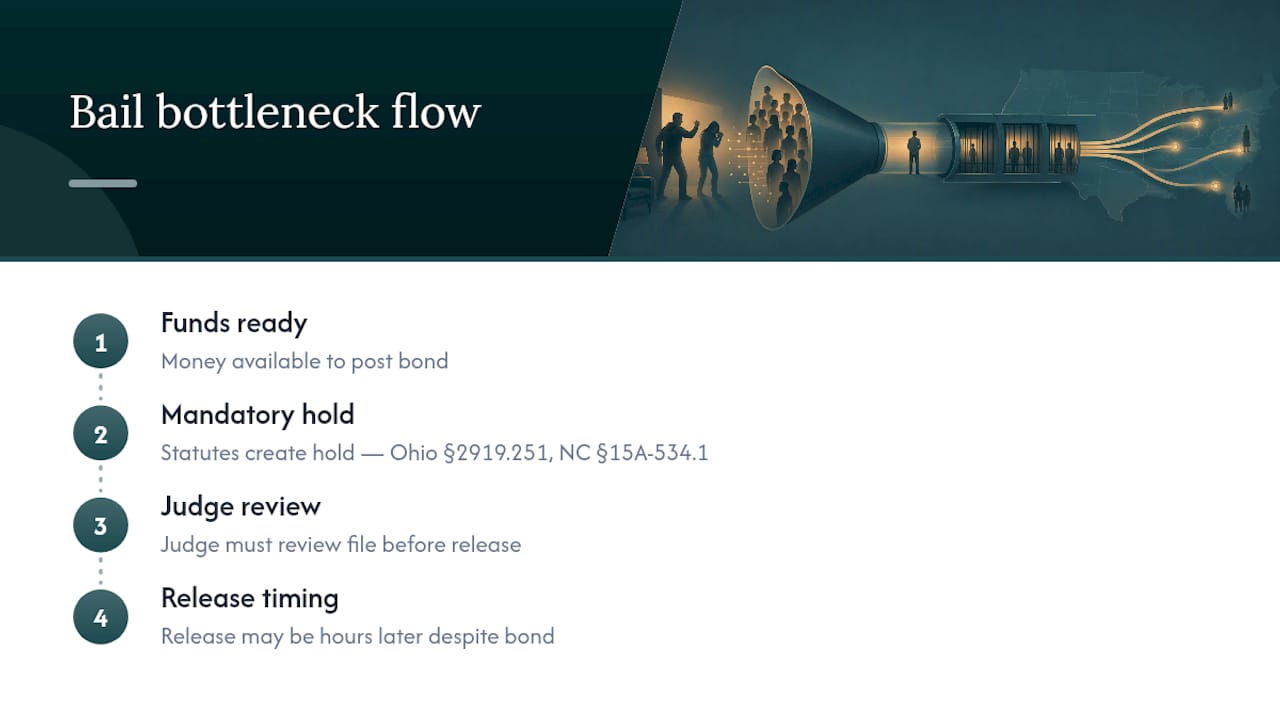
What gets underrated is how much victim-safety review shapes the entire timeline, not just the final conditions. Families fixate on the bail number when they should be asking about the hold window and hearing schedule first. That’s the actual variable that determines whether someone comes home tonight or Monday morning.
My take: prioritize information over money in the first hour. Get the booking number, ask about the hold, and call a bondsman who already knows your state’s specific rules. The premium matters less than picking someone who won’t waste your first six hours guessing.
— Jake
Get Help Posting Bail Right Now
A bail bonds service assists families with navigating mandatory holds, judge review, and the urgency of finding cash quickly. Its bilingual agents are available 24/7, and it offers inmate-locator support to simplify finding where a loved one is being held.
If you’re ready to move, Thebailnetwork is the fastest place to start a case, day or night. For details on how premiums and collateral work before you commit, read through how you pay for a bail bond, which lays out the payment structure in plain terms. One thing to know upfront: bondsman premiums are nonrefundable, regardless of how the case resolves, so ask about your exact payment plan and total cost before signing anything. Call now or start the conversation online, either way, the sooner you call, the sooner the clock starts moving in your favor.
Where to Verify These Rules
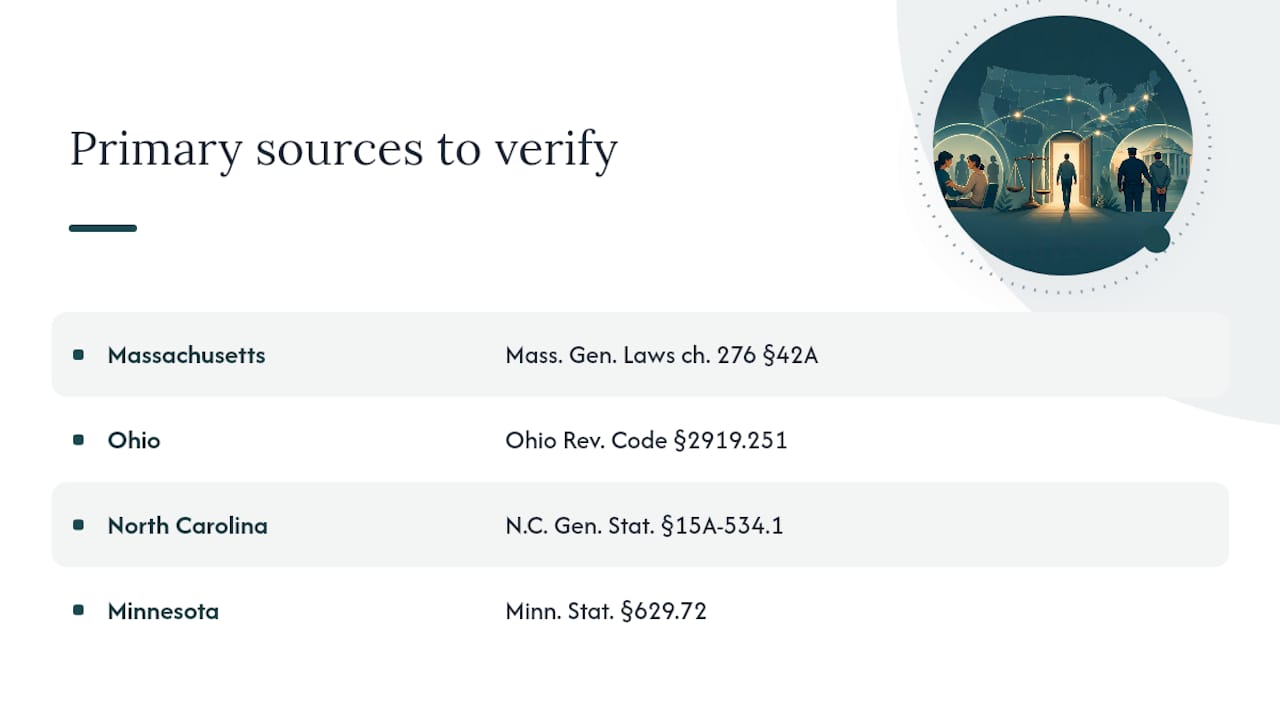
Check these primary sources directly, since statutes get amended and local court rules can add extra steps: Mass. Gen. Laws ch. 276 §42A covers bail timing and safety terms in Massachusetts. Ohio Rev. Code §2919.251 outlines judicial review factors in Ohio. North Carolina §15A-534.1 and Minnesota Stat. § 629.72 detail similar judge-led review and victim-notification rules. Confirm current text with your local court or an attorney before relying on any of it for a live case.
This article is general information, not a substitute for advice from a qualified lawyer. Consult a qualified legal professional about your own circumstances before acting on anything here.
Sources
- Section 42A: Bail or personal recognizance; terms and conditions to protect persons suffering physical abuse
- Section 2919.251 | Bail in certain domestic violence cases.
- § 15A-534.1. Crimes of domestic violence; bail and pretrial release.
- Pretrial release and bail: Michigan benchbook excerpt
- Minn. Stat. § 629.72 — Bail; domestic abuse and related provisions