
$500–$2,500 Typical DUI Bail Amounts in California: What to Do Now
Most first-time misdemeanor DUI arrests carry bail between $500 and $2,500, though FindLaw’s overview of DUI bail practices notes that felony DUI, injury crashes, or prior convictions can push that figure into the tens of thousands. The exact number comes from your county’s bail schedule and the judge’s read of your risk. Your first move should be calling an attorney or a licensed bail agent within the hour, not waiting to see what happens.
TL;DR:
- Bail amounts for first-time misdemeanor DUI typically range from $500 to $2,500, but can be higher if aggravating factors like injury or high BAC are present.
- Repeat DUI offenses can result in bail from $2,000 to over $15,000, with felony or injury cases reaching tens of thousands or more.
- Judges consider BAC, injury, prior convictions, and community ties when adjusting bail, with strong local ties potentially reducing or waiving it.
- Payment options include full cash, bail bonds with around 10% premium, or property collateral, with bonds often offering faster release.
- Missed court dates can lead to forfeiture of bail, ongoing warrants, and liability for co-signers, requiring immediate legal action to mitigate consequences.
Table of Contents
- What Determines Your DUI Bail Amount
- Typical DUI Bail Amounts by Charge Level
- Factors That Push Your DUI Bail Higher or Lower
- How to Pay DUI Bail: Cash, Bonds, and Property
- How to Get DUI Bail Reduced or Waived
- What Happens If You Miss Court or Bail Is Forfeited
- What The Bail Network Brings to a DUI Bail Situation
- Getting Someone Out Fast After a DUI Arrest
- Sources
What Determines Your DUI Bail Amount
Bail is the amount of money (or its equivalent) posted to guarantee you’ll show up for future court dates. It’s separate from release conditions like ignition interlock requirements or travel restrictions, which a judge can attach on top of whatever bail is set.
Every county keeps a bail schedule, a preset list of dollar amounts tied to specific charges. When you’re booked on a DUI, the arresting officer or jail staff usually consults that schedule to find your starting figure. It’s a baseline, not a final answer.
From there, judges have real discretion. Some jurisdictions layer in a risk-assessment tool, others rely purely on the judge’s read of the police report and your criminal history at arraignment. A judge can raise the scheduled amount, lower it, or waive bail entirely.
That last option matters more than most people realize. According to FindLaw, many first-time misdemeanor DUI arrests end in cite-and-release or release on your own recognizance (OR), meaning you walk out with a promise to appear instead of a payment. Whether that happens usually depends on:
- Whether you have prior arrests or convictions on your record
- Whether anyone was hurt or a passenger was a minor
- Your blood alcohol content at the time of arrest
- Whether the arresting officer had a safe way to release you (a sober ride home, for instance)
Quick fact: Bail schedules are published, public documents. If you know your county, you can often look up the starting number for your exact charge before you ever talk to an attorney.
Typical DUI Bail Amounts by Charge Level
Numbers vary by county, but three tiers show up consistently across jurisdictions.
First-time misdemeanor DUI: Commonly $500 to $2,500, according to FindLaw. Some counties set it as low as a few hundred dollars if there’s no aggravating circumstance attached.
Repeat offenses: Bail schedules add increments for each prior. A second or third DUI within a set lookback period (often 7 to 10 years, depending on the state) can land bail anywhere from $2,000 to $15,000 or more.
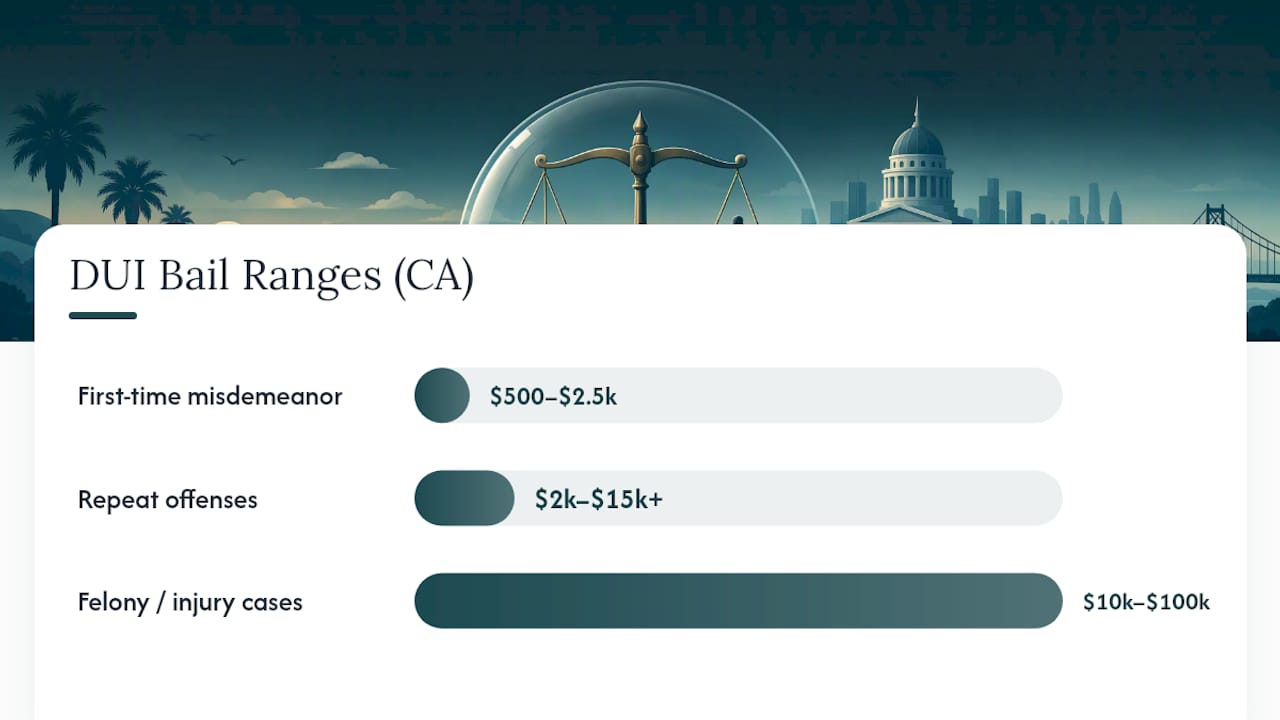
Felony DUI and injury cases: Once someone is hurt, a child was in the car, or it’s a fourth-plus offense charged as a felony, bail can reach tens of thousands of dollars, and six figures isn’t rare in serious injury cases.
The Santa Clara County criminal bail schedule is a good illustration of how this actually works on paper. It lists a base bail figure for a standard DUI charge, then adds specific dollar increments for high BAC readings and prior convictions, with combinations of aggravating factors capable of pushing the total toward $100,000.
- Base misdemeanor DUI charge: schedule starting point (varies by county)
- Add for each qualifying prior conviction: a fixed dollar increment
- Add for elevated BAC thresholds: another fixed increment
- Combine several aggravating factors: total can approach $100,000 in extreme cases
Not every state handles this the same way. DUI.org points out that Florida uses a uniform statewide bond schedule, while California and many other states leave it to individual counties. A handful of states have also moved away from cash bail entirely for lower-level offenses, replacing it with pretrial supervision. None of this is universal, so the county where you were booked is the only number that actually applies to you.
Factors That Push Your DUI Bail Higher or Lower
Judges and prosecutors weigh a short list of details, and knowing which ones apply to your arrest tells you roughly where you’ll land on the schedule.
- Blood alcohol content. A BAC well above the legal limit (say, 0.15% or higher) typically triggers an automatic increase under most county schedules.
- Collision or injury. Any accident, even a minor one, moves your case toward the higher end of the range, and injury to another person can push it into felony territory.
- A child passenger. Driving under the influence with a minor in the car is treated as a distinct aggravating factor almost everywhere, often with its own line item on the bail schedule.
- Prior DUI convictions. Each prior adds a set dollar amount, and enough of them can reclassify the charge as a felony outright.
- Refusal to take a chemical test. Refusal often carries its own bail increase separate from the underlying DUI charge.
- Ties to the community. Steady employment, a lease or mortgage in the area, and family nearby all work in your favor when a judge is deciding whether you’re a flight risk.
Pro Tip: Bring documentation of your job and address to arraignment even if you think it’s obvious. Judges move fast, and a pay stub or lease in hand does more than a verbal assurance from the defense table.
How to Pay DUI Bail: Cash, Bonds, and Property
You generally have three ways to get someone out: pay the full amount in cash, use a bail bond, or put up property as collateral.
Paying cash means you hand over the entire bail amount to the court, and you get it back (minus court fees) once the case resolves, assuming all court dates are met. Most families don’t have several thousand dollars sitting available, which is where bail bonds come in.
A bail bond works through a licensed agent who posts the full amount on your behalf in exchange for a nonrefundable premium, commonly around 10% of the total bail in many states, according to LegalClarity’s breakdown of California bail costs. That premium is the agent’s fee for taking on the risk. You don’t get it back, but it’s a fraction of what full cash bail would cost.
- Cash bail: full amount required upfront, refundable if all court dates are met
- Bail bond: pay roughly 10% as a nonrefundable premium, agent covers the rest
- Property bond: pledge real estate equity as collateral instead of cash
- Payment plans: some agents finance the premium over time for approved applicants
Property bonds involve pledging home equity or other real estate as collateral instead of cash. They require appraisal paperwork and a lien process, so they take longer to arrange than a standard bond, which matters when someone is sitting in a cell.
The fastest practical path: use the county jail’s inmate locator to confirm booking and charges, then contact either the court clerk for exact bail figures or a licensed bail bond agent about payment options who can walk you through what paperwork and financing are available. Many agents offer structured payment plans so the premium doesn’t have to be paid in one lump sum.
How to Get DUI Bail Reduced or Waived
Bail isn’t fixed once it’s set. You (or more realistically, your attorney) can push back on it at multiple points.
- Arraignment is your first shot. This is usually within 48 to 72 hours of arrest. Bring proof of employment, a lease or mortgage statement, and any evidence of family ties in the area.
- Your attorney argues against flight risk. According to the Shouse Law Group, presenting strong community ties at arraignment is often the deciding factor in whether a judge grants OR or agrees to lower the scheduled amount.
- File a formal bail reduction motion if arraignment doesn’t work. This is a separate hearing where your lawyer presents a fuller case, sometimes including character references or proof of substance abuse treatment already underway.
- Expect a ruling same day or within a few days, depending on court backlog. Outcomes range from full release on recognizance to a modest reduction to no change at all.
Timing matters more than people expect. A judge deciding bail amounts at a rushed arraignment hearing has less information than one reviewing a dedicated bail motion, so a same-day argument and a follow-up motion aren’t redundant. They’re two different chances to make your case.
What Happens If You Miss Court or Bail Is Forfeited
Missing a court date after posting bail triggers bond forfeiture, meaning the court can keep the money and issue a bench warrant for your arrest. If a bail bond was used, the agent can pursue the co-signer for the full bond amount, not just the premium already paid.
For property bonds, forfeiture can lead to a lien against the pledged real estate. Co-signers should understand upfront that they’re financially exposed if the defendant doesn’t show up, which is why agents typically require documentation before agreeing to sign.
- Contact your attorney or the court clerk immediately if you missed a date
- Ask about a motion to set aside forfeiture, which some courts allow for a documented emergency
- Expect a new bench warrant to stay active until resolved, even after forfeiture is addressed
- Understand that co-signers remain liable for the full bond amount until the case is closed
What The Bail Network Brings to a DUI Bail Situation
Bail bond services operate across Southern California with bilingual agents available 24/7, which matters most in the first chaotic hours after an arrest. Compassionate, clear communication runs through every step of the process.
— Jake
Getting Someone Out Fast After a DUI Arrest
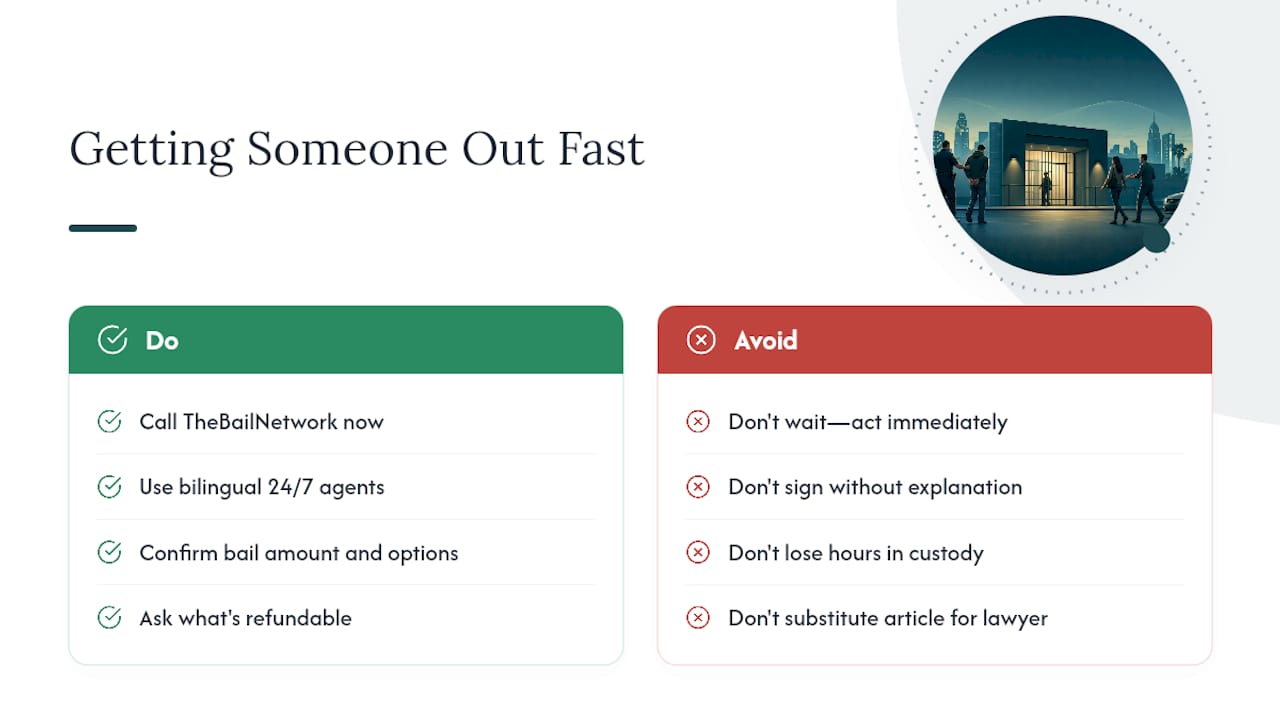
If you’re staring down a bail number and trying to figure out where the money comes from, Thebailnetwork built its whole model around exactly that moment. Bilingual agents are on call 24/7 across Southern California, which matters when a DUI arrest happens at 2 a.m. on a Saturday and every hour someone sits in custody is an hour of lost wages or missed childcare.
The team also walks you through exactly how bail bond payments work before you sign anything, so there are no surprises about what’s refundable and what isn’t.
If someone you love was just booked on a DUI charge, the next step is simple: reach out to Thebailnetwork now to check bail amount and payment options before another hour passes in custody.
This article is general information, not a substitute for advice from a qualified lawyer. Consult a qualified legal professional about your own circumstances before acting on anything here.
Sources
- How Much Is DUI Bail? - FindLaw
- Superior Court of the State of California Santa Clara County — Criminal bail schedule (2025)
- Bail for DUI in California: Amounts and How It Works - LegalClarity
- Dui
- Bail for DUI - Shouse Law Group (California) - Blog