
Before Families Pay Bail: CA Misdemeanor $0–$5K, Felony $2K–$500K
Misdemeanor bail is almost always faster and cheaper than felony bail because most misdemeanors get resolved through a preset stationhouse or magistrate schedule, sometimes even a $0 own recognizance release. Felony bail is usually higher, often requires a Superior Court hearing, and for serious violent charges can be delayed by statutory notice rules or denied outright. County bail schedules and judicial discretion decide the actual numbers.
TL;DR:
- Misdemeanor bail is typically processed quickly through preset county schedules, often within hours or days, and can be as low as zero with own recognizance release.
- Felony bail amounts are higher, require court hearings, and can be delayed or denied outright for serious or violent charges, with amounts often starting in the thousands and reaching hundreds of thousands.
- Judges can depart from bail schedules for domestic violence, repeat offenses, or threats, and bail stacking or enhancements can significantly raise the amount for both felony and misdemeanor cases.
- Post-release timelines vary, with misdemeanors often resolved in hours or days, while felony cases involving serious charges can take weeks due to court review and hearing procedures.
- Families should verify exact charges and bail amounts promptly, consider bail reduction motions, and seek professional assistance to avoid rushed decisions that could cost more later.
Table of Contents
- What’s the Difference Between Felony and Misdemeanor Bail?
- How Do Bail Schedules Work, and When Can Judges Deviate?
- What Are Typical Bail Amounts for Felonies vs. Misdemeanors?
- How Long Does It Take to Get Released on Bail?
- How Do You Actually Post Bail?
- What Should a Family Do Right After an Arrest?
- How Thebailnetwork Supports Families Through This Process
- How Do Bail Hearing Procedures Differ by Charge Type?
- Does a Criminal Record Change Bail for Felonies vs. Misdemeanors?
- What Alternatives to Bail Exist for Felonies and Misdemeanors?
- What Happens if You Miss Court on a Felony vs. Misdemeanor?
- How Does Bail Affect Plea Deals in Felony and Misdemeanor Cases?
- What Families Should Actually Prioritize First
- Need Help Posting Bail Right Now?
- Sources
- FAQ
What’s the Difference Between Felony and Misdemeanor Bail?
The biggest procedural difference is who makes the first call and how fast it happens. For most misdemeanors, a jail officer or magistrate sets bail directly off the county’s printed bail schedule, often within a few hours of booking. For felonies, that same schedule still applies at first, but the case usually moves to arraignment in front of a Superior Court judge, who can raise, lower, or hold the amount depending on the charge.
- Misdemeanors: stationhouse or magistrate schedule, first appearance typically within hours to 72 hours.
- Felonies: arraignment judge review, and for certain violent or serious offenses, a formal bond hearing under Penal Code §1270.1 before bail can deviate from the schedule.
- Legal basis: Penal Code §1275 gives judges discretion to set bail based on public safety, the seriousness of the charge, and the defendant’s ties to the community.
Prosecutors can also file motions that pause a felony bond hearing while the court reviews the charge, something that almost never happens on a routine misdemeanor case.
How Do Bail Schedules Work, and When Can Judges Deviate?
A bail schedule is a preset dollar amount attached to a specific charge code, published by each county so jails can process release without waiting for a judge to review every case individually. It exists to move people through the system faster, not to reflect what any one judge thinks the case is worth.
- Judges can depart from the schedule when a case involves domestic violence, a repeat offense, or a threat to a specific victim or witness.
- Multiple counts often get “stacked,” meaning bail is added per charge rather than capped at one number.
- Enhancements, like a weapon allegation or gang charge, can multiply the base amount several times over.
The San Bernardino County felony and misdemeanor bail schedule spells out exactly how stacking and special-category bail work county by county, and it looks very different from the schedule next door. Statistic snapshot: appearance-reminder programs studied by California courts have significantly improved attendance rates in some trials, which is part of why judges increasingly weigh pretrial support tools, not just cash, when setting conditions of release.
What Are Typical Bail Amounts for Felonies vs. Misdemeanors?
Dollar figures swing wildly by county and charge, but the general shape holds almost everywhere. Misdemeanor bail commonly runs from $0, released on your own recognizance, up to around $5,000, though domestic violence or repeat-offense misdemeanors can push higher. Felony bail starts in the low thousands for minor felonies and climbs into six figures for serious violent charges.
- Low-level felonies: often a few thousand dollars up to around $25,000, depending on the county schedule.
- Serious or violent felonies: commonly $50,000 to $500,000 or more, and some charges (certain murder or sex offense allegations) can result in bail being denied entirely.
- What drives the number up: prior record, flight risk, danger to a specific victim, and how aggressively the local district attorney’s office charges the case.
The San Diego County bail schedule marks certain charges as mandatory court appearances rather than cash-eligible, a detail easy to miss if you’re only skimming the number next to the charge code. Our guide to how judges decide bail amounts breaks down each factor in more detail.
How Long Does It Take to Get Released on Bail?
Timelines are where felony and misdemeanor cases diverge the most, and it’s often the first question families ask.
- Misdemeanor: Many people get a stationhouse or cite-and-release within hours, with a first court appearance scheduled inside 48 to 72 hours if they aren’t released immediately.
- Felony, standard: Expect at least a probable-cause review and a formal arraignment, which can take a few days depending on jail intake volume.
- Felony, serious/violent: Penal Code §1270.1 requires notice and an open-court hearing before a judge can set bail below the schedule, which routinely adds days or weeks.
- Added delays: inter-county holds, extradition requests, or a prosecutor’s motion to modify bail can stretch any felony timeline further.
Judges have broad, individualized discretion here, a principle rooted in Stack v. Boyle and reflected in current federal bail law, which is exactly why two similar felony cases in different counties can move at completely different speeds.
How Do You Actually Post Bail?
Families generally choose between paying the full cash amount directly to the court or jail, which the court refunds (minus fees) if the case resolves and every hearing is attended, or hiring a licensed bail agent who posts a surety bond for a nonrefundable premium, typically a percentage of the total bail.
- Cash bail: full amount held by the court, refundable at case resolution, ties up the whole sum until then.
- Surety bond: an agent posts the full bail on your behalf for a fraction of the cost upfront, and that premium is not returned.
- Release after posting a bond usually takes one to a few hours, though holds for warrants, ICE detainers, or paperwork backlogs at the jail can push it longer.
Pro Tip: Ask any bondsman for the exact premium percentage and any collateral requirement in writing before you sign anything. Payment structures vary, and providers like Thebailnetwork advertise plans as low as 1% with approved credit specifically so families aren’t forced to choose between bail and rent.
What Should a Family Do Right After an Arrest?
- Confirm the booking details. Use the county jail’s inmate locator to verify the charge and the bail amount actually set.
- Call an attorney first if one is available, then a licensed bail agent. Ask about total premium, collateral needs, and whether a payment plan applies.
- Gather documentation: photo ID, proof of income or a co-signer, and any information about prior court dates.
- Talk to counsel about a bail reduction motion if the scheduled amount is unaffordable. Filing at arraignment, or requesting a separate hearing, is a standard route to a lower bond according to legal reference notes on Penal Code §1275.
Pro Tip: Write down every court date the moment it’s set. Missing one turns a manageable misdemeanor into a bench warrant almost overnight.
How Thebailnetwork Supports Families Through This Process
Thebailnetwork operates across Southern California with bilingual bail agents available 24/7, so a call at 2 a.m. gets the same response as one at noon. Flexible payment plans, including options as low as 1% with approved credit, along with free educational resources and inmate locator support, are built to help families act fast without guessing at the process alone.
How Do Bail Hearing Procedures Differ by Charge Type?
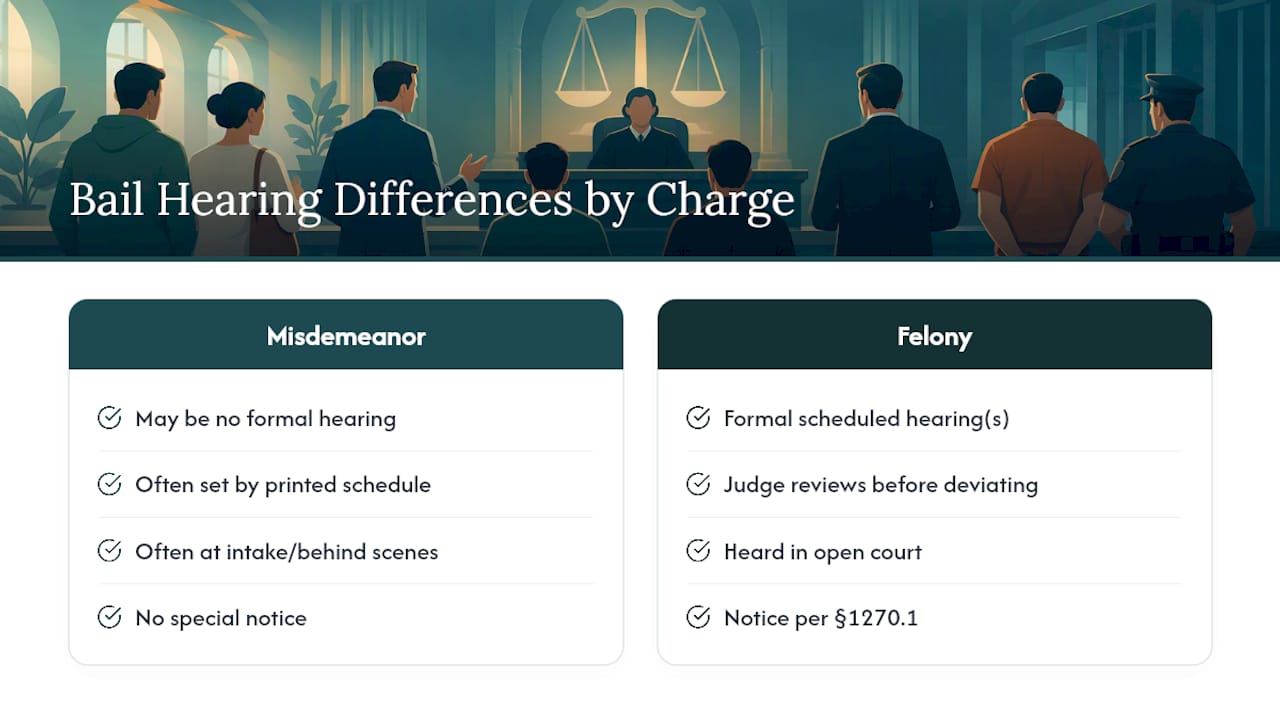
A misdemeanor bail hearing is often barely a hearing at all. If bail was already set off the schedule, the defendant simply pays it or gets released and shows up for arraignment later, where a judge may not revisit bail unless someone raises an objection.
Felony bail hearings look different by design. The judge reviews the police report or a probable-cause declaration, hears from the prosecutor on flight risk and public safety, and often hears from defense counsel arguing for release on recognizance or a lower amount. For felonies covered under Penal Code §1270.1, the court must give notice to both sides before deviating from the printed schedule, and the hearing happens in open court rather than behind the scenes at intake.
Victims also have a more formal role in felony hearings, particularly in domestic violence, sexual assault, or violent offense cases, where the court may hear directly from a victim advocate. Misdemeanor hearings rarely include that step unless the charge itself is a domestic violence misdemeanor.
The practical takeaway for families: don’t assume a “hearing” for a misdemeanor and a “hearing” for a felony mean the same amount of court time, paperwork, or waiting. A misdemeanor can be over before a family even reaches the courthouse. A felony bail hearing can be scheduled, continued, and argued over multiple appearances.
Does a Criminal Record Change Bail for Felonies vs. Misdemeanors?
Prior record matters in both cases, but it carries far more weight in felony court. A judge setting misdemeanor bail off the schedule usually applies the listed amount regardless of history, unless the charge is a repeat offense category (a second DUI or repeat domestic violence charge, for instance) that specifically triggers a higher listed number.
Felony cases work differently. A prior felony conviction, especially for a violent offense, gives the judge grounds to depart from the schedule entirely and set bail well above the listed amount, or deny it. Judges weigh criminal history alongside the nature of the alleged harm and any threat to witnesses far more heavily in felony cases than in typical misdemeanor bail decisions.
A defendant with no record charged with a low-level felony might see bail set close to or even below the schedule. A defendant with a violent felony history charged with a similar offense could see the number multiply several times over, or face a request for pretrial detention with no bail option at all. County prosecutors routinely cite prior convictions in their arguments at felony bond hearings, something that almost never comes up in a routine misdemeanor stationhouse release.
What Alternatives to Bail Exist for Felonies and Misdemeanors?
Own recognizance release, often called OR, lets a defendant go home on a promise to return to court, with no money exchanged at all. It’s common for low-level, first-time misdemeanors and is available for some lower-level felonies too, particularly when the defendant has strong community ties and no history of missing court.
Supervised release adds conditions like check-ins, electronic monitoring, or a no-contact order, which judges use more often in felony cases where straight OR feels too risky but full cash bail feels excessive. Some counties also use risk-assessment tools to help judges decide who qualifies.
Misdemeanors see OR far more often simply because the underlying risk is lower. Felony OR exists but is harder to get, especially for violent charges, and judges lean on it mainly when pretrial programs and reminder systems are part of the release plan. As courts have found, pretrial support programs meaningfully improve appearance rates, which gives judges more confidence releasing people without cash bail attached.
What Happens if You Miss Court on a Felony vs. Misdemeanor?
Failing to appear on a misdemeanor typically triggers a bench warrant and, if a bond was posted, forfeiture proceedings that give the bail agent a window to locate the defendant before losing the full amount. Courts may also add a separate failure-to-appear charge, which is itself a misdemeanor in most cases.
Missing a felony court date carries heavier consequences across the board. The warrant issued is usually a “no bail” or high-bail warrant, meaning the next arrest could mean sitting in custody with no quick release option. Failure to appear on a felony charge can also be charged as its own separate felony under some state laws, stacking additional prison exposure on top of the original case.
In both situations, the bail bond itself is at risk of forfeiture, and any collateral put up to secure it is on the line. Our breakdown of how court dates affect your bail bond covers what happens step by step once a date is missed. The gap between misdemeanor and felony consequences here is exactly why bail agents push so hard on reminder calls and transportation help, small interventions that keep a stressful situation from becoming a much worse one.
How Does Bail Affect Plea Deals in Felony and Misdemeanor Cases?
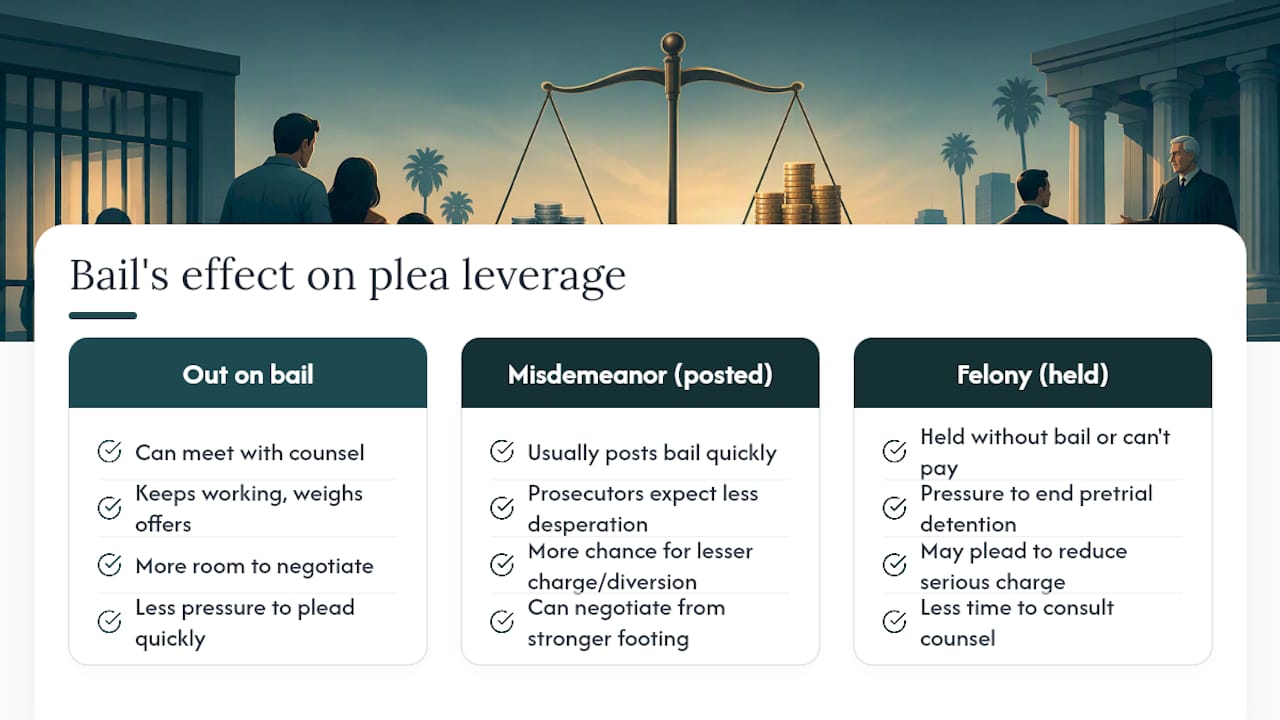
Being out on bail changes the leverage in a case more than most people realize. A defendant who’s out of custody can meet with counsel, keep working, and take time to weigh a plea offer carefully. A defendant sitting in jail because they couldn’t afford bail often feels pressure to take whatever deal gets them out fastest, even if it isn’t the best outcome for the case.
That dynamic shows up differently across charge types. Misdemeanor defendants who post bail quickly usually have more room to negotiate down to a lesser charge or diversion program, since prosecutors know the defendant isn’t desperate to resolve the case just to leave custody. Felony defendants held without bail, or unable to afford a high felony bond, sometimes plead to reduce a serious charge simply to end pretrial detention, a pattern widely documented in coverage of how cash bail functions in the justice system.
Prosecutors are aware of this leverage too, and bail amount can become part of the negotiation itself, with defense counsel arguing for a reduction specifically to give a client a fairer footing before any plea discussion begins. Getting out on bail, in other words, isn’t just about freedom before trial. It often shapes how the entire case ends.
What Families Should Actually Prioritize First
The conventional advice, “just check the bail schedule and pay it,” works fine for a straightforward misdemeanor and falls apart fast for anything felony-level. Schedules are a starting point, not a final answer, and too many families assume the printed number is fixed when it’s often the opening position a defense attorney can challenge within hours of arraignment.
What gets underrated is how much a bail reduction motion can move the number on a felony case, and how rarely families ask their attorney about it. Judges have real discretion under Penal Code §1275, and that discretion cuts both ways. It can raise a schedule amount for a dangerous case, but it can also lower an unaffordable one when counsel makes the right argument.
If there’s one thing worth prioritizing over everything else, it’s speed on information, not speed on payment. Confirm the exact charge, the exact bail amount, and whether the case falls under a special notice statute like §1270.1 before committing to a payment plan or collateral arrangement. A rushed decision on a felony bond can cost far more than a few hours of careful phone calls to a bail agent and an attorney would have saved.
— Jake
Need Help Posting Bail Right Now?
Thebailnetwork is the alternative to figuring this out alone at 3 a.m.: bilingual bail agents answer around the clock, and payment plans starting as low as 1% with approved credit mean a family doesn’t have to drain savings or skip rent to bring someone home.
Whether you’re dealing with a straightforward misdemeanor stationhouse release or a felony case that needs a bond posted fast, Thebailnetwork’s agents walk you through the charge, the amount, and the fastest legitimate path to release. Service options include 1% bail bonds for qualifying clients, 2% bail bonds with approved credit, and 24-hour bail bonds for cases that can’t wait until morning. Start at Thebailnetwork or call the number listed there to get a licensed agent working on your case right now.
Sources
- California Penal Code §1275
- San Bernardino County Felony and Misdemeanor Bail Schedule (2026)
- San Diego County bail schedule
- Courts news: Study shows positive impact of pretrial programs
- How cash bail works — Brennan Center for Justice
This article is general information, not a substitute for advice from a qualified lawyer. Consult a qualified legal professional about your own circumstances before acting on anything here.
FAQ
What Crimes Don’t Qualify for Bail?
Certain charges, like capital murder or specific violent felonies where no release condition can protect public safety, can result in bail being denied entirely. Judges make that call case by case under principles described in the Brennan Center’s explainer on cash bail, rather than through a fixed list of banned charges.
Does Bail Go Down the Longer You Stay in Jail?
Not automatically. Bail can be lowered through a formal reduction motion filed by defense counsel, usually at arraignment or a separate hearing, but simply waiting in custody doesn’t reduce the amount on its own.
Is It Better to Stay in Jail or Post Bail?
Posting bail almost always gives a defendant more control over the case, more time to work with counsel, and less pressure to accept a fast plea deal just to get out. Staying in custody rarely improves a case outcome and can push defendants toward accepting worse terms.
What Are the Four Main Types of Bail?
The common categories are cash bail (paid in full to the court), surety bond (posted by a licensed agent like Thebailnetwork for a percentage fee), own recognizance release (no money required), and property bond (real estate used as collateral). Which one applies depends on the charge, the county schedule, and the judge’s discretion.
How Much Does It Cost to Use a Bail Bond Service?
Thebailnetwork’s standard bail premium is 10%, with reduced options like 1% bail bonds and 2% bail bonds with approved credit available depending on eligibility. Exact terms depend on the case and creditworthiness, so it’s worth calling an agent directly for a quote.