
Win Own Recognizance Release in the U.S.: 5 Steps to Improve Your Odds

Release on one’s own recognizance means a judge lets a defendant go free before trial without paying bail, based on a signed promise to appear in court. It typically applies to nonviolent or first-time offenders with steady jobs, stable housing, and no history of skipping court. Judges retain full discretion, and even strong candidates can be denied if the charge is serious or the risk assessment flags concern.
TL;DR:
- Approval for OR depends heavily on risk assessment results, community ties, and criminal history, especially prior failures to appear.
- Requesting OR requires preparation, including gathering ID, proof of employment, references, and timely filing through counsel or court clerks.
- OR can take 48 to 72 hours to be granted after booking, making bail faster for immediate release in urgent situations.
- Violating conditions of OR, such as missing hearings or breaking laws, often results in re-arrest or revoking release.
- Jurisdictional differences, including state laws and local practices, significantly influence the likelihood and speed of obtaining OR.
Table of Contents
- What Is Release on One’s Own Recognizance (OR/ROR)?
- Who Actually Qualifies for OR Release?
- How to Request OR and What Pretrial Programs Actually Do
- How Long Does OR Actually Take?
- Conditions Attached to OR and What Happens if You Break Them
- Why the Rules Change Depending on Where You’re Arrested
- What Actually Improves Your Odds of Getting OR
- What I’d Tell a Family Member Facing This
- When OR Isn’t Granted: Posting Bail Through The Bail Network
- Sources
What Is Release on One’s Own Recognizance (OR/ROR)?
Own recognizance release, often shortened to OR or ROR (release on recognizance), lets a defendant walk out of custody on a written pledge to show up for every court date. No money changes hands, and no property gets pledged. That’s the core distinction from every other pretrial option.
Compare that to the alternatives:
- Cash bail: the defendant or family pays the full amount, refunded (minus fees) after the case resolves.
- Surety bond: a bail agent posts the bond for a nonrefundable premium, usually a percentage of the total.
- Unsecured appearance bond: no money is paid upfront, but the defendant owes the full amount if they skip court.
The Legal Information Institute at Cornell defines OR precisely this way: liberty pending trial, secured only by a promise, not cash. The Bureau of Justice Statistics frames it as one end of a spectrum that runs from OR through supervised release to fully secured bonds.
Who Actually Qualifies for OR Release?
Judges don’t grant OR on a whim. They weigh a specific set of factors, and pretrial officers usually put those factors in writing before the judge ever rules. The American Bar Association’s pretrial-release standards push courts toward the least restrictive condition that still guarantees appearance and public safety, which is why OR is often the default starting point for lower-risk defendants rather than the exception.
The factors that matter most:
- Criminal history, especially prior failures to appear (FTAs)
- Severity and nature of the current charge
- Ties to the community: how long someone has lived locally, family in the area
- Employment status and income stability
- Documented substance use or violence risk
- Results from a formal risk-assessment tool used by the jurisdiction
Prosecutors weigh in too, and many counties run local bail schedules alongside OR criteria, so the two systems interact rather than operate in isolation. A defendant charged with a low-level offense but flagged as a flight risk on a validated risk tool can still get bail set instead of OR. Community ties and a clean record help, but as Justia’s practitioner guidance notes, outcomes still vary by judge and by which courthouse hears the case.
How to Request OR and What Pretrial Programs Actually Do
Requesting OR isn’t passive. Here’s the practical sequence:
- Contact counsel immediately after booking, before the first hearing if possible.
- Gather documentation: government ID, recent pay stubs, a lease or utility bill, and any letter from an employer confirming employment.
- Line up character references willing to speak or submit a letter, ideally an employer or landlord.
- File a formal OR request through counsel or directly with the court clerk if unrepresented.
- Ask the prosecutor whether they’ll recommend OR, since prosecutorial non-objection often speeds things along.
Behind the scenes, a county OR program does the legwork. Los Angeles County’s Probation Department runs a typical model: interviewers verify employment, confirm residence, check references, and compile a suitability report for the judge before arraignment. That report carries real weight, so incomplete or unverifiable information almost always works against the defendant.
How Long Does OR Actually Take?
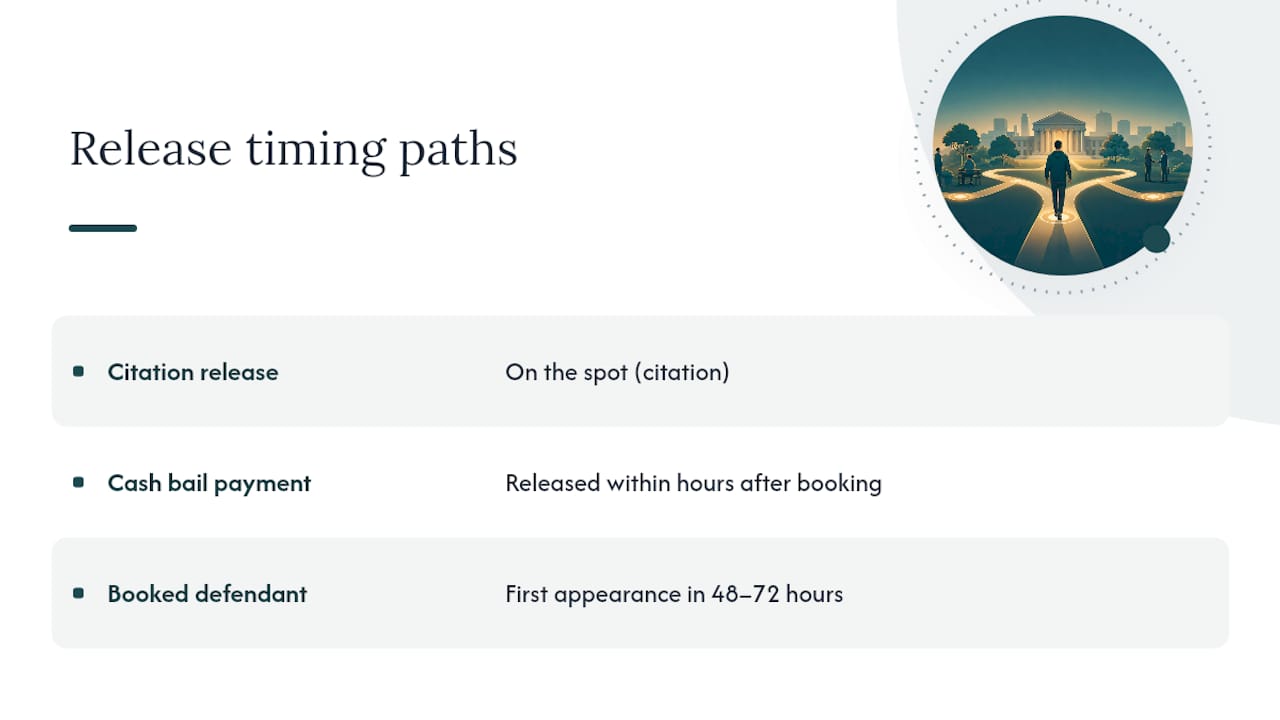
Timing depends heavily on how the arrest unfolds. Some minor offenses qualify for citation release, meaning the person is never fully booked and gets a court date on the spot. Booked defendants usually wait for a first appearance, which in most jurisdictions happens within 48 to 72 hours.
That waiting period is where OR loses ground to cash bail on pure speed. Posting bail can get someone out within hours of booking, once payment clears, while an OR decision waits for the judge’s calendar. If release timing matters most, gathering documents and contacting a lawyer while waiting can shorten the eventual hearing, but it won’t beat a same-day bail payment for raw speed. Readers weighing that trade-off often start by understanding how bail amounts get set in the first place.
Conditions Attached to OR and What Happens if You Break Them
OR isn’t unconditional freedom. Courts attach specific requirements, and violating any of them carries real consequences.
Common conditions include:
- A signed promise to appear at every scheduled hearing
- Obeying all laws during the release period
- Travel restrictions, sometimes limited to the county or state
- No-contact orders in cases involving an alleged victim
- Drug testing or check-ins with pretrial supervision
Miss a court date or break a condition, and the court typically issues a bench warrant. Rearrest is common, sometimes on an added charge for failure to appear, and the judge who previously granted OR may revoke it entirely, requiring cash bail on a new hearing. Defendants can petition the court to modify conditions, arguing a travel restriction blocks employment, for example. Courts grant these requests case by case, and clear documentation helps.
Why the Rules Change Depending on Where You’re Arrested
State statutes vary enough that a nearly identical arrest can produce different outcomes depending on the courthouse. California governs OR primarily under Penal Code §1270, which sets a presumption favoring OR for most misdemeanors. Texas and Ohio each maintain their own statutory frameworks with different presumptions and different judicial discretion built in.
Federal cases follow a separate track entirely. Under 18 U.S.C. §3142, a judicial officer must order release on personal recognizance or an unsecured bond unless doing so won’t reasonably assure appearance or will endanger public safety. That’s a meaningfully different standard than most state courts apply.
Local court culture matters just as much as the statute itself. County OR programs, like the one in Los Angeles, shape outcomes through their own investigation standards, so the fastest way to know what applies is checking that county’s probation or pretrial services page directly.
What Actually Improves Your Odds of Getting OR
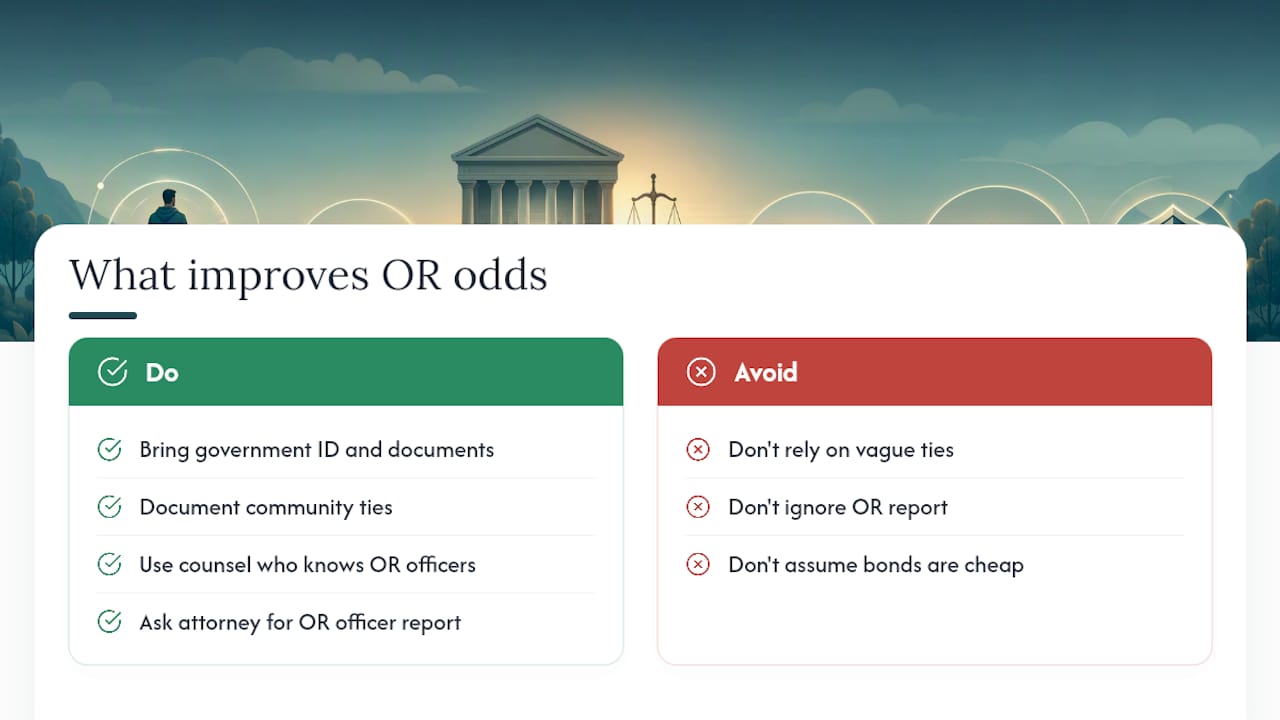
Preparation beats hope here. Bring a government ID, recent pay stubs, a signed lease, and a letter from an employer or school confirming your status, since OR officers verify all of it before writing their report to the judge. Community ties carry weight only when they’re documented, not just claimed.
Defense counsel who knows the local OR officers and judges can frame that same evidence more persuasively, sometimes arranging for a supervisor to confirm employment by phone during the hearing itself. That kind of practical legwork, according to Justia, routinely moves the needle more than the underlying facts alone.
Pro Tip: Ask your attorney to request the OR officer’s report before the hearing. If it flags a gap, like an unverifiable address, you can often fix it with one phone call before the judge ever sees the file.
When OR isn’t available, alternatives like unsecured appearance bonds or surety bonds come with their own costs and enforcement terms worth understanding before the hearing, not after.
What I’d Tell a Family Member Facing This
OR decisions come down to documentation and timing more than most people expect. If you’re waiting on a judge’s discretion, don’t sit idle. Call counsel, gather your paperwork, and understand that pretrial services can move faster with a complete file than an empty one.
— Jake
When OR Isn’t Granted: Posting Bail Through The Bail Network
When a judge denies OR, waiting isn’t really a strategy. Cash bail or a bail bond becomes the practical route to getting someone out while the case proceeds, and speed matters more than almost anything else at that point.

A bail bond network works this exact situation regularly across Southern California, with bilingual agents available 24/7 to assist with releases. Immediate inmate-locator support also helps ensure you don’t have to guess which facility someone is in before starting the release process. If OR wasn’t granted and you need someone released now, see how bail bond payment works and get a same-day plan started.
This article is general information, not a substitute for advice from a qualified lawyer. Consult a qualified legal professional about your own circumstances before acting on anything here.
Sources
- release on one’s own recognizance | Legal Information Institute
- Pretrial release | Bureau of Justice Statistics
- 18 U.S.C. §3142 — Release or detention pending trial
- ABA Standards: Pretrial Release