
PC 1275 Hold: 24‑Hour Rule, §1275.1, and What Families Must Bring
A PC 1275 hold stops a jail from accepting bail money when a judge, prosecutor, or officer has probable cause to believe the funds came from a felony. Release freezes immediately, even if bail was already set. Penal Code § 1275.1 governs the process, and it gives the court a limited time to act on the hold before the defendant must be released on posting the authorized bail.
TL;DR:
- A PC 1275 hold is triggered by probable cause to believe bail funds were feloniously obtained, preventing acceptance or processing of bail temporarily.
- The court has 24 hours to review the declaration, or the defendant must be released on previously set bail if no judicial action occurs within that timeframe.
- The defense carries a preponderance of the evidence burden to prove funds are legitimate at the hold hearing, which is scheduled quickly due to strict time limits.
- Supporting documents like bank statements, payroll records, and affidavits are critical for persuading judges the money came from lawful sources.
- Rapid coordination with bail agents and legal counsel immediately after a hold is crucial, utilizing prepared financial documentation to avoid indefinite detention.
Table of Contents
- What PC 1275.1 Actually Says About Bail Funds
- Who Files the Hold, and What the Defense Has to Prove
- How the Hold Freezes Release, and Why the 24-Hour Clock Matters
- How to Challenge a PC 1275 Hold at the Hearing
- Evidence Checklist: What Actually Persuades a Court
- When Prosecutors Actually Use a PC 1275 Hold
- What to Do Right Away if Bail Gets Held Under PC 1275
- How Bail Agents and Defense Counsel Actually Coordinate on These Cases
- How The Bail Network Helps Once a PC 1275 Hold Is Resolved
- Where to Read the Actual Law and Local Guidance
- Sources
What PC 1275.1 Actually Says About Bail Funds
The statute is blunt: a court cannot accept bail if it has probable cause to believe any part of the money was “feloniously obtained.” That single rule drives everything else about how a 1275 hold plays out in a California courtroom.
The law doesn’t require proof beyond a reasonable doubt to trigger a hold. It only takes probable cause, a much lower bar, and that’s part of why these holds catch families off guard. A peace officer, prosecutor, or magistrate can start the process by filing a sworn declaration under penalty of perjury laying out the factual basis for believing the funds are dirty.
Once that declaration lands, the court’s job shifts. A judge reviews the declaration and decides whether it establishes probable cause. If it does, the hold goes into effect, and:
- The jail treats the bail money as suspect, not usable, until a judge says otherwise.
- The burden shifts to the defense to prove the funds are clean.
- A hearing gets scheduled where that proof gets tested.
None of this decides guilt on the underlying criminal charge. It’s a separate, narrower fight about where the bail money came from.
Who Files the Hold, and What the Defense Has to Prove
Three types of people can start a 1275 hold: a peace officer, a prosecutor, or a magistrate or judge acting on their own review of the case. Each files a declaration alleging probable cause that some or all of the bail money traces back to a felony, and the statute lets any of them initiate that step.
That’s a low bar by design. Probable cause just means a reasonable basis to suspect the funds are tainted, not certainty. The real fight happens later, at the hearing, where the standard flips entirely.
At that hearing, the defendant carries the burden of proof, and it’s measured by a preponderance of the evidence, meaning more likely than not. If the defense shows that, the judge has to release the hold. Key points to understand about this stage:
- The defense doesn’t need to disprove every possible suspicion, just tip the scale past 50%.
- Prosecutors who file these declarations in good faith carry statutory immunity from liability over the filing itself.
- The burden never shifts back to the prosecution once the hold is triggered. It sits with the defense until the hearing resolves it.
How the Hold Freezes Release, and Why the 24-Hour Clock Matters
A 1275 hold creates what’s best described as an administrative freeze. The jail won’t process cash, won’t accept a bond, and won’t release the defendant, regardless of whether the bail amount was already set by a judge. Families sometimes show up with cash in hand only to be told the payment simply cannot go through while the hold stands, a scenario practitioner accounts describe as one of the most common points of confusion in these cases.
The statute builds in a safeguard. Under § 1275.1(g), if a declaration alleging probable cause is filed but no judge or magistrate acts on it within 24 hours, the defendant must be released upon posting the bail amount already set. That clock is one of the few hard deadlines in the entire bail process, and it exists specifically to stop holds from becoming indefinite detention by delay.
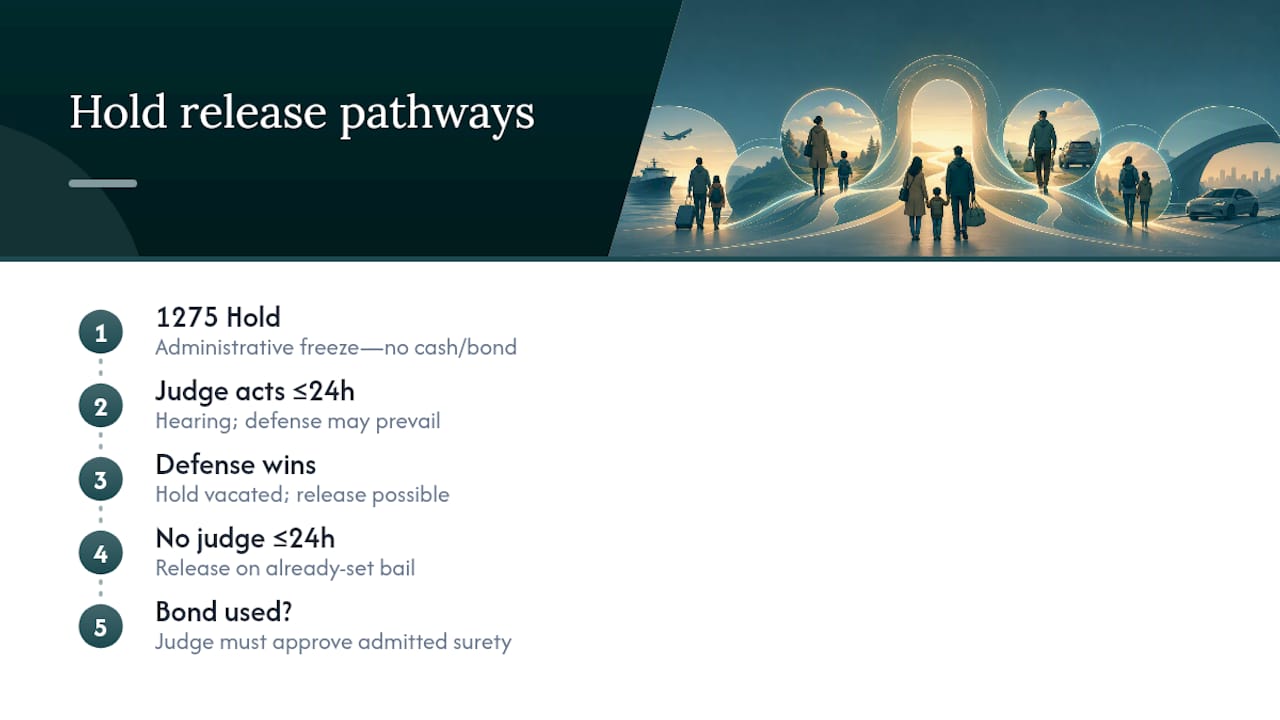
A hold gets vacated one of two ways: either the defense meets its burden at the hearing, or the 24-hour window lapses without judicial action. If the defense succeeds and a bail bond will be used for release, the judge still has to approve that bond before the jail processes it, since the statute requires the bond to come from an admitted surety or a bail agent licensed by the Insurance Commissioner.
How to Challenge a PC 1275 Hold at the Hearing
Fighting a 1275 hold comes down to one number: preponderance of the evidence, or better than 50-50 odds that the money is clean. That’s a lower bar than the “probable cause” standard prosecutors use to get the hold in the first place, which sounds encouraging until you realize the defense has almost no time to gather proof before the hearing gets scheduled.
Here’s roughly how the process unfolds once a hold is in place:
- The court sets a hearing date, often on an expedited basis given the 24-hour rule pushing everyone toward speed.
- The defense assembles documentation tracing the bail money back to a legitimate source, whether that’s wages, savings, a loan, or a gift.
- Witnesses may testify, including the person who supplied the funds, an employer confirming income, or a family member explaining a loan arrangement.
- The prosecution cross-examines and may challenge gaps, inconsistencies, or timing that doesn’t line up.
- The judge rules, either releasing the hold if the burden is met or keeping it in place if the explanation falls short.
What actually moves a judge? Defense attorneys consistently point to the same thing: speed and completeness of financial documentation matter more than clever legal argument. A hearing officer isn’t looking for a persuasive story. They’re looking for paper that lines up.
That means bank statements with matching timestamps, payroll records that corroborate income claims, and sworn affidavits from anyone who gave or loaned money toward bail. Courts respond well to a clean paper trail and respond poorly to vague explanations that ask them to take someone’s word for it.
Pro Tip: Pull bank statements covering at least 60 to 90 days before the bail amount was funded, not just the days immediately surrounding the deposit. A single large transfer looks suspicious in isolation but often makes complete sense once a judge sees the full pattern of income and savings behind it.
Evidence Checklist: What Actually Persuades a Court
Judges weighing a 1275 challenge respond to documents that show a clear, traceable line from income to bail money. Vague explanations rarely survive cross-examination.
Priority evidence includes:
- Bank statements showing the source and exact timing of deposits used for bail.
- Payroll stubs or direct deposit records that match claimed income.
- Recent tax returns confirming reported earnings align with the funds in question.
- Loan agreements or repayment schedules if the money was borrowed.
- Signed affidavits from friends or relatives who gifted or loaned funds informally.
Informal cash gifts are the hardest category to prove. If a relative handed over cash without any paper trail, get a sworn affidavit describing the amount, date, and relationship, and pair it with anything corroborating, like a withdrawal from the giver’s own account around the same time.
Pro Tip: Avoid unexplained cash gaps at all costs. A deposit with no clear source is exactly the kind of detail a prosecutor will highlight, even when the underlying money is completely legitimate.
When Prosecutors Actually Use a PC 1275 Hold
Certain fact patterns show up again and again in cases where prosecutors push for a hold. Recognizing them helps families understand why scrutiny landed on their case specifically.
- Drug-sale proceeds: Cases involving narcotics distribution charges almost always draw a look at how bail funds were assembled, since cash from alleged drug sales is a common suspicion.
- Large, sudden deposits: A bank account showing a big, unexplained deposit shortly before an arrest tends to trigger automatic scrutiny, even when the source turns out to be legitimate.
- Collateral tied to the alleged offense: If a vehicle or property used to secure a bond was purchased with funds suspected to be connected to the crime itself, that link alone can justify a hold.
None of these patterns guarantee a hold will be filed, but they’re the situations where prosecutors most often decide the risk of tainted funds is worth raising with the court.
What to Do Right Away if Bail Gets Held Under PC 1275
Time matters more than almost anything else once a hold is in place, given the 24-hour statutory clock working in the background.
- Get the basics from the jail or booking desk: booking number, exact charges, the bail amount set, and whether anyone has confirmed who filed the declaration.
- Call defense counsel immediately, even before contacting a bail agent, since counsel needs to start building the financial record right away.
- Loop in a bail agent early so a bond is ready to move the moment the hold lifts, whether that’s through a successful hearing or the 24-hour deadline passing. Our guide on how long after bail is posted you’re released covers what happens procedurally once that green light comes.
- Start pulling financial documents same day: bank statements, pay stubs, and any loan paperwork, before memories fade or records become harder to access.
- Organize everything by date before the hearing, since judges respond better to a clean chronological story than to a folder of unsorted paper.
How Bail Agents and Defense Counsel Actually Coordinate on These Cases
Southern California bail agents who’ve handled 1275 holds know the coordination has to move fast. The agent typically locates the defendant and confirms the hold status while counsel starts building the financial record, since both tracks need to run at once rather than one after the other.
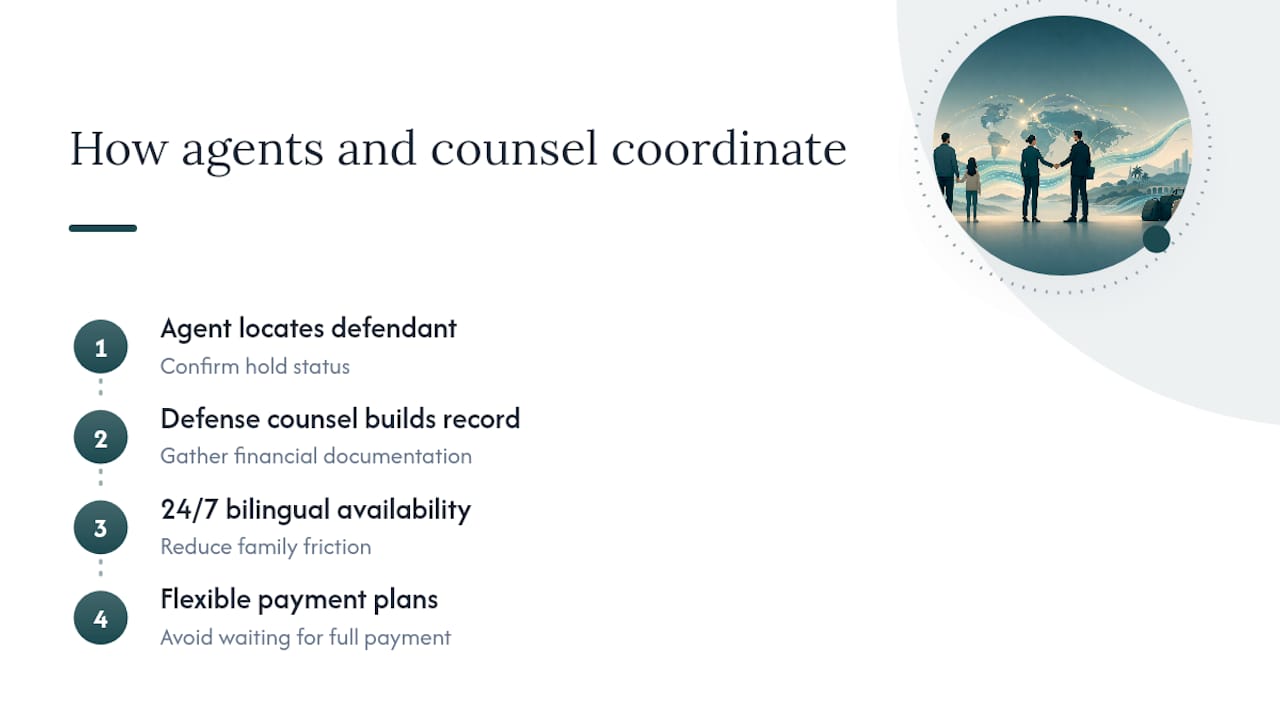
Bilingual, 24/7 availability matters here more than people expect. Families dealing with a hold are often stressed, confused about jail procedures, and juggling work schedules while trying to reach an attorney. A bail agent who answers at 2 a.m. and speaks the family’s language removes one layer of friction from an already difficult day.
Once a hold lifts, flexible payment plans mean the bond doesn’t have to wait on a family scrambling for full payment. Fast coordination at that moment can shave hours off total time in custody.
— Jake
How The Bail Network Helps Once a PC 1275 Hold Is Resolved
The Bail Network gives you a faster path back to your family once a judge lifts the hold, without the added stress of scrambling for full payment on short notice. Our bilingual agents are available 24/7 across Southern California, so the moment a hold clears, we can move on posting bail instead of making you wait until business hours.

Here’s what to have ready when you call, and what we can and can’t do while a hold is still active:
| Situation | What The Bail Network Can Do |
|---|---|
| Hold is still active | Confirm booking details, coordinate with your attorney, prepare paperwork in advance |
| Hold has been lifted | Move immediately on posting bail with flexible payment plans as low as 1% with approved credit |
| Bond already set, funds unclear | Cannot process payment until the court vacates the hold, per statute |
Have the booking number, bail amount, and jail location on hand when you reach out. Our guide on how to pay for a bail bond walks through financing options so you’re not caught off guard by cost once the hold clears. Reach out to The Bail Network now to get your questions answered and your bond ready to move the moment the court gives the go-ahead.
Where to Read the Actual Law and Local Guidance
For the statute itself and jurisdiction-specific practice, consult:
- Penal Code § 1275.1 full text, including the 24-hour rule under subsection (g).
- California courts administrative order SP20-08 for procedural guidance.
- LA County DA special directive as an example of local prosecutor practice.
This article is general information, not a substitute for advice from a qualified lawyer. Consult a qualified legal professional about your own circumstances before acting on anything here.
Sources
- California Code, Penal Code - PEN § 1275.1 | FindLaw
- California public law — Penal Code § 1275.1
- What is a PC 1275 Hold? — Eisner Gorin LLP
- California courts administrative order SP20-08
- LA County DA special directive (example)