
4 Steps to Post Police Station Bail and Leave With a Dated Receipt
Yes, most police stations and detention facilities accept bail directly at a bond desk or booking window, and many large facilities process payments 24/7. The fastest path is confirming the inmate’s booking or case number, bringing valid government ID, and heading straight to the custody window, or calling a licensed bail agent if you can’t get there yourself. Expect conditions attached to release, and know that breaking them can trigger a re-arrest.
TL;DR:
- Most police stations and detention facilities accept bail payments at designated windows, often with 24/7 processing at larger jails, but confirmation is essential before arriving.
- Paying bail requires booking or case numbers, valid government IDs, and accepted payment methods; failure to follow procedures can cause delays or re-arrest.
- Different bail types—own recognizance, unsecured, cash, or surety bonds—carry varying conditions and refund rules that families must understand to avoid extra costs.
- Bail conditions such as contact restrictions and travel limits are legally binding and can lead to re-arrest if violated, making it critical to follow instructions precisely.
- To avoid additional delays, always call the facility beforehand, bring exact payment, and secure written proof of payment and court dates before leaving.
Table of Contents
- Where to Post Bail at the Station
- How to Post Bail in Person: A Step-by-Step Checklist
- Types of Bail You’ll Encounter
- Common Bail Conditions at the Station and How to Comply
- After-Release Checklist: Receipts, Court Dates, and Next Steps
- How Thebailnetwork Can Help You
- How to Request Bail Reduction or Modifications
- What to Do If Bail Is Denied at the Police Station
- Contact Information and Availability for Posting Bail
- Jake’s Practical Tips and Common Mistakes to Avoid
- If You Need Fast, Professional Help
- Sources
- FAQ
Where to Post Bail at the Station
Not every window at a police station or jail handles money. Knowing which one does saves you a wasted trip.
- Booking window or central receiving: intake point where new arrests are processed; sometimes doubles as the payment counter at smaller stations.
- Bond desk or jail cashier: the dedicated payment counter at larger county jails and detention centers, usually separate from booking.
- Court clerk’s office: handles bail once a case has moved to arraignment, typically during business hours only.
Before you drive anywhere, call the facility directly or use its online inmate locator to confirm the person is actually being held there. Bookings sometimes take hours to appear in the system, and a defendant can be transferred between facilities without notice.
Hours matter as much as location. Many county jails run bond desks around the clock, but court clerk windows almost always keep standard business hours. The NYC Department of Correction notes that some facilities accept payment at any hour while others follow court schedules, so calling ahead isn’t optional if you want to avoid standing outside a locked door at midnight.
How to Post Bail in Person: A Step-by-Step Checklist
Posting bail correctly the first time avoids delays that can add hours to someone’s stay in custody. Follow these steps in order.
- Confirm the booking or case number and charges. You’ll need this identifier, often called a booking number, case number, or NYSID depending on the state, before the desk staff can even look up the file.
- Bring valid government-issued ID. The person paying needs a driver’s license, passport, or state ID. If someone other than you is authorized to pay on the defendant’s behalf, bring documentation proving that authorization.
- Know the accepted payment types. Cash is common but usually must be the exact amount. Cashier’s checks and money orders are widely accepted; some facilities now take cards or online payments, though remote payment portals often state that submitted funds legally belong to the defendant, not the person who paid, which affects who gets a refund later.
- Sign the bond paperwork and get a dated receipt. This receipt should list the amount paid, the court date, and any conditions of release. Don’t leave without it.
Release rarely happens the instant a payment clears. Fingerprinting, warrant checks, and medical clearance can add anywhere from thirty minutes to several hours after the money is processed, according to guidance from the NYC Department of Correction. Some counties also tack on nonrefundable filing fees, often in the $40 to $50 range, according to Clark County Justice Court, so bring a little extra beyond the stated bail figure.
Pro Tip: Call the facility and ask specifically which payment instruments they’ll accept before you leave the house. A cashier’s check that isn’t made out correctly, or a personal check they don’t allow, means driving home and starting over.
Types of Bail You’ll Encounter
The word “bail” covers four distinct arrangements, and each one changes what you pay and what you get back.
- Own recognizance (PR release): No money changes hands. The defendant signs a written promise to appear in court, typically reserved for low-risk, first-time, or minor offenses.
- Unsecured bond: Nothing is paid upfront. The defendant signs a bond that only becomes payable if they fail to show up in court.
- Cash or secured bond: The full bail amount is paid and held by the court. If the case resolves and all appearances were met, the funds are typically returned, minus any court fees, though refund rules vary by jurisdiction.
- Surety bond: A bail bond agency posts the full amount on the defendant’s behalf in exchange for a premium, usually a percentage of total bail. That premium is nonrefundable, and the agency may require collateral or a co-signer, according to the New York State Unified Court System.
Families choose surety bonds most often simply because most people don’t have $10,000 or $20,000 in cash sitting around. The tradeoff is straightforward: you pay a smaller, nonrefundable fee instead of a much larger refundable one.
Common Bail Conditions at the Station and How to Comply
Getting released doesn’t mean the case is over, and custody officers can attach real strings to that release.
- No contact with the alleged victim or witnesses
- A fixed residence requirement, sometimes verified by address
- Passport surrender, particularly in cases involving flight risk
- Scheduled check-ins at a specified police station
- Travel restrictions limiting how far the defendant can go
UK law gives a clear example of how binding these conditions are. Under the Police and Criminal Evidence Act 1984, custody officers can attach conditions when granting bail and can re-arrest a person without a warrant if new evidence surfaces or a condition is broken. Government guidance on being charged with a crime confirms that breaching a condition, such as missing a scheduled check-in or contacting a person you were ordered to avoid, can lead straight back to custody.
Conditions are documented in writing at the time of release, not verbally implied. If a condition seems unclear, unworkable, or unfairly restrictive, the right move is to contact the station or a defense attorney promptly rather than guess and risk violating it. Modification requests generally have to go through the assigned officer or the court, depending on the stage of the case.
After-Release Checklist: Receipts, Court Dates, and Next Steps
Getting out of custody is the beginning of a set of obligations, not the end of them.
- Keep every piece of bail paperwork and the payment receipt; photograph or photocopy them in case originals go missing.
- Calendar the court date immediately, along with any required station check-ins, and set a reminder several days in advance.
- If a bail bond agency posted the bond, confirm the payment schedule and stay reachable. Bondsmen can require collateral or a co-signer, and missed payments or a client who skips court can lead the agency to surrender the defendant back into custody.
- Avoid giving voluntary statements or interviews without an attorney present, even if it feels routine.
Pro Tip: Take a photo of the receipt and the court date the same day you’re released. Phones get lost, papers get crumpled in pockets, and a photo backup has saved more than a few people from missing a hearing.
Missing a scheduled appearance doesn’t just risk a warrant. It can also mean forfeiture of the bond and, if a bondsman was involved, the loss of any collateral put up to secure it.
How Thebailnetwork Can Help You
There are bilingual bail agents available 24/7 to help people navigate this process at any time, including late at night, with a booking number and minimal information. Having the inmate’s booking number, a valid ID, and a decided-on payment method ready before you call cuts real time off the process, since agents can coordinate directly with the facility while you’re still driving over.
Callers should expect a service agreement, a premium fee that isn’t refundable once the bond is posted, and clear instructions about the court date and any ongoing obligations tied to the release. None of that is unusual. It’s how surety bonds work everywhere, and knowing it upfront avoids surprises later.
How to Request Bail Reduction or Modifications
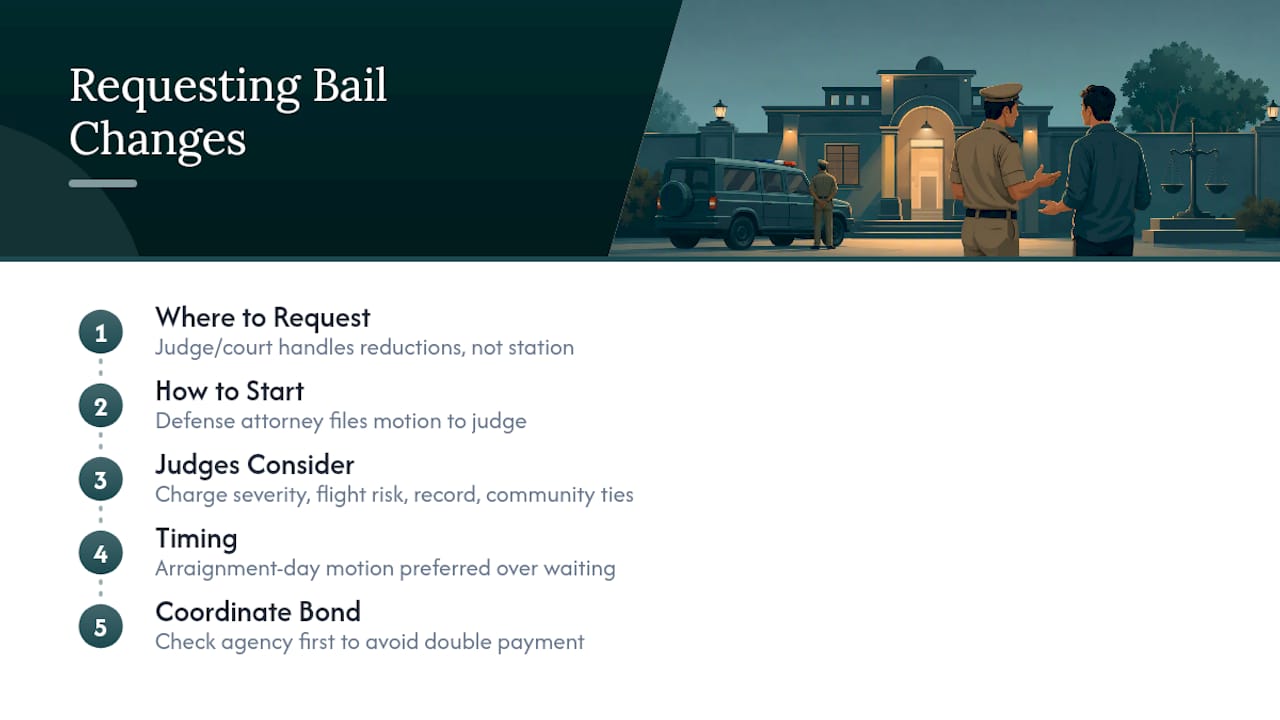
Bail reduction requests almost never happen at the police station itself. Once bail is set, whether by a fixed bail schedule or by a magistrate, the request to lower it or change its conditions generally goes to the court, not the desk sergeant.
The process typically starts with a motion filed by a defense attorney asking a judge to reconsider the amount or the conditions attached to it. Judges look at factors like the severity of the charge, flight risk, prior record, and ties to the community, which is the same reasoning explained on pages covering how judges decide bail amounts. A defendant who can show strong community ties, steady employment, or no criminal history has a real shot at a reduction.
Some jurisdictions allow an informal request at arraignment if bail hasn’t been posted yet, letting the defense argue for a lower figure before the family scrambles to pay the original one. Timing matters here. Filing a motion the same day as arraignment is far more useful than waiting a week while the defendant sits in custody.
If the family has already arranged a bail bond agency, it’s worth checking in with the agency before filing anything. A reduced bail amount changes the size of the premium, and coordinating the timing prevents a family from paying a bond company for the original amount right before a judge lowers it. Communication between the attorney, the agency, and the family avoids that expensive mistake.
What to Do If Bail Is Denied at the Police Station
Denial at the police-station level usually means the officer decided the case doesn’t qualify for release before seeing a judge, not that bail is permanently off the table. Certain charges, particularly violent offenses, repeat offenses, or cases where the person is seen as a flight risk, routinely get held for a judge’s decision instead of an officer’s.
The next stop is arraignment, where a judge reviews the case and sets, denies, or modifies bail. According to Massachusetts guidance on the bail process, someone who can’t post bail set at the station level, or who is denied at that stage, is held until they’re brought before a court, and a judge can revisit the decision entirely at that hearing.
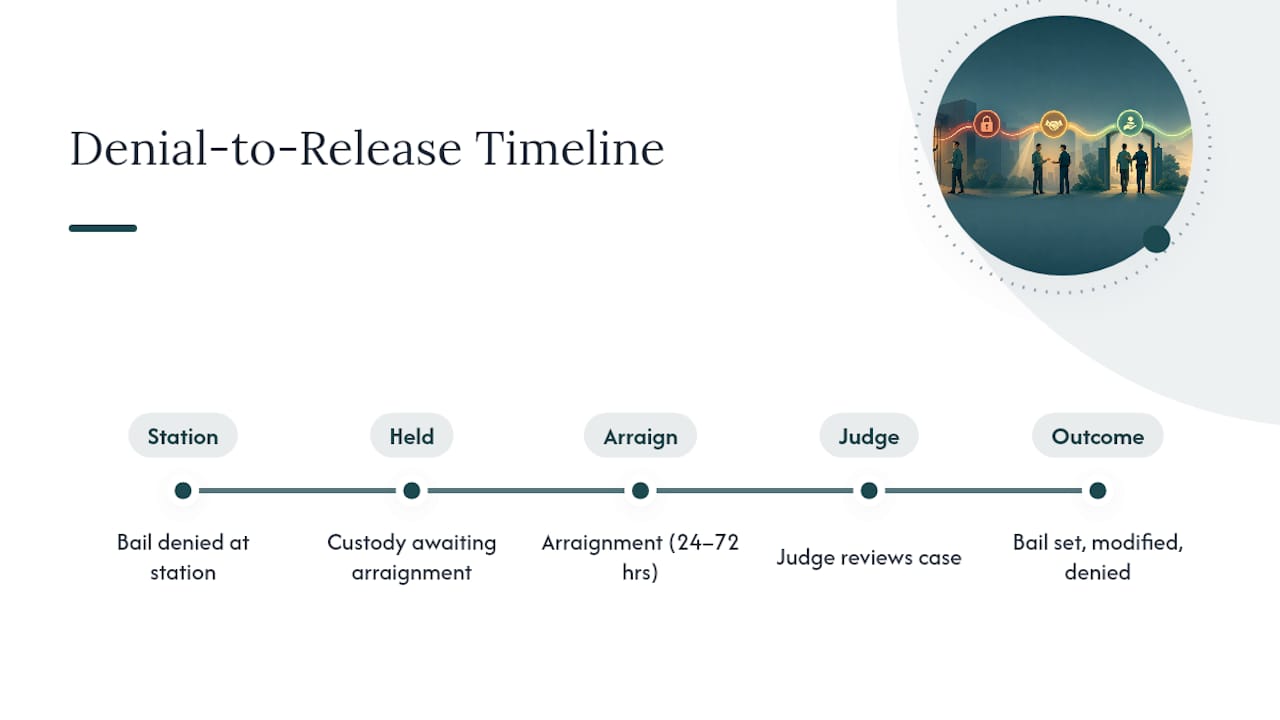
This is the point where an attorney becomes essential rather than optional. A defense lawyer can argue for release conditions instead of straight denial, request an expedited hearing, or present evidence about community ties and job stability that an officer never considered. Families sometimes assume a denial is final and stop pushing, but arraignment is a fresh opportunity, often within 24 to 72 hours of arrest depending on the jurisdiction and whether it falls on a weekend or holiday.
In the meantime, staying in contact with the facility about visitation rules, and keeping a bail bond agency in the loop if one has already been contacted, keeps the family ready to move the moment the judge sets a workable figure.
Contact Information and Availability for Posting Bail
Every facility publishes its own phone number, address, and hours, and none of that information is standardized nationally. The single most useful habit before driving anywhere is calling the specific facility’s booking or bond desk line directly, confirming both the inmate’s location and what payment methods that particular window accepts that day.
Large county jails frequently staff bond desks 24 hours a day, seven days a week, which matters enormously for an arrest that happens on a Friday night. Smaller municipal police stations may only process bail during set shifts, sometimes handing off the responsibility to a county jail after a few hours in temporary holding. Court clerk offices, by contrast, almost always run on standard weekday business hours and close for holidays.
Sheriff’s departments frequently publish warnings on their own sites about which payment channels are legitimate. Dallas County Sheriff’s Office specifically advises against using apps like CashApp or Venmo to pay bail and recommends sticking to the official bond desk or a licensed bonding company. That’s not a minor detail. Scammers have targeted worried families with fake “pay bail online” links, and a legitimate facility will never ask for payment through a peer-to-peer app.
If you can’t reach anyone by phone, most county jail websites list current hours and accepted payment types on an inmate services page, which is worth checking before assuming a desk is closed.
Jake’s Practical Tips and Common Mistakes to Avoid
Three things matter more than anything else here: call the facility first, bring the exact amount in an accepted form, and get written proof of both the payment and the court date before you leave the building. Skip any of those three, and you’re gambling with hours you don’t have.
The mistakes I see repeated most often aren’t complicated. People trust unofficial payment apps because they’re fast, then find out the facility never accepted that method to begin with. People show up without confirming the booking number and lose an hour while staff search for the right file. And people walk out relieved, forgetting to write down the next check-in date, then miss it entirely.
— Jake
If You Need Fast, Professional Help
Thebailnetwork gives Southern California families a faster route than piecing together cash, driving between facilities, and guessing at payment rules on their own. Its bilingual agents work 24/7 and offer flexible payment plans starting as low as 1% with approved credit, which matters when a family doesn’t have the full bail amount sitting in a bank account at 2 a.m.
Before calling, have the inmate’s full name and booking number, your own ID, and a general idea of your preferred payment method ready. That single step lets an agent start working the case immediately instead of spending the first ten minutes gathering basics. Using a licensed agency also sidesteps the scam risk that sheriff’s departments repeatedly warn about with unofficial payment apps. For a full walkthrough of what payment looks like once you’ve connected with an agent, see how bail bond payments work, or start with a call through Thebailnetwork’s main line to get the process moving right now.
This article is general information, not a substitute for advice from a qualified lawyer. Consult a qualified legal professional about your own circumstances before acting on anything here.
Sources
- Gov
- Bail and arraignment — New York State Unified Court System
- How to post bail — NYC Department of Correction
- Police and Criminal Evidence Act 1984 — Section 47 (UK legislation)
FAQ
What Are the Four Types of Bail?
The four main types are own recognizance (a signed promise with no payment), unsecured bond (payable only if the defendant fails to appear), cash or secured bond (full amount paid and held by the court), and surety bond, where a bail bond agency posts the amount for a nonrefundable premium.
How Much Is a $1,000 Bail Bond?
With a surety bond, families typically pay a percentage of the total bail as a nonrefundable premium rather than the full bail amount; Thebailnetwork offers payment plans as low as 1% with approved credit, so check current pricing details for an exact figure.
How Does Bail Work in Massachusetts?
In Massachusetts, bail can be set at the police station level after an arrest, but if it can’t be posted there, the defendant is held until arraignment, where a judge reviews and can adjust the amount.
How Many Days Before Bail Is Granted?
Bail is often set within hours of arrest at the police-station level for eligible offenses, but if denied or unset there, arraignment usually happens within one to three days, where a judge makes the final decision.
What Happens if I Miss a Police Station Check-In?
Missing a scheduled check-in is treated as a violation of bail conditions and can result in re-arrest without a warrant, plus possible bond forfeiture if a bail bond agency was involved.