
Get Someone Out Fast: 24/7 Bilingual Bail Online, Payment Plans, SoCal
Yes, you can arrange bail online right now by hiring a licensed bail bond agent who posts a surety bond on the defendant’s behalf. Have the booking details ready, call or fill out an online intake with a 24/7 bilingual agent, and expect to sign a bond contract with a regulated premium. Payment plans and cosigners are usually available if you can’t cover the full fee upfront.
TL;DR:
- Bail bond premiums in California are typically around 10% of the bail amount and are regulated by the state, making discounts below this rate suspicious.
- The online bail posting process involves quick steps: collecting defendant details, verifying licensing, signing electronic paperwork, and choosing a payment method, often completed within 15 to 30 minutes.
- It takes one to six hours for a defendant’s release after the bond is posted, depending on the jail’s processing speed and staffing levels.
- Only licensed bail agents can legally post bail bonds; verifying the agent’s license number on the state regulator’s site is essential to avoid scams.
- Collateral is usually required for larger bail amounts or when extra security is needed, and signing an indemnity agreement makes the co-signer financially responsible if the defendant fails to appear in court.
Table of Contents
- What Does “Post Bail Online” Actually Mean?
- How Do You Arrange Bail Online Step by Step?
- What Does It Cost to Post Bail Online?
- How Long Does Release Take After the Bond Is Posted?
- What Should You Ask Before You Pay a Bail Agent?
- Who Qualifies for Online Bail Bond Services?
- What Documents Do You Need to Post Bail Online?
- What Are the Risks of Using an Online Bail Service?
- How Do Collateral and Indemnity Agreements Work?
- Why Speed and Verification Both Matter Here
- Ready to Post Bail? Here’s How Thebailnetwork Helps
- Where to Verify Bail Agent Licensing
- Sources
- FAQ
What Does “Post Bail Online” Actually Mean?
When people search for how to post bail online, they’re almost never talking about paying cash directly to a jail’s payment portal. They mean hiring a bail bond company to post a surety bond, a written guarantee backed by an insurance company that the defendant will appear in court. The California Department of Insurance confirms this is exactly how the process works: a licensed bail agent posts the bond to the court, acting as the appointed representative of a surety insurer.
That distinction matters for your wallet. Bail bond premiums aren’t negotiable in the way a mattress price is. They’re filed with the state and regulated.
- A bail bond is a legal contract, not a loan you pay back over time in full.
- Agents must represent a licensed surety company and follow that company’s filed rates.
- The premium you pay is a service fee, and it’s almost always nonrefundable, even if charges are dropped later.
- Licensed agents are required to report their activity and pricing to state regulators.
Knowing this upfront keeps you from being surprised later, and it helps you spot an agent who’s playing by the rules versus one who isn’t.
How Do You Arrange Bail Online Step by Step?
Once you know a bail bond is what you’re actually looking for, the process moves fast if you come prepared. Most agents can start working your case within minutes of your first call or online form submission.
- Collect the defendant’s information first. You’ll need their full legal name, date of birth, the booking number if you have it, and the name of the jail or facility holding them.
- Confirm the agent is licensed in California. A legitimate agent will give you a license number without hesitation and confirm they can file the bond at the correct jail or courthouse.
- Complete the cosigner paperwork. Many agents now handle this electronically, though some counties still require a signed physical signature depending on local procedure.
- Choose how you’ll pay. Card, ACH transfer, and financed payment plans are the common online options; confirm the agent won’t post the bond until funds or authorization clear.
- Ask for an estimated release window. Get a rough timeline and stay reachable, since agents often need quick confirmations from you as the process moves.
Pro Tip: Screenshot or save every text and email confirmation from the agent. If a dispute ever comes up about what was promised or paid, that timestamped record is worth more than a memory of a phone call.
The whole intake conversation, from first contact to signed paperwork, usually takes 15 to 30 minutes when you’ve got the defendant’s details ready in advance.
What Does It Cost to Post Bail Online?
Bail bond premiums in California are commonly set around 10% of the total bail amount, though the exact figure depends on the filed rate each surety company has on record with the state. For example, a bail amount of $20,000 would mean paying a premium significantly less than the full amount in cash.
By the numbers: the California Department of Insurance states that premiums are filed with the state and commonly run about 10% of the bond amount, with additional actual and necessary expenses sometimes added on top.
Here’s what typically shows up on the bill and how you can pay it:
- Credit or debit card payment processed directly by the agent.
- ACH bank transfer for larger amounts.
- Financed payment plans that split the premium into installments, often requiring a cosigner.
- Collateral arrangements for higher bail amounts, covered in more detail below.
That premium is generally nonrefundable once the bond posts, even if the case gets dismissed the next week, according to a legal explainer on California bail. If an agent quotes you a rate far below the standard filed percentage, treat that as a warning sign rather than a deal. Rates are set by the state for a reason, and steep discounts often mean unlicensed or predatory behavior. You can review current posting bail fees to see what a transparent breakdown should look like.
How Long Does Release Take After the Bond Is Posted?
Release timing depends more on the jail than the bail agent. Once an agent posts the bond electronically or in person, the facility still has to process the paperwork, verify the defendant’s identity, and clear them through booking.
- Smaller county facilities can release someone in as little as one to three hours after the bond posts.
- Larger, busier jails, especially on weekends or during shift changes, can take six hours or longer.
- Time of day matters. Overnight bookings often move slower than midday ones simply due to staffing.
A detailed breakdown of release timelines explains why two nearly identical cases can have very different release speeds. Once the bond is accepted, the defendant’s custody status changes from “held pending bail” to “released on bond,” which comes with a legal obligation to appear at every scheduled court date. The cosigner should receive a copy of the bond agreement and a payment receipt. Keep both. You’ll want that paperwork if any question comes up later about what was paid or agreed to.
What Should You Ask Before You Pay a Bail Agent?
A rushed decision is how people end up scammed during one of the worst days of their year. A few direct questions separate a licensed professional from someone who shouldn’t be handling your money.
- What’s your California bail agent license number?
- What is the filed premium rate for this bond amount?
- Can you provide identification and proof you’re bonded with a licensed surety?
- Are you available 24/7, and who do I contact if something changes overnight?
- Will I get a signed receipt and copy of the bond contract once payment clears?
Pro Tip: Search the agent’s license number directly on the state regulator’s site before you pay anything. It takes two minutes and it’s the single best scam check available to you.
Watch for red flags: demands for cash only with no paperwork, vague answers about licensing, promises to “make the charge disappear,” or rates that undercut the standard filed premium by a wide margin. Legitimate agents don’t need to hide their credentials, and they won’t ask you to skip the contract.
Who Qualifies for Online Bail Bond Services?
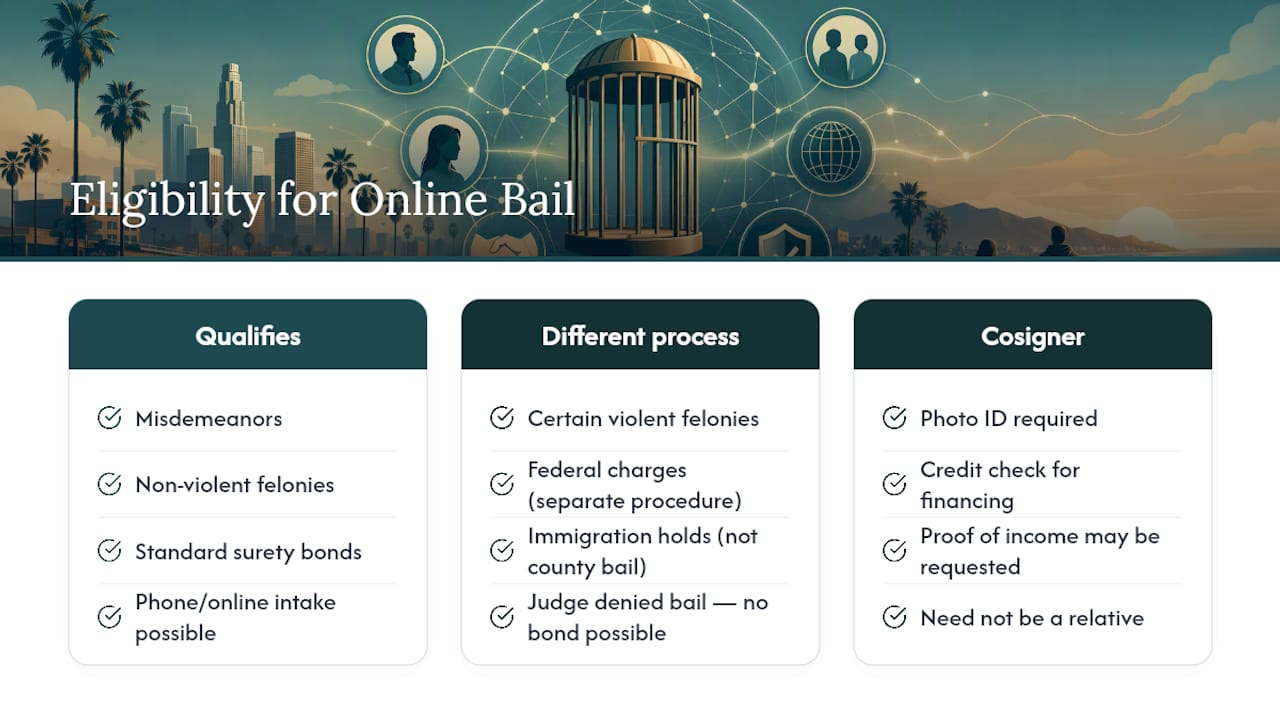
Eligibility depends more on the charge and the court than on you as the cosigner. Most misdemeanor and non-violent felony cases in Southern California counties qualify for standard surety bonds, and agents can typically arrange these fully through phone or online intake without an in-person meeting beforehand.
Cases involving certain violent felonies, federal charges, or immigration holds work differently. Federal bail follows separate procedures entirely, and immigration detention isn’t handled through the same county bail system at all. If a judge has denied bail outright, no bail bond agent, online or otherwise, can override that decision.
Jurisdiction matters too. An agent licensed and bonded to work in Los Angeles County may not automatically have the relationships or authority to post at a facility in a different county, so confirm the agent covers the specific jail where the defendant is held. Southern California’s dense patchwork of county jail systems, from Los Angeles to Orange, Riverside, San Bernardino, and San Diego counties, makes this a real practical consideration rather than a technicality. A cosigner’s own eligibility usually comes down to identification and, for financed plans, a credit check or proof of income. You don’t need to be a relative to cosign, though most agents will ask about your relationship to the defendant as a standard part of the intake.
What Documents Do You Need to Post Bail Online?
Having the right information ready before you call cuts real time off the process. Agents can’t start until they have enough detail to identify exactly who they’re bonding out and where.
For the defendant, you’ll typically need their full legal name, date of birth, the booking or case number if available, and the name and location of the holding facility. If you don’t have the booking number, the defendant’s name and approximate arrest time is usually enough for the agent to locate them.
For the cosigner, expect to provide a valid government-issued ID, a current address, and contact information. Financed payment plans usually require additional proof, such as recent pay stubs or bank statements, since the agent is extending credit against your signature. If collateral is involved, be ready to show ownership documents, such as a vehicle title or property deed.
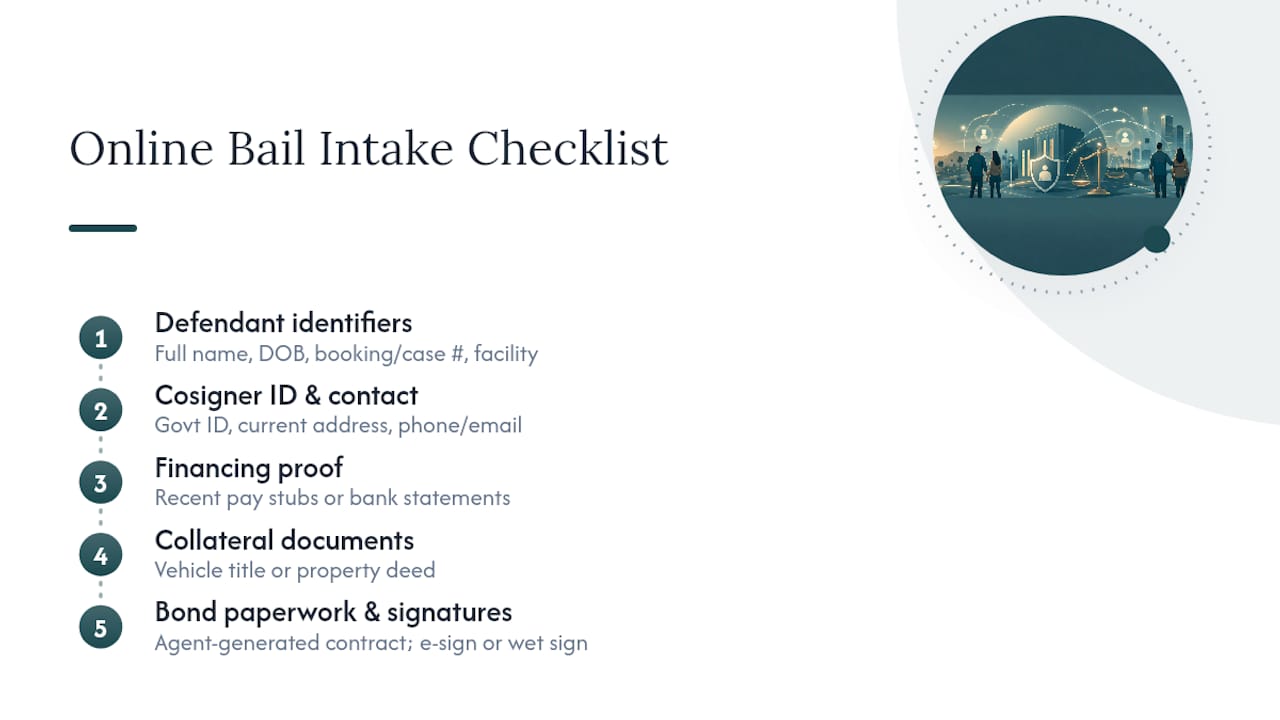
Everything else, the actual bond contract and indemnity agreement, gets generated by the agent once your information is confirmed. Most of this can be signed electronically, though cosigner paperwork occasionally requires a wet signature depending on the county’s specific procedures. A good agent will tell you upfront which parts, if any, need to happen in person.
What Are the Risks of Using an Online Bail Service?
The biggest risk isn’t the online part. It’s signing a bond agreement without understanding what you’re financially responsible for. Once you cosign, you’re legally on the hook if the defendant skips a court date.
If the defendant fails to appear, the court can order the full bail amount forfeited, and the bail company will typically come after the cosigner and any collateral pledged to recover that loss. This isn’t a hidden clause. It’s the entire mechanism that makes bail bonds work, and it’s spelled out in the contract you sign.
A separate risk sits with the agent rather than the defendant. Unlicensed operators sometimes advertise bail services online without holding a valid California license, and paying one can leave you with no bond actually posted, no legal recourse, and a defendant still sitting in custody. This is why verifying a license number before paying anything isn’t optional caution, it’s the single step that protects your money.
There’s also a practical risk in moving too fast without reading the paperwork. Rushing to get a loved one released is understandable, but skimming past the terms of an indemnity agreement because you’re stressed is exactly how people end up blindsided by collateral claims months later.
How Do Collateral and Indemnity Agreements Work?
Every bail bond involves an indemnity agreement, the contract where the cosigner promises to reimburse the bail company for any losses if the defendant fails to appear. This agreement is separate from the premium payment. The premium is the fee for the service; the indemnity agreement is your financial guarantee behind the whole arrangement.
Collateral comes into play for larger bail amounts or when the agent needs extra assurance. Common forms of collateral include real estate equity, vehicle titles, or sometimes jewelry and other valuables. The agent holds a legal claim to that collateral until the case resolves and the bond is exonerated, meaning the court releases the bail company from its obligation.
If the defendant shows up to every court date as required, the collateral gets released back to the cosigner once the case concludes, regardless of the case’s outcome. If the defendant fails to appear, the collateral can be seized to cover the forfeited bond amount. This is why understanding how people typically afford to pay bond matters before you sign anything. Not every case requires collateral. Many standard bonds are approved on signature and credit alone, especially for lower bail amounts with a cosigner who has steady income.
Why Speed and Verification Both Matter Here
Families calling about bail are almost always in crisis mode, and that urgency is exactly what predatory operators count on. The honest tension in this whole process is that you need to move fast and you need to slow down enough to check credentials, and most guides only tell you to do one or the other.
Here’s what gets underestimated: verifying a license takes two minutes, and it’s not in conflict with speed. A legitimate 24/7 bilingual agent expects that question and answers it without friction. If an agent gets defensive or evasive about their license number, that reaction alone tells you more than any online review could.
Some bail networks build their process around that reality, keeping bilingual agents available around the clock and structuring payment plans to help clients manage costs under pressure. Verify the license, ask the direct questions, and move quickly once you’re satisfied. Those two instincts aren’t opposites. They’re both part of doing this right.
— Jake
Ready to Post Bail? Here’s How Thebailnetwork Helps
Some bail services provide families with a direct path to release assistance, including access during late night hours.
Every step from this article, verifying licensing, gathering booking details, choosing a payment method, is built into Thebailnetwork’s online intake process. You can start immediately by calling an agent or completing the online form, and if you’re still working out how to structure payment, the payment options page walks through card, ACH, and financing choices in plain language. Fill out the intake form now or call directly, either way, an agent can begin working the case within minutes.
Where to Verify Bail Agent Licensing
Confirm any agent’s credentials directly rather than taking their word for it.
- The California Department of Insurance’s bail bonds page lists licensing requirements and filed-rate rules for every legal bail agent in the state.
- A plain-language legal explainer on how California bail works covers the practical mechanics behind the contracts you’ll be asked to sign.
This article is general information, not a substitute for advice from a qualified lawyer. Consult a qualified legal professional about your own circumstances before acting on anything here.
Sources
- Bail Bonds | California Department of Insurance
- What Is Bail and How Does It Work in California? - My Rights Law
FAQ
Can You Really Post Bail Online?
Yes, though “online” here means hiring a licensed bail bond agent through phone or web intake, not paying cash bail directly through a jail’s payment system.
How Much Does an Online Bail Bond Cost?
Premiums are commonly around 10% of the total bail amount, based on rates filed with the California Department of Insurance, and this fee is generally nonrefundable.
What Does a Cosigner Need to Provide?
A cosigner typically needs valid government ID, contact information, and sometimes proof of income; cosigner responsibilities include financial liability if the defendant misses court.
How Long Does Release Take After Posting Bail?
Release usually takes one to six hours after the bond is accepted, depending on the facility’s size and how busy booking is at that time.
How Do I Know a Bail Agent Is Licensed?
Ask for their California license number directly and verify it against the state regulator’s records before paying anything; a legitimate agent will never hesitate to provide it.