
$25,000–$100,000: Robbery Bail Costs in California and Los Angeles

Robbery bail in California typically starts between $25,000 and $50,000 for second-degree robbery and $50,000 to $100,000 or higher for first-degree or armed robbery, with Los Angeles County running near the top of that range. These are presumptive starting figures from county bail schedules, not fixed prices. A judge can raise, lower, or deny bail entirely based on the facts of the arrest. Your first moves: confirm the exact amount through the jail or court, then decide whether to post bail immediately or request a bail reduction hearing with an attorney.
TL;DR:
- Bail for second-degree robbery in California generally ranges from $25,000 to $50,000, with Los Angeles County often at the higher end of that spectrum.
- First-degree robbery, especially involving firearms or aggravated circumstances, can have bail set between $75,000 and $100,000 or more, depending on enhancements and county schedules.
- Judges weigh factors like weapon use, injury, prior convictions, and community ties, leading to significant bail variation even for identical charges.
- Posting bail through cash, bonds, or property has differing costs and speeds; bonds typically cost about 10% of the bail amount and can secure faster release.
- A bail review hearing can lead to reductions or alternative conditions, but documentation of employment, residence, and community support strongly influences the outcome.
Table of Contents
- How Much Is Robbery Bail in California and Los Angeles County?
- What Factors Do Judges Weigh When Setting Robbery Bail?
- How Do Felony Bail Schedules and Enhancements Set the Starting Number?
- How Do You Post Bail: Cash, Bond, or Property?
- How Do You Request a Bail Reduction or OR Release?
- What Do Court Practice and Edge Cases Actually Look Like?
- What Legal Rights Apply to Robbery Bail?
- What Happens if You Skip Court After Posting Robbery Bail?
- How Does Robbery Bail Compare to Other Violent Felonies?
- What Families Should Prioritize in the First 48 Hours
- How The Bail Network Gets You Through This Faster
- Sources
- FAQ
How Much Is Robbery Bail in California and Los Angeles County?
The number on the booking sheet comes from a felony bail schedule, a table of presumptive dollar amounts tied to specific Penal Code violations that every California county publishes and updates. Robbery is charged under Penal Code §211, but the bail schedule splits it by degree, and the gap between the two is significant.
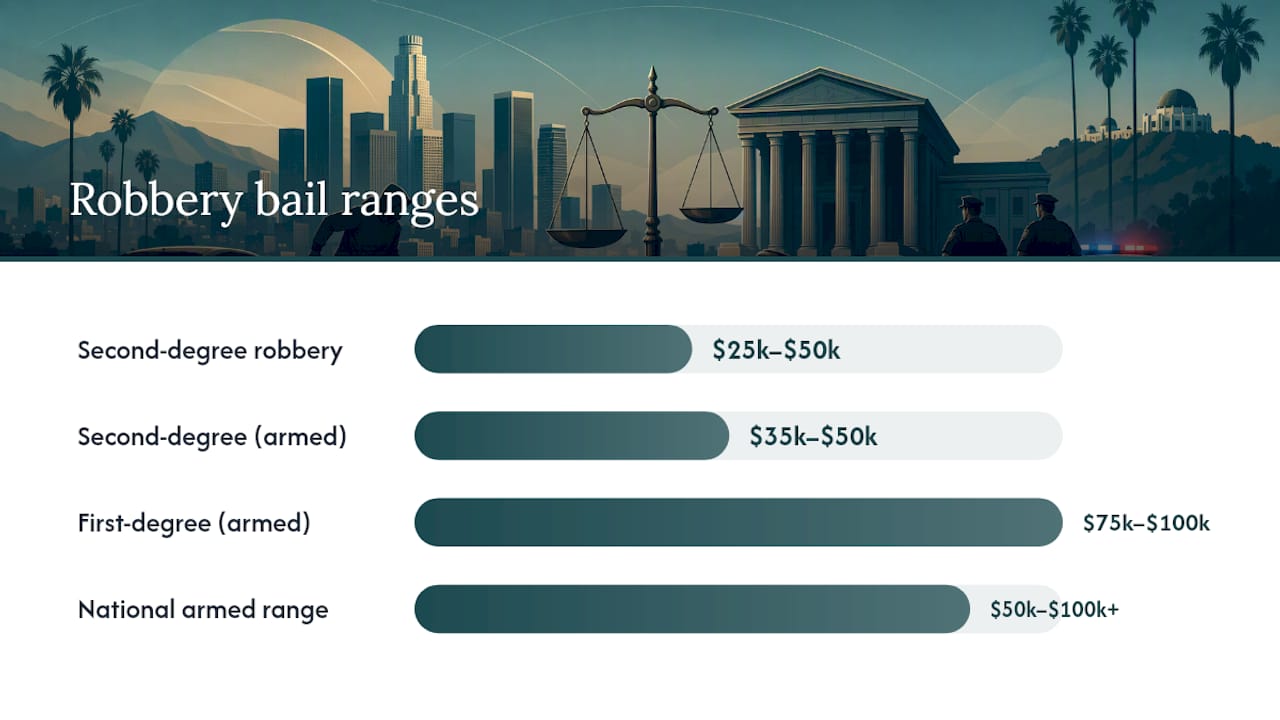
Second-degree robbery, the more common charge covering most strong-arm and unarmed robbery cases, generally starts in the $25,000 to $50,000 range on county schedules. First-degree robbery, which applies to robberies involving a residence, a vehicle other than a taxi, or certain victims like ATM users, tends to start much higher. Some county documents put first-degree armed robbery at $75,000 to $100,000, while second-degree armed cases land closer to $35,000 to $50,000. Legal explainers covering armed robbery bail nationally put the common range at $50,000 to $100,000 or more, which lines up closely with what California counties actually publish.
Los Angeles County follows this same structure. The LA Superior Court felony bail schedule lists presumptive amounts by Penal Code section, and robbery entries sit well above property crimes and most non-violent felonies because robbery is classified as a violent offense with a mandatory strike enhancement in many circumstances. A defendant booked in downtown LA on a second-degree robbery charge with no weapon and no prior record will usually see a bail figure closer to the schedule’s baseline. Someone booked on first-degree armed robbery with a firearm allegation attached will see a number multiples higher.
A quick note on what drives that range:
- Whether the robbery is charged as first-degree (residence, vehicle, certain victims) or second-degree
- Whether a weapon was used or displayed during the offense
- Whether the victim suffered physical injury
- Whether the defendant has prior felony convictions, especially prior strikes
- Which county’s schedule applies, since presumptive figures vary from county to county
Here’s the number that surprises most families: Aggravated robbery cases, such as those involving a firearm, serious injury, or a defendant with a prior strike, often lead to bail in a much higher range. A first-degree armed robbery with a great bodily injury allegation typically carries a substantially increased presumptive bail once enhancements are applied, even before a judge weighs flight risk or community ties.
That’s the range. The actual number for any specific case depends on the county schedule in effect, the exact charges filed, and what the judge does at the first court appearance, which is why calling the jail or the bail agent handling the case matters more than any average you read online.
What Factors Do Judges Weigh When Setting Robbery Bail?
Two people arrested on the same second-degree robbery charge, in the same county, on the same day, can walk out with wildly different bail amounts. The schedule gives judges a starting point, not a final answer, and California courts have real discretion to move off that number in either direction.
Judges generally weigh the offense itself first: how the robbery happened, whether a weapon was involved, and whether anyone was hurt. A robbery involving a knife pressed against a clerk’s neck reads very differently to a judge than one where a defendant grabbed a phone and ran. Both might get charged under the same statute, but the underlying conduct shapes how much risk the court believes it’s managing.
Criminal history carries heavy weight too. A first-time defendant with steady employment gets treated very differently from someone with two prior robbery convictions or an open case in another county. Prior failures to appear in court are a particularly sharp red flag, since bail exists to guarantee the defendant shows up again, and a documented history of skipping court dates tells a judge that a higher amount, or stricter conditions, is the only way to secure that promise.
Flight risk and danger to the community are the two lenses California judges are required to look through, and they don’t always point the same direction. Someone with deep roots in Los Angeles, a job, a lease, and a family nearby is a low flight risk even if the charge is serious. Someone with no fixed address and a history of missing court is a flight risk regardless of how minor the underlying offense looks on paper. In rare cases involving repeat violent offenses or specific statutory triggers, a judge can deny bail outright, though that outcome is uncommon outside the most serious robbery cases with aggravating enhancements.
You can influence this. Judges respond to documentation, not just arguments from counsel.
- Recent pay stubs or a letter from an employer confirming active employment
- A signed lease or mortgage statement showing a fixed address in the county
- Letters from family members confirming ongoing support and supervision
- Proof of enrollment in school, a treatment program, or a job training course
- Documentation of any pending or resolved cases that show a pattern (or the absence of one)
Pro Tip: Bring the paperwork to the first hearing, not the second one. A bail review motion filed with employment and residency documents attached moves faster than one that promises to “follow up” with proof later.
The factors a judge weighs at the initial hearing are largely fixed by California law, but how well a defense attorney presents them on a given day is not, and that’s usually where a five figure swing in bail actually happens.
How Do Felony Bail Schedules and Enhancements Set the Starting Number?
A felony bail schedule is a published table, updated periodically by each county’s superior court, that lists a presumptive bail amount next to nearly every Penal Code section a person can be charged under. Booking officers and judges use it as the default figure the moment someone is arrested, before any judge has reviewed the case in person. Penal Code §1305 and related statutory provisions give courts the authority to rely on these schedules, which is why the number on a booking sheet often appears within hours of an arrest, long before any hearing takes place.
County schedules like the one published for Marin County show exactly how this works in practice. Robbery entries are listed by degree, with first-degree robbery carrying a materially higher presumptive figure than second-degree, and separate line items exist for enhancements that stack on top of the base amount rather than replacing it.
| Charge or enhancement | Typical presumptive addition |
|---|---|
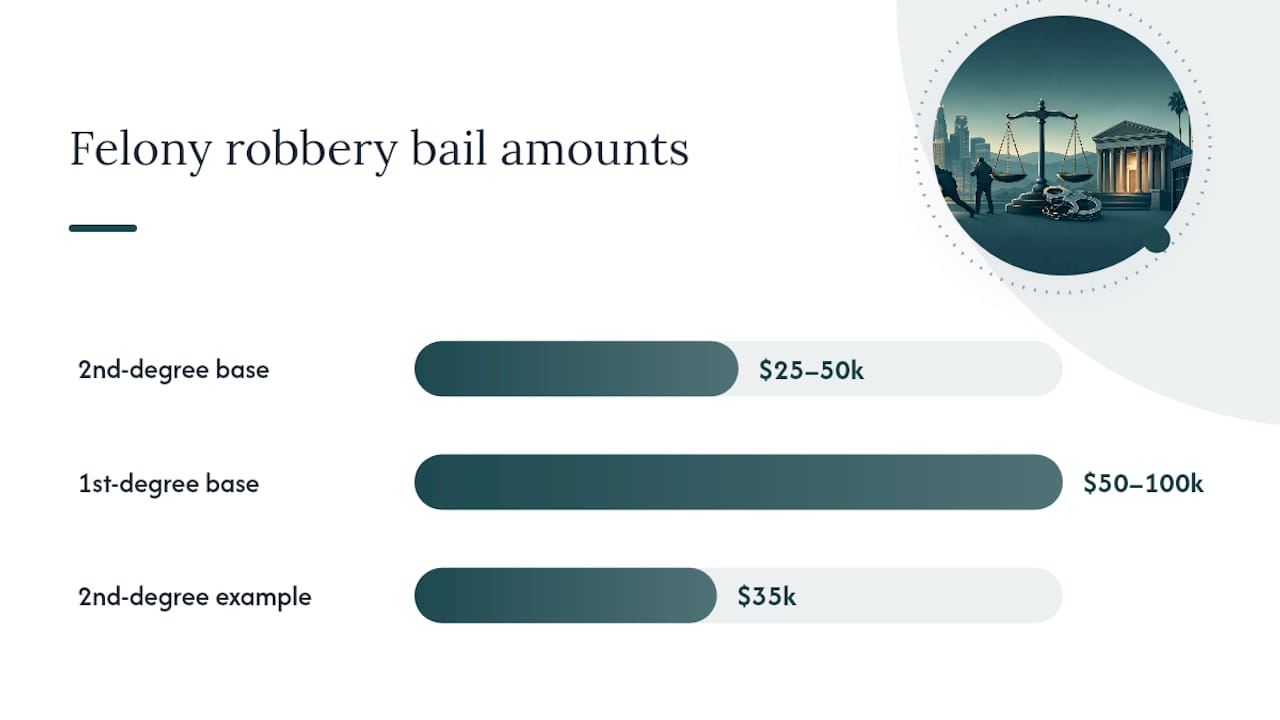
| Second-degree robbery (base) | Schedule base amount, often $25,000 to $50,000 |
| First-degree robbery (base) | Schedule base amount, often $50,000 to $100,000 |
| Firearm use enhancement | Substantial fixed addition per county schedule |
| Great bodily injury enhancement | Substantial fixed addition per county schedule |
| Prior strike enhancement | Can multiply or significantly increase the base figure |
The exact dollar addition for each enhancement varies by county, since every superior court sets its own schedule under the authority granted by state law, but the mechanism is consistent statewide. A base second-degree robbery bail might sit at $35,000. Add a firearm allegation, and the schedule adds a fixed enhancement amount on top of that base. Add a prior strike conviction, and many schedules apply a further increase, sometimes doubling or more than doubling the combined total. This is why two robbery arrests with the same underlying charge code can produce bail figures tens of thousands of dollars apart, purely based on what got checked off on the arrest report.
Law enforcement officers booking a suspect are generally permitted to apply these enhancement additions themselves at intake, before any judge has looked at the file, based on the county’s published bail schedule and the allegations listed on the arrest report. That means the number a family sees on the initial booking screen already reflects any firearm or injury enhancement the arresting officer flagged. It is not yet a judicial determination, and it can still change once a judge reviews the case, but it is not arbitrary either. It is the schedule doing exactly what it was built to do.
How Do You Post Bail: Cash, Bond, or Property?
California gives you three real paths to get someone released, and the cost, speed, and paperwork differ sharply between them.
Cash bail means paying the full presumptive amount directly to the court or jail, in cash or by cashier’s check. If the case resolves and the defendant meets every court date, the court returns the money at the end, minus a small administrative fee. The catch is obvious: a $50,000 robbery bail means finding $50,000 in liquid funds, which most families simply don’t have sitting in a checking account.
Surety bonds, commonly called bail bonds, work differently. A licensed bail agent posts the full amount with the court on the defendant’s behalf, and the family pays the agent a fee instead of the full bail. California practice generally runs that fee around 10% of the total bail, so a $50,000 bond typically costs about $5,000 out of pocket. Unlike cash bail, this fee is nonrefundable. It’s the cost of the agent taking on the financial risk of the full bond amount.
Property bonds let a defendant’s family pledge real estate, usually with equity well above the bail amount, as collateral instead of cash. Courts require a title search and appraisal before approving this option, which can take days the family often doesn’t have. It’s rarely the fastest route, but it matters when cash isn’t available and a bondsman isn’t an option for some reason.
Here’s a straightforward sequence for the first hours after an arrest:
- Use the county sheriff’s inmate locator to confirm booking, charges, and the exact bail amount.
- Call the jail’s booking desk to confirm which payment methods that specific facility accepts.
- Gather government-issued ID for whoever will be signing paperwork, plus proof of address.
- Decide between cash, a surety bond, or property, based on how much liquid cash the family has available.
- If going the bond route, contact a licensed bail agent to start paperwork immediately, since agents can often begin the release process within the hour.
Pro Tip: *Ask about payment plans before assuming a bond is out of reach.
How Do You Request a Bail Reduction or OR Release?
A bail reduction or request for release on your own recognizance (OR release) takes place through a bail review hearing, often soon after arrest, with exact timing guided by local court rules and calendar conditions.
Judges at these hearings look for the same things they weighed at the initial bail decision, just with more detail and documentation than a booking officer had available. Evidence that tends to move a judge includes proof of stable, verifiable employment, a documented residence with a lease or utility bill in the defendant’s name, and a workable supervision plan, meaning a family member or third party willing to confirm they can monitor compliance with court conditions.
Rather than simply lowering the dollar figure, judges frequently attach alternative conditions instead of or alongside a reduced bail amount:
- Electronic monitoring, requiring an ankle device that tracks location
- A curfew restricting the defendant to a residence during set hours
- Travel restrictions limiting movement outside the county or state
- Regular check-ins with a pretrial services officer
- No-contact orders protecting the alleged victim or witnesses
These conditions let a judge address flight risk and public safety without keeping bail at a level the family can’t realistically afford. A judge’s decision at a bail reduction hearing still comes down to the same core questions from the original bail schedule, but a skilled attorney presenting the right documentation at the right moment can meaningfully change the outcome, sometimes by tens of thousands of dollars.
What Do Court Practice and Edge Cases Actually Look Like?
Robbery bail rarely plays out as cleanly as a schedule number and a hearing date. Court practice around California adds layers that catch a lot of families off guard.
Booking officers can apply enhancement additions to presumptive bail before any judge ever sees the file, based on allegations listed on the arrest report. That’s standard procedure under most county schedules, not an error or overreach, but it means the number a family sees in the first hour can already include additions for a firearm allegation or an injury claim that hasn’t been formally charged yet.
Some counties, including practice notes from courts like San Luis Obispo, describe growing judicial scrutiny of “no bail” holds, meaning courts are increasingly expected to justify a bail denial rather than default to it, especially when counsel challenges the decision directly. That’s a meaningful shift for families dealing with the rare robbery case where bail was denied outright.
One edge case worth flagging specifically: booking on multiple incidents can produce separate presumptive bails for each incident, unless every charge stems from a single continuous event. A defendant arrested for two unrelated robbery incidents weeks apart, even if consolidated into one case later, may initially face two separate bail figures added together rather than one combined number. Families sometimes assume the booking sheet reflects one total when it actually reflects a stack of individual amounts.
The purpose behind all of this isn’t punishment. Bail exists to secure appearance and protect public safety, which is why judges look past the charge itself to community ties and prior conduct. That’s also why two people facing identical robbery charges can walk out with very different numbers attached to their release.
Robbery’s classification as a violent felony in California means judges start from a higher baseline than they would for most property crimes, and experienced counsel presenting the right facts at the right hearing can sometimes shift that starting point meaningfully.
What Legal Rights Apply to Robbery Bail?
Every defendant arrested for robbery in California has a right to a prompt bail determination, generally within 48 hours of arrest, excluding weekends and court holidays. That timeline is not optional, and unreasonable delay in setting or reviewing bail is itself grounds for a motion before the court.
Defendants also have the right to be represented by counsel at any bail hearing, including the initial appearance where bail first gets addressed by a judge. If a defendant can’t afford an attorney, the court appoints a public defender, and that attorney can request a bail reduction hearing at any point in the case, not just at arraignment.
Excessive bail is constitutionally prohibited under both the California Constitution and the Eighth Amendment, which means bail set purely to keep someone in custody, rather than to secure appearance and manage risk, can be challenged. That’s a narrow legal argument, and courts don’t grant it often for robbery given its classification as a violent felony, but it exists as a real avenue when the amount set clearly exceeds what the facts justify.
Defendants also retain the right to request a bail reduction hearing more than once if circumstances change. New evidence of community ties, a resolved warrant in another jurisdiction, or a change in employment status can all support a second motion even after an earlier request was denied.
What Happens if You Skip Court After Posting Robbery Bail?
Missing a court date after posting bail triggers consequences that hit fast and hard, regardless of whether the bail was cash, a surety bond, or property.
The court issues a bench warrant for arrest almost immediately once a defendant fails to appear. That warrant is active statewide, meaning any traffic stop or police contact anywhere in California can result in immediate re-arrest, often with no new bail set at all pending a hearing on the failure to appear itself.
If the release was secured through a surety bond, the bail agent who posted it becomes financially responsible for the full amount unless the defendant is located and returned to custody within a set forfeiture window, typically 180 days under California law. Agents actively pursue defendants who miss court for exactly this reason, and families who cosigned the bond agreement can be held liable for the forfeited amount if the agent can’t recover it.
Cash bail posted directly with the court gets forfeited outright on a failure to appear, meaning the family loses the entire amount, not just a fee. Property pledged as collateral faces the same risk, potentially resulting in a lien against the property or forced sale to satisfy the forfeited bail.
Beyond the financial hit, a failure to appear typically adds a separate criminal charge on top of the original robbery case, and judges treat it as a serious credibility problem at every future hearing, including any bail reduction request tied to the underlying charge.
How Does Robbery Bail Compare to Other Violent Felonies?
Robbery sits in an unusual spot on California’s bail schedules: more serious than most property crimes, but generally set lower than the most severe violent felonies unless enhancements push it higher.
Assault with a deadly weapon and robbery often land in similar presumptive ranges when no firearm or serious injury is involved, since both are charged as violent felonies with comparable base schedule figures. Where robbery starts pulling ahead is when a firearm enhancement or great bodily injury allegation attaches, since robbery’s enhancement structure stacks in largely the same way assault enhancements do.
Kidnapping and carjacking, both frequently charged alongside robbery when a vehicle or forced movement is involved, tend to carry presumptive bail at or above first-degree armed robbery figures, reflecting the added element of restraint or vehicle theft layered onto the underlying taking.
The clearest gap shows up against homicide-adjacent charges. Attempted murder and voluntary manslaughter routinely carry presumptive bail well into the high six figures or seven figures, sometimes with no bail offered at all depending on the facts, dwarfing even aggravated armed robbery figures. Robbery, even at its highest enhanced level, rarely reaches that tier unless a death resulted during the commission of the offense, which reclassifies the case entirely under different statutes.
What Families Should Prioritize in the First 48 Hours
The first two days after an arrest set the tone for everything that follows, and most families waste hours on the wrong priorities.
Start with the inmate locator system for the county where the arrest happened. Confirm the exact booking charge, not just “robbery,” since first-degree versus second-degree changes the bail figure dramatically, and confirm which courthouse will handle the case.
Once you have the number, decide fast between cash, property, or a bail bond, based on what you can actually access within hours rather than days. If a bond makes more sense, contacting a licensed bail agent early means paperwork can move while you’re still gathering documents. Loop in an attorney as soon as possible, even before the first hearing, since counsel can flag reduction options a family might not know exist.
While that’s happening, start pulling together proof of community ties: pay stubs, a lease, letters from employers or family. These documents matter far more at a bail review hearing than anything said in the moment, and having them ready before the hearing is scheduled, rather than scrambling the morning of, changes outcomes.
How The Bail Network Gets You Through This Faster
Once you know the bail figure, the next call matters more than any research you do online.

Calling in doesn’t require a stack of paperwork upfront. Agents walk you through what’s needed, typically ID and basic defendant information, and most bonds move fast enough that families see their loved one released within hours of approval. If you’re still locating where someone is being held, Thebailnetwork’s inmate locator support handles that step directly instead of leaving you on hold with a jail switchboard. For the payment side specifically, the payment options for a bail bond breaks down exactly how the 1% plans work and what approved credit means in practice. If a robbery bail figure just landed on you and you need to move now, start with Thebailnetwork and get a licensed agent on the phone tonight.
This article is general information, not a substitute for advice from a qualified lawyer. Consult a qualified legal professional about your own circumstances before acting on anything here.
Sources
- FELONY BAIL SCHEDULE JANUARY 2023 (Marin County consolidated PDF)
- California Penal Code §1305
- LA Court felony bail schedule (PDF)
- How Much Is Bail for Armed Robbery? Ranges & Factors - LegalClarity
FAQ
Is $10,000 a lot for bail?
For most misdemeanors, yes, $10,000 sits well above typical schedule amounts. For robbery, it’s actually low. Second-degree robbery in California generally starts higher, often around $25,000 to $50,000, and armed or first-degree robbery routinely starts significantly higher.
How much money is considered a robbery?
Robbery is defined by the act, taking property from a person through force or fear, not by a dollar threshold. Unlike theft charges, which split into petty and grand theft based on value, robbery applies regardless of how much was taken.
How long do you stay in jail for robbery?
If bail isn’t posted, a defendant typically stays in custody until arraignment, generally within 48 hours of arrest, and then remains held until bail is posted, reduced, or the case resolves. There’s no fixed jail duration tied to the charge itself before conviction; it depends entirely on whether release happens through bail or OR.
What is 10% of a $20,000 bond?
Many agents, including Thebailnetwork, structure that fee into payment plans rather than requiring the full amount upfront.