
Clear a Warrant Recall on Bail in 2–6 Hours With a Prearranged Bond
The fastest safe way to handle a warrant recall on bail is to ask the issuing court to recall it, either by filing a motion to recall or through a coordinated voluntary surrender with a prearranged bond. Start by calling the court clerk to confirm the case number and warrant status. If you need speed, loop in a criminal defense attorney or a licensed bail agent immediately. Nothing is actually resolved until a judge signs a written recall or quash order that updates law enforcement databases.
TL;DR:
- Recalls are typically achieved through filing a motion or coordinating a voluntary surrender with posted bond, but the warrant isn’t fully cleared until a judge signs a recall order.
- A warrant recall removes the enforcement flags, but the underlying charge, court date, and bail obligations still remain and must be addressed.
- Proper documentation, such as proof of missed court reasons and stability, improves the chances of a successful recall request, especially if supported by a concise, organized declaration.
- If the court denies the recall, surrendering voluntarily with bond arranged in advance can minimize custody time and prevent additional bail forfeiture risks.
- The average time for misdemeanor warrant resolution is 2 to 6 hours with proper coordination, while felony warrants often involve multi-day waits before the first court appearance.
Table of Contents
- What Does a Warrant Recall Actually Do?
- How Do You Get a Warrant Recalled Step by Step?
- What Documents Help Your Case for Recall?
- What If the Court Denies the Recall Request?
- How Long Will You Actually Be in Custody?
- When Should You Hire an Attorney for a Warrant Recall?
- Does a Recall Affect Your Future Court Dates?
- Can a Warrant Recall Affect Immigration Status?
- Do Warrant Recall Procedures Differ by State?
- Insider Perspective on Getting a Warrant Actually Cleared
- Coordinating a Walk-Through Surrender With Bond Ready
- Sources
- FAQ
What Does a Warrant Recall Actually Do?
A motion to recall (sometimes called a motion to quash, depending on the jurisdiction) is a formal request asking the court that issued the warrant to withdraw it. Filing one is the standard first move, and a properly arranged walk-through booking can often resolve in 2 to 6 hours, with same-day release common for misdemeanor matters.
Recalling a warrant is not the same as dismissing your case. The recall just removes the enforcement flag, meaning police can no longer arrest you on sight for that warrant. Your underlying charge, court date, or bail obligation still exists and still has to be dealt with. A “quash” sometimes carries a slightly different legal meaning: it can imply the warrant had a defect (bad service, wrong information) rather than simply being lifted as a matter of discretion. Courts use the terms loosely, so ask your clerk which framework your jurisdiction applies.
How Do You Get a Warrant Recalled Step by Step?
Clearing a warrant recall on bail follows a fairly predictable sequence, whether you handle it yourself or through counsel.
- Verify the warrant. Call the clerk’s office for the exact court branch, case number, and docket status. Ask specifically whether the warrant shows in the Warrant Section or state database, not just the local court file.
- Pick your route. Options include filing a motion to recall directly with the court, having an attorney appear on your behalf without you present, arranging a voluntary surrender (walk-through) with bond ready to post, or, for minor traffic or fine-only matters, an administrative payment or online motion if your local court allows it.
- Prearrange the walk-through. If surrender is the plan, contact the prosecutor or court coordinator ahead of time, line up your surety, and schedule the surrender for a time when booking and release processing are actually open, usually a weekday morning. Walking in at 6 p.m. on a Friday can turn a quick process into a weekend stay.
- Coordinate the bond. Have your bail agent or attorney confirm the bond amount and paperwork before you show up, not after.
- Confirm the outcome. The warrant is not cleared until the judge signs a written recall order and it hits the docket. Ask your attorney or the clerk to also confirm the update reached the Warrant Section or NCIC.
Pro Tip: Ask your attorney to submit a proposed order along with the motion. Judges sign faster when the exact language they need is already drafted, and clerks use that same language to update the warrant database.
What Documents Help Your Case for Recall?
Judges deciding a warrant recall on bail want to see two things: a credible reason you missed court, and proof you are not a flight risk. A sworn declaration explaining the missed appearance, backed by supporting records, does most of the persuading.
- A sworn declaration with attached evidence: medical records, hospital discharge papers, deployment orders, or returned mail showing a notice problem.
- Proof of stability: recent pay stubs, a signed lease, school enrollment, or documentation of compliance with probation or other court orders.
- Bond readiness: proof of surety, draft bond paperwork, or a payment plan offer already lined up.
- Clean formatting: a short, factual declaration, exhibits labeled and tabbed, and a proposed order attached for the judge’s signature.
Pro Tip: Keep the declaration under two pages. Judges skim these on a crowded warrant calendar, and a tight, well-organized packet reads as more credible than a long one.
What If the Court Denies the Recall Request?
If a motion to recall gets denied or isn’t available in your court, voluntary surrender is usually the safer fallback rather than waiting to be picked up in the field.
- A walk-through surrender, where you arrive at the jail on a scheduled date with bond arranged in advance, generally cuts custody time compared to a surprise arrest.
- Bail can be reset at a higher amount after a missed appearance, and any previous bond may be at risk of forfeiture.
- A licensed bail agent can coordinate the bond amount, payment plan, and exact timing so you’re not sitting in a cell longer than necessary.
- Surrendering without an attorney is riskier when the underlying warrant stems from a missed court date, since prosecutors sometimes add a separate failure-to-appear or bail-jumping charge without someone negotiating on your behalf.
How Long Will You Actually Be in Custody?
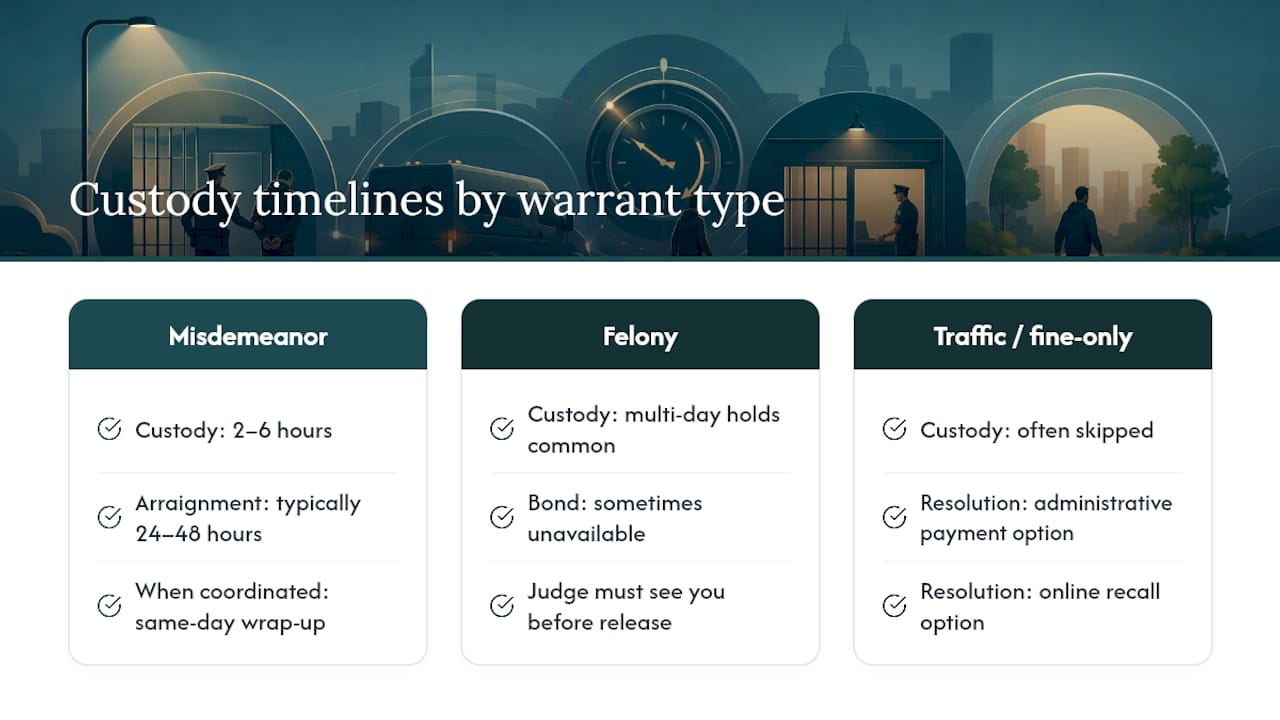
Timelines vary sharply by charge level. Misdemeanor walk-throughs, when properly coordinated, often wrap up the same day or within 2 to 6 hours, with arraignment typically scheduled 24 to 48 hours out. Felony warrant arrests are a different story: multi-day holds before a first appearance are common, and some felony warrants carry no bond option at all, meaning a judge has to see you before release is even possible. For minor traffic or fine-only warrants, some courts offer administrative payment or online recall options that skip custody entirely. Always ask the clerk which category your warrant falls into before assuming the worst.
When Should You Hire an Attorney for a Warrant Recall?
Judges tend to grant recall requests faster and without requiring custody when a licensed attorney files the motion rather than the defendant appearing alone. Many courts also allow attorney-only appearances for misdemeanor recalls, meaning you may never have to set foot in the courthouse.
Counsel typically handles confirming the warrant status with the clerk, drafting the sworn declaration, coordinating surrender logistics with the court and prosecutor, and negotiating to head off a separate bail-jumping charge. That negotiation piece matters: prearranging surrender through counsel can sometimes avoid a parallel prosecution entirely. Costs range widely depending on jurisdiction and case complexity, and if you already have a public defender from the underlying case, ask whether they can be reappointed for the recall motion at no added cost rather than hiring new counsel.
Does a Recall Affect Your Future Court Dates?
Clearing a warrant recall on bail resets the clock, it does not erase it. Once the warrant is lifted, your original case obligations snap back into place: the missed hearing gets rescheduled, and you’re expected to show up this time.
Judges factor in your criminal history, the severity of the charge, and how promptly you sought the recall when deciding conditions going forward. A first-time missed date with a solid medical excuse and a fast recall request looks very different to a judge than a pattern of no-shows. Expect stricter conditions after a recall: some courts add check-in requirements, electronic monitoring, or require a cosigner on a new bond. Others may increase the bail amount to account for the perceived flight risk, even if you show up voluntarily.
Missing the newly scheduled date after a recall is far worse than the original miss. Courts view a second failure to appear as evidence the first excuse either wasn’t valid or wasn’t heeded, and judges have far less patience for a repeat. If your case involves probation, expect the recall to trigger a separate compliance review, since a bench warrant is often itself a probation violation independent of the underlying charge. Get every new date, condition, and deadline in writing from your attorney or the clerk, and calendar it immediately. The recall solved the enforcement problem. It did not solve the case.
Can a Warrant Recall Affect Immigration Status?
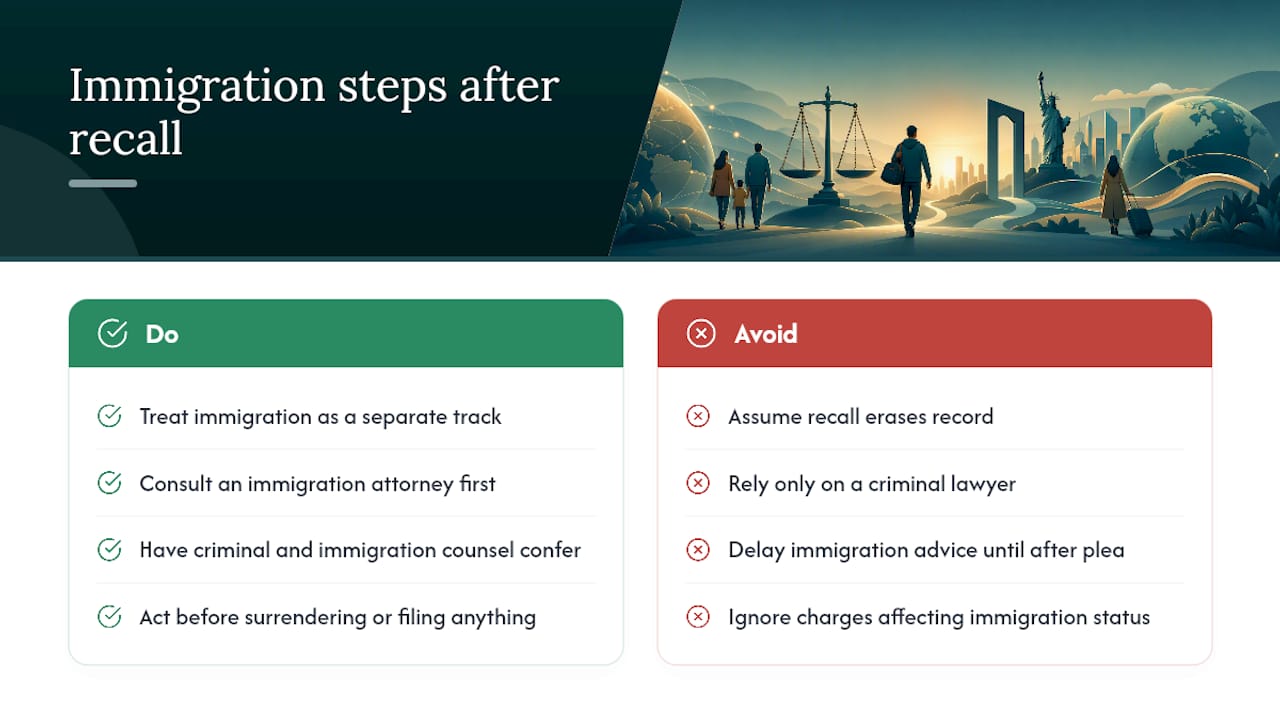
For non-citizens, a warrant recall on bail carries stakes beyond the criminal case. Immigration authorities can access criminal history and warrant records, and an arrest, even one that ends in same-day release after a recall, can still surface during a visa renewal, green card application, or naturalization interview.
The recall itself is a good outcome. It means you were not taken into custody or held for an extended period, which reduces the chance of an immigration hold being placed during a jail stay. But the underlying arrest and case record typically remain part of your history regardless of how quickly the warrant was lifted. Certain charges, particularly anything involving moral turpitude, drugs, or domestic violence, can trigger immigration consequences independent of whether you ever spent a night in custody.
If you are not a citizen and are dealing with an active warrant, treat the immigration question as its own track. A criminal defense attorney can advise on the recall process, but immigration consequences usually require a separate consultation with an immigration attorney, ideally before you take any action on the warrant. Timing matters here more than in most other contexts: some plea arrangements that look favorable on the criminal side carry immigration consequences that a criminal-only lawyer might not flag. If your case touches both systems, get both attorneys talking to each other before you surrender or file anything.
Do Warrant Recall Procedures Differ by State?
Yes, and the differences are not cosmetic. Some states use “recall,” others use “quash,” and a few use both terms for slightly different procedures within the same court system. What counts as a valid excuse for a missed appearance, what documentation a judge expects, and whether attorney-only appearances are permitted all vary by county, sometimes even by individual judge within the same courthouse.
A few practical differences worth checking locally:
Some jurisdictions run a dedicated warrant calendar or warrant recall calendar, a specific court session set aside for these motions, which can move faster than filing into the general criminal docket. Others require you to wait for your case’s regular calendar slot, which can add weeks.
Bond rules also shift. In some states, a recalled warrant automatically requires a new bail hearing with a fresh amount set. In others, the original bail rules apply until the underlying case is resolved. Whether a bail agent can post bond before or only after the recall order is entered depends on local court practice, so this is worth confirming directly with your bail agent rather than assuming.
Given how much this varies, the issuing court clerk is the only reliable source for your specific jurisdiction’s rules. National guides, including this one, can tell you what to expect in general terms, but the clerk’s office and your attorney are the ones who know what your specific courthouse actually requires.
Insider Perspective on Getting a Warrant Actually Cleared
The step people skip is confirmation. Put every document in one packet, verify the docket entry the moment the hearing ends, and notify the Warrant Section directly. Schedule surrender during business hours and have your surety on standby so booking and release happen the same visit. Nothing is settled until the clerk enters the order and NCIC reflects it.
— Jake
Coordinating a Walk-Through Surrender With Bond Ready
A licensed bail agent’s real value in a warrant recall situation is timing. Rather than surrendering and hoping bond gets sorted out afterward, a bail agent can have your bond prearranged before you ever walk through the jail doors, which is often the difference between a same-day release and an unplanned overnight stay.
Thebailnetwork works with 24/7 bilingual agents across Southern California who coordinate exactly this kind of logistics: confirming the warrant status, prearranging the bond amount, and timing the surrender for a window when booking and release are actually moving. If the cost of posting bail is the sticking point, flexible options like 1% bail bonds with approved credit or a 2% bail bond with approved credit can make posting feasible without draining savings or waiting on a slower payment plan. Whether you’re planning a voluntary surrender or bail was just reset after a recall hearing, contact Thebailnetwork to line up a bond before you or your family member walks in.
Sources
Confirm your specific court’s rules on motions to quash and walk-through surrender directly with the issuing court clerk before acting on general guidance.
This article is general information, not a substitute for advice from a qualified lawyer. Consult a qualified legal professional about your own circumstances before acting on anything here.
- How to Quash a Warrant | Nolo
- Clear a bench warrant without going to jail | TheCompleteLawyer
- Warrant recall & process crimes (Texas) | L&L Law Group
- How an attorney recalls an arrest warrant | Kenney Legal Defense
FAQ
What Is a Warrant Recall on Bail?
A warrant recall on bail is a court order that withdraws an active arrest warrant, usually after a motion is filed or a voluntary surrender is coordinated. It removes the enforcement flag but does not resolve the underlying case or bail obligation.
How Long Does It Take to Recall a Warrant?
A well-coordinated walk-through booking often resolves in 2 to 6 hours, with same-day release common for misdemeanors. Felony warrants frequently involve multi-day holds before a first court appearance.
Can My Attorney Recall a Warrant Without Me Appearing?
In many jurisdictions, yes. Courts often accept attorney-only appearances for misdemeanor warrant recalls, meaning your lawyer can file and argue the motion without you present.
What Happens to My Bail After a Recall?
Bail is not automatically forgiven. It can be reset at a new amount, and any prior bond risks forfeiture if it wasn’t properly addressed before the recall.
How Much Does Posting Bail Cost After a Recall?
Costs depend on your bond amount and jurisdiction, but Thebailnetwork’s standard bail premium is 10%, with reduced payment options like 1% or 2% plans available for those who qualify with approved credit. Contact an agent directly for a specific quote on your case.